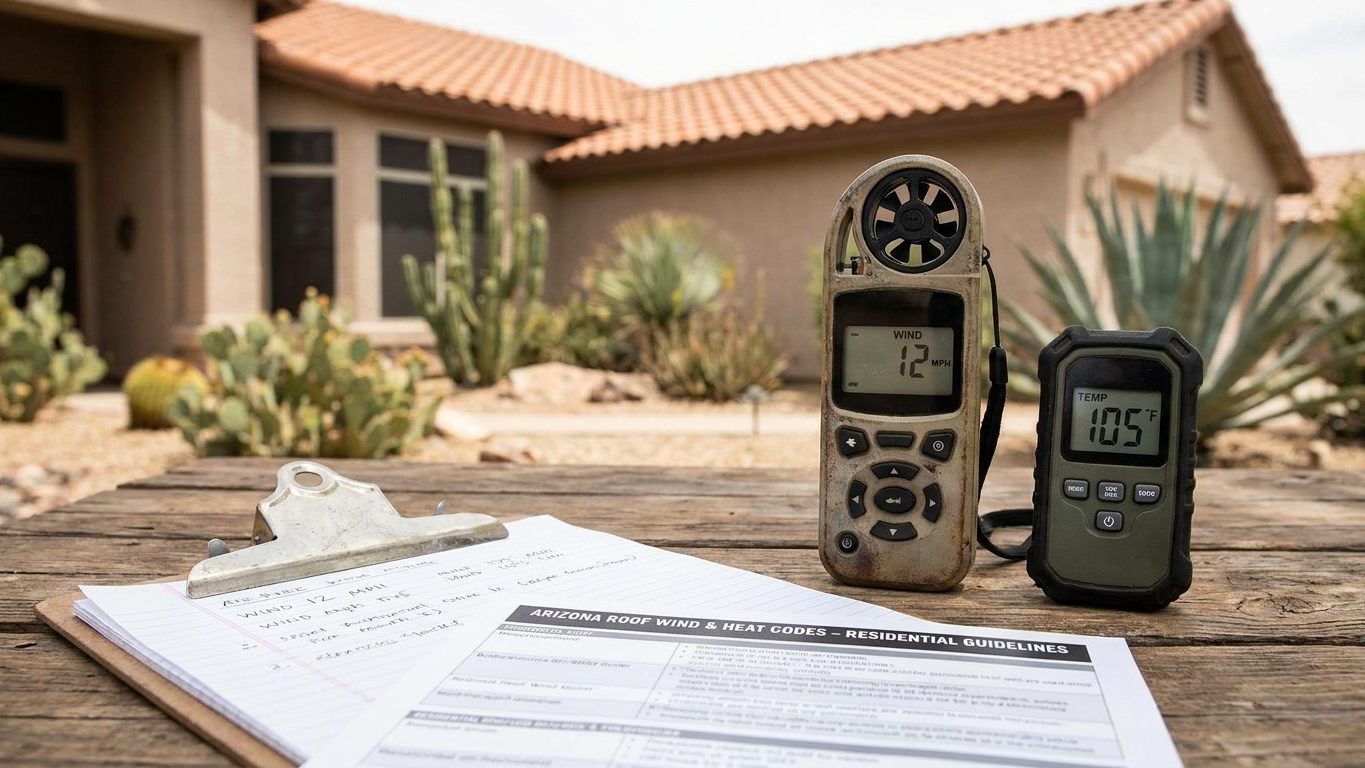

A 126 mph three-second gust, measured at 33 feet in open country, is the wind load Florida’s building code assumes when it sets nailing patterns, sheathing fasteners and the straps that tie a roof down to its walls. That figure comes from the Jacksonville area, the state’s most-cited reference point, and it is not the same thing as a hurricane’s forecast wind speed. The one thing to do with it: pull your county’s adopted wind speed and exposure category before you assume this number applies to your own roof, because the coast and other cities run higher.
What wind speed must a roof withstand in Florida?

At Jacksonville, the reference city the wind maps use for northeast Florida, the basic design wind speed is 126 mph under ASCE 7-16, the edition of the wind-load standard that IRC/IBC 2021 makes applicable in most states. That number is a 3-second gust measured at 33 feet in open, flat terrain, what the standard calls Exposure C, for a Risk Category II building, meaning an ordinary single-family house. It is not a sustained wind speed, and it is not the same figure a hurricane forecast reports as the storm’s top wind. A truss engineer and a code plan reviewer both work from the gust figure, not from the forecast one.
ASCE 7-22, the newer edition of the same standard, maps the same point at 125 mph. That is not a sign the wind risk has eased. It reflects a remapping of the same hazard, and the edition your permit uses is the one your local building department has adopted, so the 7-16 figure is still the one that governs most current construction.
What the figure actually sets
This single number drives a long list of decisions on an ordinary asphalt-shingle roof:
- The wind rating a shingle must carry to be approved for the job
- The nailing pattern, meaning how many nails per shingle and where they land
- How the sheathing panels are fastened to the rafters or trusses
- The straps, clips and connectors that tie the roof structure down to the wall framing
Uplift does not load a roof evenly. It concentrates at the edges, the rakes and the ridge, which is why those areas carry tighter fastener spacing than the field of the roof. A roof that fails in a wind event almost always starts losing shingles or decking at a corner or an edge first, then the failure spreads inward as the wind gets under whatever lifted.
None of this tells you what your own roof is rated for. Wind exposure, the size of the house, and roof shape all change the actual design pressures a specific structure must resist, and those calculations belong to your county building department or a licensed engineer, not to a state-level figure. What you can take from the Jacksonville number is the order of magnitude: this is a wind-engineered structure, not a snow-engineered one, and the coast can run higher still than the reference point used here.
Does Florida require impact-rated roofing or shutters?
At the Jacksonville reference point, the basic wind speed of 126 mph falls just below the wind-borne debris threshold that would apply the requirement region-wide. But move to the beachfront, within about a mile of the coast, and the requirement applies regardless: openings need impact-rated glazing or approved shutters. That line is written into the wind maps themselves, and it means two houses a few miles apart can face different rules purely because of proximity to the water.
Why the requirement targets openings, not just the roof
The mechanism is worth understanding because it explains why a roofing project and a window project are really one problem. If a window, door or skylight breaks in high wind, the wind that gets inside the house pressurizes the interior. That internal pressure pushes outward on the roof from underneath, adding to the uplift already acting on the outside. A roof built to withstand 126 mph of external uplift was never designed to also resist a pressurized attic, so a single broken opening can take the roof with it. That is why the code treats impact-rated glazing and roof performance as connected requirements rather than separate line items.
Florida’s own code for this is the Florida Building Code, Residential, 8th Edition (2023), based on the 2021 International Residential Code, in force statewide since December 31, 2023. It applies as a statewide minimum that the Florida Building Commission administers, and a city or county can adopt technical amendments only if they are stricter, never looser. The permit itself is still issued locally, so your building department is the place to confirm whether your address falls inside the wind-borne debris region.
On the roof’s own terms, wind-borne debris exposure adds requirements that have nothing to do with the glazing: a sealed roof deck, ring-shank nails instead of smooth-shank, a secondary water barrier under the covering, and roof-to-wall connections rated to carry the uplift load down through the walls to the foundation rather than just to the top plate. Coastal Louisiana works through a similar calculation for its own wind-borne debris region, covered in our guide to Louisiana’s roof wind speed and heat rules, where the Gulf-facing coast carries its own version of this same rule.
Does snow ever matter for a roof in Florida?
No, not for design purposes. The ground snow load ASCE 7-16 maps at Jacksonville is 0 psf, and that is the figure IRC/IBC 2021 makes applicable for truss drawings and permit review across most of the country. Wind, not snow, is the load that governs shingle choice, fastening and structural connections on a Florida roof, and that has been true across the whole design process described above.
ASCE 7-22 maps the same point at 4 psf, but that number sits on a different basis, a strength-level load meant to be used with a 1.0 load factor, versus the older nominal load used with 1.6, and it is still far too small to change how a roof is framed. It is not evidence of new snow risk, just a different accounting method for the same negligible hazard.
Where a rare snowfall still causes damage
A freak snow event in a place that never designs for snow does not usually break a roof through weight. It causes trouble through drainage: a flat or low-slope roof with scuppers or internal drains that were never meant to handle standing snow, or the ice that follows, can pond water long after the snow itself has melted, and ponding on a low-slope membrane is a much more common failure than a rafter overloaded by weight it was never asked to carry.
How much does heat shorten a roof in Florida?

Jacksonville averages 73.2 days a year at 90°F or above, according to NOAA’s NCEI 1991-2020 climate normals, and that heat load is a bigger factor in how long a roof covering lasts than any single storm. Florida’s counties also split across two IECC climate zones: 63 counties in zone 2A and 4 counties in zone 1A, both hot and humid classifications that put sustained heat, not cold, at the center of how a roof assembly is supposed to perform.
What the heat does to the shingle itself
Asphalt shingles depend on oils in the asphalt mat to stay flexible. Ultraviolet light and sustained heat drive those oils out over time, and as they leave, the mat stiffens and the granules embedded in its surface start to let go their grip. A shingle that has lost its flexibility can no longer lie flat through the daily expansion and contraction of a hot roof deck, and that is usually the point where cracking and granule loss accelerate.
The deck itself runs hotter than the air around it. A dark-colored roof surface in direct Florida sun can push the deck temperature well above the surrounding air temperature, and that heat radiates straight into the attic below. That is why attic ventilation is a roof-lifespan question, not just a comfort one: a vented attic that moves that hot air out reduces the temperature swing the underside of the deck and the shingle above it both go through, and slows the same oil loss described above. An unvented, poorly insulated attic bakes the roof assembly from both sides at once.
None of this yields a number of years, because how long a given roof lasts depends on the specific product’s own heat rating, the color and reflectance of its surface, the quality of the attic ventilation, and how the roof was installed, all things a licensed roofer or the manufacturer’s own documentation address, not a state-level climate figure. Nevada’s roofs face their own version of this heat problem without the same hurricane wind risk, a comparison covered in our guide to Nevada’s roof wind speed and heat rules.
What roofing material suits Florida best?
Given a basic wind speed of 126 mph at Jacksonville and a climate that spends much of the year at or near 90°F, the honest starting point is that how a roof is fastened to the deck matters more than what covers it. A shingle rated for a high wind speed that gets nailed to a lower standard, with fewer nails or the wrong nail placement, performs to the lower standard the installer actually used, not to the rating printed on the wrapper. That single fact matters more than any comparison between materials that follows.
How the main categories differ under these loads
With that said, the covering itself does change what a roof has to deal with over time.
| Material | Wind performance | Heat and UV behavior |
|---|---|---|
| Architectural asphalt shingles | Carry a published wind rating tied to a specific nailing pattern, edges and ridges need extra fasteners in high-wind zones | Rely on asphalt oils for flexibility, which UV and heat drive out over time |
| Standing-seam metal | Uses concealed clips rather than exposed fasteners, which removes a common failure point at the fastener itself | Reflects more solar heat than a dark shingle, reducing deck temperature |
| Concrete and clay tile | Heavy, which resists uplift on the field of the roof, but individual tiles and their fasteners can fail at edges and ridges in high wind | Very durable under sun exposure, largely unaffected by UV |
A reflective surface, whatever the material, changes one thing specifically: it lowers the temperature the deck and attic reach under direct sun, which slows the oil loss and brittleness described above. It does not change the wind rating or the fastening requirement, which is set separately by the covering’s own wind-rating tests and by the local code’s nailing and connector requirements. Choosing a covering and choosing a fastening standard are two different decisions, and this state’s wind figures mean the fastening decision is the one that carries the most weight. Anyone weighing these categories against each other benefits from starting at our general guide to roofing before narrowing to a specific material.