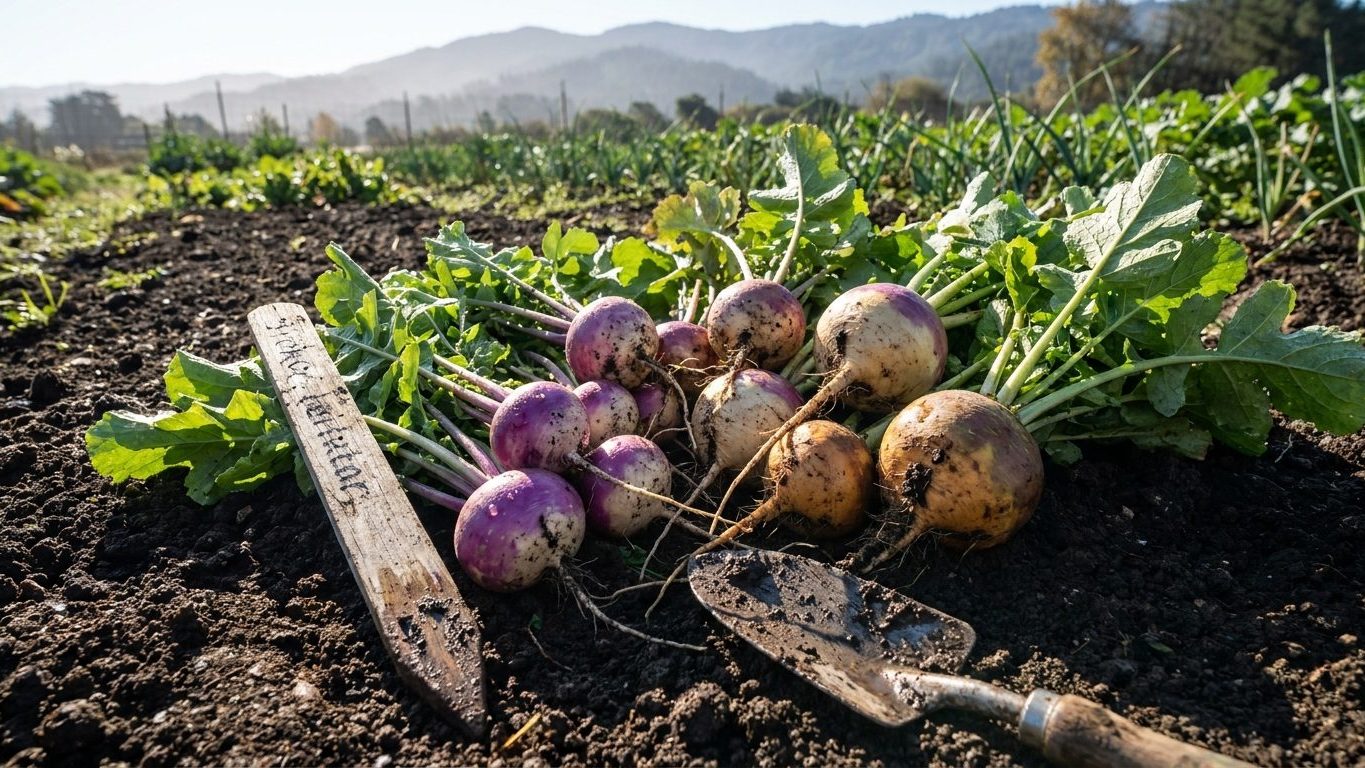

Fast turnips win statewide: varieties maturing in 35 to 55 days (Hakurei, Purple Top White Globe) fit almost anywhere in Colorado, from the high valleys to the warmer river bottoms. Rutabaga, needing 90 to 100 days, only pencils out where the frost-free season runs long enough to let it finish before the ground locks up.
The short answer for Colorado
Start with the two dates that actually run this state’s growing calendar: last spring frost falling between May 1 and May 11, and first fall frost arriving September 30 to October 12, both measured at the Denver-area reference station. That gives the plains and foothills something like 140 to 165 frost-free days in a typical year. It’s enough for two full turnip crops (a spring planting and a second one in late summer for fall harvest) and enough, just barely, for one rutabaga crop if you don’t waste the calendar.
Rutabaga is the variety that punishes hesitation. Count back 90 to 100 days from the earliest fall frost date of September 30, and you land in the third week of June. Sow rutabaga seed later than that on the Denver-area plains and you’re racing a clock you’re likely to lose, ending up with roots the size of golf balls when the freeze hits.
Turnips are more forgiving because they’re faster and because several varieties are bred for exactly this kind of squeeze. Salad-type turnips like Hakurei or Tokyo Cross mature in 35 to 50 days, which means you can tuck a crop into a shoulder season most other root vegetables can’t touch: sow in late July or early August, and you’re still comfortably inside the frost-free window by the time first fall frost shows up. Purple Top White Globe, the classic storage turnip, runs closer to 55 days and still fits if sown by early September on the plains.
The decision by type, then, is straightforward. If you want a sure thing anywhere in the state, plant fast turnips and plan two harvests. If you want rutabaga, you need to know your local season is long enough to carry it, and that’s not guaranteed everywhere in Colorado, which is the subject of the next section.
What will not work here

The slowest rutabaga varieties are the first casualty of a short Colorado season. Anything pushing past the 100-day mark needs to be in the ground by mid-June at the very latest on the plains, and in many mountain valleys that math doesn’t work at all: those towns can see a killing frost in July, long before a 100-day rutabaga has finished sizing up its root. A variety that performs fine in a longer-season state simply runs out of daylight and warmth here.
Storage turnips sown too late are the second failure mode, and it’s the one gardeners repeat every year without noticing the pattern. Sow a 60-day turnip after mid-August on the plains and you’re gambling against a first fall frost that can land as early as September 30. Miss that gamble and you’re pulling underdeveloped roots in October instead of full-sized ones.
Weekly watering is the third trap, and it’s specific to Colorado’s combination of high elevation, intense sun, and low humidity. Turnip and rutabaga seed need continuously moist soil to germinate evenly; skip a few days in a dry Front Range or Eastern Plains summer and germination turns patchy, then the surviving seedlings bolt to flower early once soil moisture swings wide. A once-a-week irrigation schedule that works fine in a humid climate leaves Colorado soil bone-dry between waterings.
Leaving roots in the ground through winter for storage is the fourth mistake, and the number behind it is the coldest month’s mean daily minimum: 18.4°F at the Denver reference station. That’s not the record low, it’s the average nightly floor for the coldest month, and it’s cold enough that unmulched roots left in the ground are likely to freeze and turn to mush rather than store safely. Gardeners who count on in-ground winter storage the way some Southern growers do are setting themselves up for a spoiled crop.
What changes across Colorado
Colorado is not one growing season, it’s several stacked on top of each other by elevation. The USDA hardiness zone range for the state runs from 3b to 7b, a spread wide enough that a garden two hours’ drive from another can be growing under completely different rules. That range is built on one variable, the average annual extreme minimum temperature, and it tells you about winter survival more than it tells you about summer length, but the two tend to move together here: colder zones cluster in the high mountain valleys, warmer zones sit in sheltered river valleys and lower-elevation basins like the western slope canyon country.
A reader gardening at higher elevation or farther into the mountains should assume a shorter frost-free window than the Denver-area dates in this article, sometimes dramatically shorter. That means skipping rutabaga altogether in many of those spots, sticking to the fastest 35-to-45-day turnip varieties, and moving both spring and fall plantings earlier to squeeze them into a tighter calendar. A reader in a warmer valley or on the lower plains has more room to experiment: full-season rutabaga becomes realistic, and a third turnip planting is sometimes possible in years with a late fall frost.
None of this replaces knowing your own zone. The spread across Colorado is too wide for a state-level article to tell an individual reader which end of it they’re on, so treat the 3b-7b range as a signal that local conditions matter more here than in a smaller, flatter state, and check the map for the specific number that applies to your address.
Where to check this for your own county
This article gives you the state picture, built from a single reference station on the Denver-area plains. Your county can differ enough to change every date above, and the authority that tracks those differences is Colorado State University Extension, at extension.colostate.edu. A county recommendation beats a state one every time, because it accounts for local elevation, local frost patterns, and local soil that a statewide page can’t.
Once there, look for two specific things. First, the local planting calendar for your county office, which will adjust the spring and fall sowing windows this article gave for Denver to whatever your actual elevation and microclimate demand. Second, look for any variety trial results or extension bulletins naming turnip and rutabaga varieties that have performed well in trials run in your part of the state. Colorado’s growing conditions vary enough between counties that a variety recommended for the Eastern Plains isn’t automatically the right pick for a mountain valley or a western slope orchard county.
Contacting your county extension office directly is worth the phone call if the website doesn’t answer your specific question. Extension agents typically know which years ran early or late locally, which is information no climate normal can give you, and they can tell you whether rutabaga has a track record of finishing in your particular pocket of the state before it’s worth risking a full season on it.
Checking this against your own garden
Every date in this article is a probability built from thirty years of averages, not a guarantee for this particular spring or fall. Your own garden will tell you more than any calendar once the season actually starts, and three signs matter most.
Soil warmth by feel is the first check, done before you sow anything. Push a finger a couple inches into the bed in spring; turnip and rutabaga seed germinate reliably once the soil no longer feels cold to the touch, which in most years lines up close to the last-frost window but can run earlier or later depending on your bed’s sun exposure and mulch.
The first true leaves are the second check. Once seedlings push past their initial seed leaves and put out the first serrated true leaf, growth speeds up noticeably, and that timing tells you how your particular bed is running compared to the state average, faster in a south-facing raised bed, slower in heavy clay that holds cold longer.
Watching for an early flowering stalk is the third and most useful signal, because it’s a warning rather than a milestone. A turnip or rutabaga that bolts to flower early is telling you the plant experienced a cold snap after germination or a stretch of heat and drought stress, either of which means your local conditions ran rougher than the averages this year, and it’s worth noting for next season’s planting date.