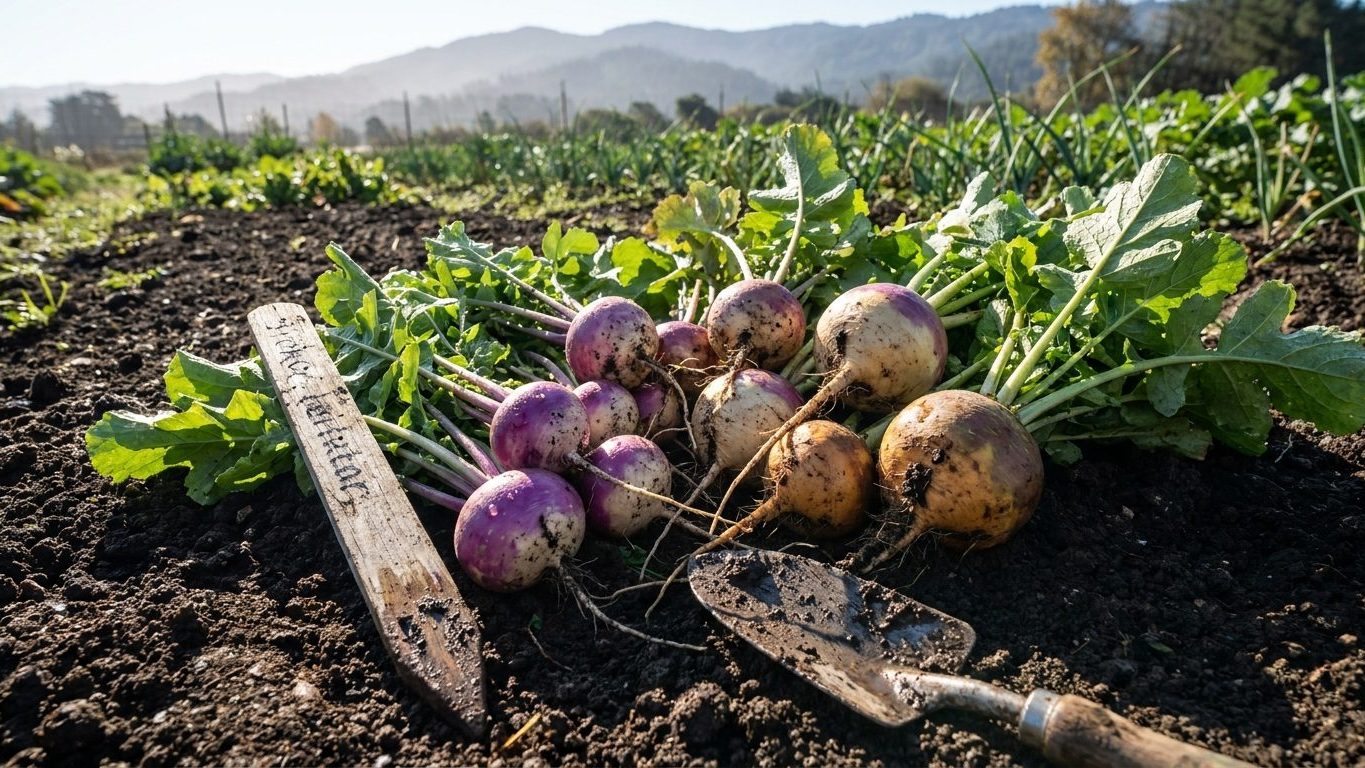

Delaware’s frost-free season runs long enough for two turnip crops and one rutabaga crop, but the two roots don’t share a calendar. Fast turnip varieties handle spring and fall plantings fine; rutabaga only works as a single, carefully timed fall crop that finishes before hard frost.
The short answer for Delaware
Turnips and Rutabaga are both brassicas, but they live on different clocks. Turnips like Purple Top White Globe, Hakurei, and Tokyo Cross mature in 40 to 60 days, which means Delaware gardeners can grow them twice: once in early spring and again for a fall harvest. Rutabaga, on the other hand, needs 90 to 100 days of steady, cool growth and only fits once, timed to finish right as the weather turns cold.
Delaware’s last spring frost falls between April 3 and April 14, and the first fall frost arrives between October 26 and November 7, based on the 1991-2020 NOAA climate normals for the Wilmington-area station. That gives a frost-free window of roughly 195 to 218 days, depending on where in that range your particular year lands. That’s plenty of runway for two turnip cycles bracketing the season, but rutabaga eats up nearly half of it in one shot.
For turnips, plant the first round as soon as the soil can be worked in late March or early April, and count backward from the first fall frost for the second round. If you’re aiming for a harvest before Halloween, sow again by mid-August. Rutabaga is less forgiving. Counting back 90 to 100 days from the earliest expected fall frost puts the safe sowing deadline in mid-July, and pushing later than that risks small, woody roots caught by cold before they’ve bulked up.
So the decision by type looks like this: turnips are the flexible, twice-a-season crop, and rutabaga is the single, disciplined fall planting that has to hit its window. Growers who try to treat rutabaga like a spring crop, or who push turnips into the peak of summer heat, run into the problems covered next.
What will not work here

Spring-sown rutabaga is the most common mistake in this climate. Started in April, it spends June, July, and August pushing through Delaware’s humid 90-degree stretches, and the heat turns the roots bitter, woody, and prone to splitting before they ever reach usable size. Rutabaga wants cool soil at the finish line, not the middle of a mid-Atlantic summer.
Turnips sown in the dead heat of July have their own failure mode. Seeds germinate poorly above 85°F soil temperature, and any bulbs that do form tend to turn pithy and sharp-tasting, since heat pushes the plant toward bolting rather than root development. If you want a fall turnip crop, mid-August is close to the latest sensible start, not the earliest.
Watering on a once-a-week schedule during a Delaware summer dry spell is another common way to lose a crop. Turnip and rutabaga roots split and turn woody when moisture swings between drought and flood, and Delaware’s sandy coastal-plain soils, especially in Sussex and Kent counties, drain fast enough that a single weekly soaking often isn’t enough to keep roots from stressing in between.
Overwintering roots in the ground
Some gardeners try to leave rutabaga in the ground through winter, banking on the cold to sweeten the flavor. That can work in a mild year, but the coldest month here averages a daily minimum of 25.6°F, and an unmulched root left exposed through a hard cold snap can suffer freeze damage at the shoulders even when the average sounds survivable. Without at least a few inches of mulch piled over the row before the ground locks up, this strategy is a gamble more years than it pays off.
Tight spacing is the last trap. Delaware summers run humid enough to favor downy mildew and Alternaria leaf spot, and crowded rows with poor airflow give both diseases exactly the damp, still conditions they need to spread through a planting before the roots have matured.
What changes across Delaware
Delaware isn’t one climate, even though it’s a small state. USDA hardiness zones here range from 7a to 8a, and that spread matters more than the state’s size suggests. Northern New Castle County, inland from the Delaware River, tends to sit on the colder 7a edge, while the southern coastal stretches of Sussex County, moderated by the Delaware Bay and the Atlantic, lean toward the warmer 8a end.
That difference shows up directly in planting windows. A grower near the northern border working with a 7a-leaning microclimate should expect frost risk to linger a bit longer into spring and arrive a bit earlier in fall than a grower near Rehoboth or Lewes on the warmer coastal edge. In practical terms, that can mean shifting a fall rutabaga sowing date up to two weeks earlier in the north to make sure the crop finishes before frost, while southern coastal gardeners sometimes get a small cushion to plant later.
Elevation plays a smaller role in Delaware than in mountainous states, since the whole state sits low and close to sea level, but low-lying inland pockets away from the bay’s moderating effect can still run noticeably colder on clear, still nights than the official station data suggests. The airport-based frost dates cited earlier come from a single reference station, and suburban or rural gardens routinely see frost a week or two outside that window in either direction.
None of this adds up to one single answer for the whole state. A grower in Wilmington and a grower in Georgetown are working from different practical calendars even though both fall under the same statewide guidance, and the only way to know which end of the 7a-8a range applies to a specific yard is to check the map directly rather than guess from a town name.
Where to check this for your own county
This page gives the state-level picture, built from one weather station and a statewide hardiness zone range. A county-level recommendation from the University of Delaware Cooperative Extension will always beat that, because it accounts for local soil, local frost pockets, and years of trial data from growers in that specific county.
The Cooperative Extension can be reached at https://www.udel.edu/academics/colleges/canr/cooperative-extension/. Once there, look specifically for two things: the local vegetable planting calendar for your county, which will give sowing windows adjusted for that area’s actual frost history rather than the airport-station averages used here, and any list of turnip or rutabaga varieties that extension agents have trialled in Delaware conditions. Extension trial data tends to flag which varieties held up against local disease pressure and which bolted early in a hot spring, information that a general planting guide like this one simply can’t provide at the state level.
If the county calendar and this page disagree on a date, follow the county calendar. It’s built from closer, more specific data, and that’s exactly the gap it’s meant to fill. Think of this article as the starting framework and the extension office as the fine-tuning that turns it into a plan for your actual backyard.
Extension offices also typically post seasonal reminders and pest alerts specific to brassica crops, which matter more in a humid coastal state like Delaware than in drier climates, since disease pressure on turnip and rutabaga foliage tends to build up fast once summer humidity sets in.
Checking this against your own garden
Every date on this page is a regional average pulled from one weather station and one hardiness zone range. Your own garden will tell you more than either, if you know what to watch for.
Soil warmth is the first check. Turnip seed germinates reliably once the soil has warmed past the cold, wet feel of late winter, roughly the point where a handful crumbles instead of clumping. If the ground still feels cold and heavy in your hand in early April, hold off a few more days regardless of what the calendar says.
The first flush of flowers is the second signal, and it’s a warning rather than a green light. Once a turnip plant starts pushing up flower stalks, it’s bolting, and root quality drops fast after that point. Catching bolting early, especially during an unexpected warm stretch in what should be cool weather, tells you that plant’s growing window has effectively closed and it’s time to harvest whatever root size you’ve got.
The third check is the first set of true leaves, the ones that emerge after the initial rounded seed leaves. Their appearance timeline, faster in warm soil, slower in cool, gives a rough read on how quickly the rest of that planting will move, and it’s a better predictor for your specific bed than any generic days-to-maturity number on a seed packet. If true leaves show up noticeably faster or slower than expected, adjust your harvest-date guess accordingly rather than trusting the packet’s average maturity window alone.