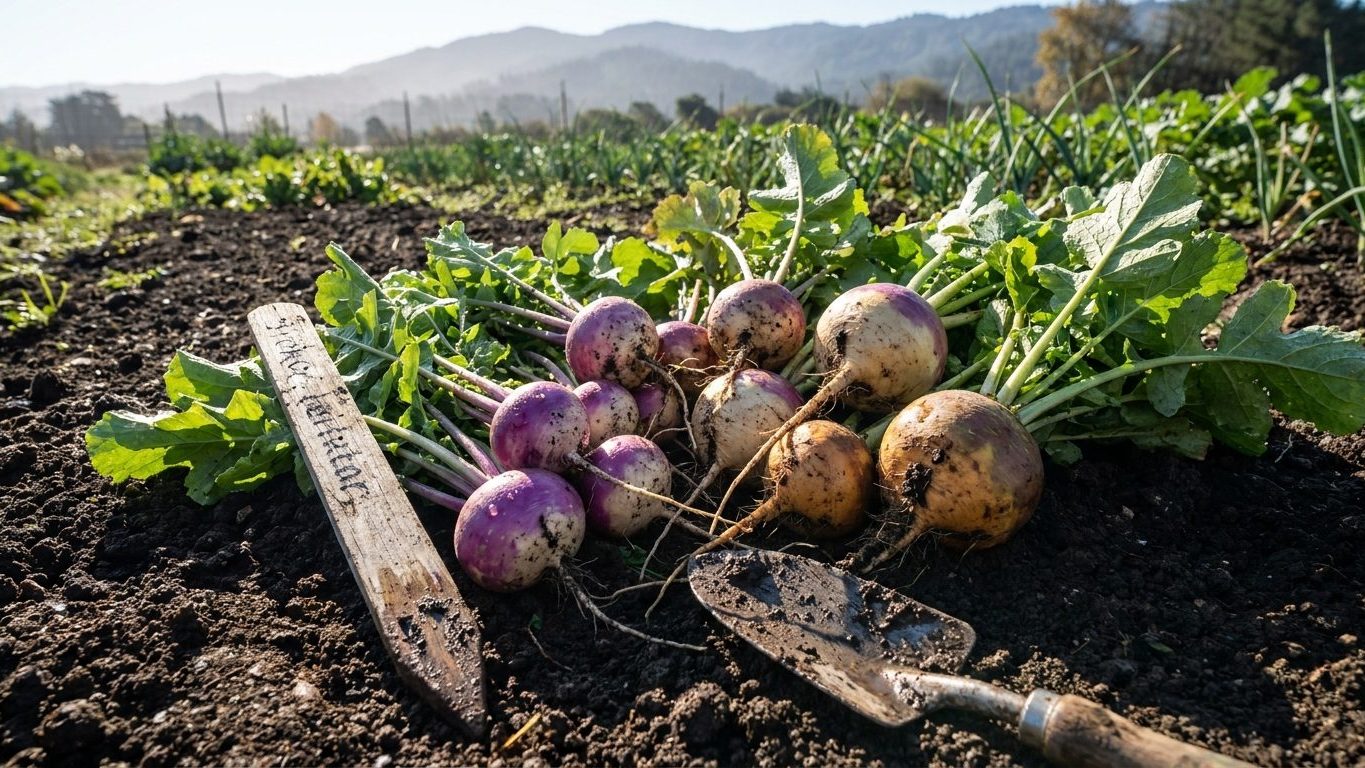

Turnips beat rutabaga almost everywhere in Florida, and the reason comes down to timing. Rutabaga needs a long, steady stretch of cool weather to bulk up its root without turning bitter or woody, and Florida’s cool season is short, mild, and quick to break into warmth. Fast-maturing turnip varieties, grown mainly for greens and small roots, fit that compressed window far better than a slow root crop ever will.
The short answer for Florida
North Florida, using the Jacksonville area as the reference point, gets a real but narrow cool season: last spring frost odds run February 16 to March 7, and the first fall frost typically lands November 26 to December 13. That’s a workable frost window, but the deciding number for root crops is the mean minimum temperature in the coldest month, which sits at a mild 42.9°F. That’s not a hard freeze climate. It’s a state where winter dips low enough to slow plants down but rarely stays cold long enough to let a slow crop finish properly.
That single fact sorts turnips from rutabaga almost by itself. Turnips mature quickly, often in six to eight weeks for greens or small roots, so they can slot into a short cool stretch and still get harvested before heat returns. Rutabaga runs closer to three months from seed to a usable root, and it wants that whole stretch to stay cool and even. Florida’s winter usually can’t promise three uninterrupted cool months, especially once you move south of the panhandle.
The practical decision splits by region and by crop type:
- In north Florida, plant turnips twice: once in early fall for a fall harvest, and again in the coldest weeks of winter using the Jacksonville frost dates as a rough guide, so the second crop matures before spring heat arrives.
- In central and south Florida, where winter frost is occasional or absent, grow turnips through what northern gardeners call winter, roughly October through March, because summer heat, not cold, is what shuts the crop down there.
- Treat rutabaga as a north Florida crop with a narrow window only, sown as soon as the weather turns in early fall so it can finish before the mild winter tips back toward warm.
Anywhere in the state, a variety bred for heat tolerance and quick maturity is the safer bet than a classic long-season rutabaga type, simply because Florida rarely gives a crop the cold, steady months it was bred for further north.
What will not work here

Treating the Jacksonville frost dates as a promise is the first mistake. The station sits inland in north Florida, and even there, three of thirty fall seasons in the historical record never produced a freeze at all. If a supposedly reliable planting calendar misses a freeze one year in ten at its own reference point, leaning on it as a fixed rutabaga deadline further south is asking for trouble. Move into central Florida and the whole frost framework stops applying; move into south Florida and it inverts completely, with the growing season running through what would be winter elsewhere and summer becoming the dead zone.
Planting rutabaga on a calendar built for cold country doesn’t work here either. A gardener transplanting a habit from a northern state, sowing rutabaga in early summer for a fall harvest, runs straight into Florida’s brutal early-summer heat before the plant has any chance to establish. And sowing it too late in fall, hoping to stretch the season into winter, runs into the opposite problem: the coldest month barely dips to that 42.9°F mean minimum, so the root often bolts or turns fibrous the moment a warm spell arrives before it’s finished bulking.
Spacing and watering habits borrowed from drier states also backfire. Florida’s humidity, especially in the shoulder seasons when both crops are typically planted, encourages fungal problems like downy mildew and leaf spot on tightly packed turnip greens. A planting scheme that works fine in a dry Western garden, rows close together to save space, can turn into a disease outbreak here within a few humid weeks. Wider spacing and watering at the soil line rather than overhead cuts that risk substantially.
Finally, summer sowing of either crop is close to pointless statewide. There’s no real dormant season to exploit; the heat that shuts down cool-season vegetables in north Florida is the same heat that runs nearly year-round further south, just extended by a few extra months.
What changes across Florida
Florida’s hardiness zone spread runs from 8b to 11b, which is one of the widest ranges of any state and means there is no single planting calendar that covers the whole territory. A zone spread that large is the difference between a garden that still sees a handful of freezing nights most winters and one that essentially never does.
| Region | General zone character | Frost pattern | Turnip and rutabaga strategy |
|---|---|---|---|
| North Florida (Jacksonville reference) | Cooler end of the state’s range | Measurable frost window, roughly late November through early March | Fall crop plus a second late-winter turnip crop; rutabaga only in the narrow fall window |
| Central Florida | Milder, transitional | Occasional light frost, no reliable annual freeze | Turnips grown through the cool months; rutabaga a poor bet most years |
| South Florida and the Keys | Warmest end of the state’s range | Essentially frost-free | Turnips as a winter-only crop; rutabaga not realistic |
A gardener in the northern part of the state can lean on the frost dates in this article with some confidence, since they come from a north Florida station. Someone gardening further south should shift the entire calendar toward winter for planting and toward summer for the shutdown period, because the limiting factor flips from cold to heat somewhere around the middle of the peninsula. This page can’t tell an individual reader which side of that line their own yard falls on. That’s a question for a hardiness zone map, checked by ZIP code, not a statewide article.
Where to check this for your own county
Florida’s extension network runs through the University of Florida’s Institute of Food and Agricultural Sciences, and the statewide entry point is sfyl.ifas.ufl.edu. From there, every county has its own local office, and that’s the resource that actually matters more than this page.
What to look for once there: the county’s own vegetable planting calendar, which will already be built around that county’s local frost pattern rather than the north Florida numbers used here, and any list of turnip or rutabaga varieties the local office has trialed or recommends for that specific area’s soil and humidity. UF/IFAS county offices also field regular questions about disease pressure on brassica crops, since that varies by local rainfall and drainage as much as by temperature.
A county-level recommendation beats a state-level one every time, for a simple reason: this article is built on a single reference station and a hardiness zone range that spans nearly the entire USDA scale, from 8b to 11b. A county extension office is working from local trial data and local growers’ actual results, which is a finer instrument than any statewide summary can be. Treat this page as the starting point for understanding why Florida behaves the way it does, and treat the county office as the source for what to actually plant on a specific date in a specific yard.
Checking this against your own garden
Every date on this page is an average built from decades of weather records. A reader’s own soil and seedlings will always outrank it, and three simple observations tell the story better than any calendar.
First, soil feel at planting time. Sandy Florida soil warms and cools faster than heavier soils further north, so a handful that crumbles cool and slightly moist, rather than clumping wet or sifting bone-dry, signals the ground is ready for turnip seed regardless of what the calendar says that week.
Second, germination speed. Turnip seed in favorable soil typically breaks the surface within about a week. Slow, patchy sprouting after that points to soil that’s still running warmer than it should for the season, a common problem in central Florida yards where a “fall” planting can land during a lingering warm spell.
Third, and most telling, watch for the first true leaves. Seedlings start with a pair of rounded seed leaves, then push out their first true, toothed leaves once they’ve settled into steady growth. A quick, uniform flush of true leaves across a bed means that spot is tracking with the county’s typical cool season. A slow or uneven flush, especially in one corner of the yard, usually points to a microclimate running warmer or cooler than the rest of the garden, whether from a low spot collecting cold air at night or a bed near pavement holding extra heat into the evening.