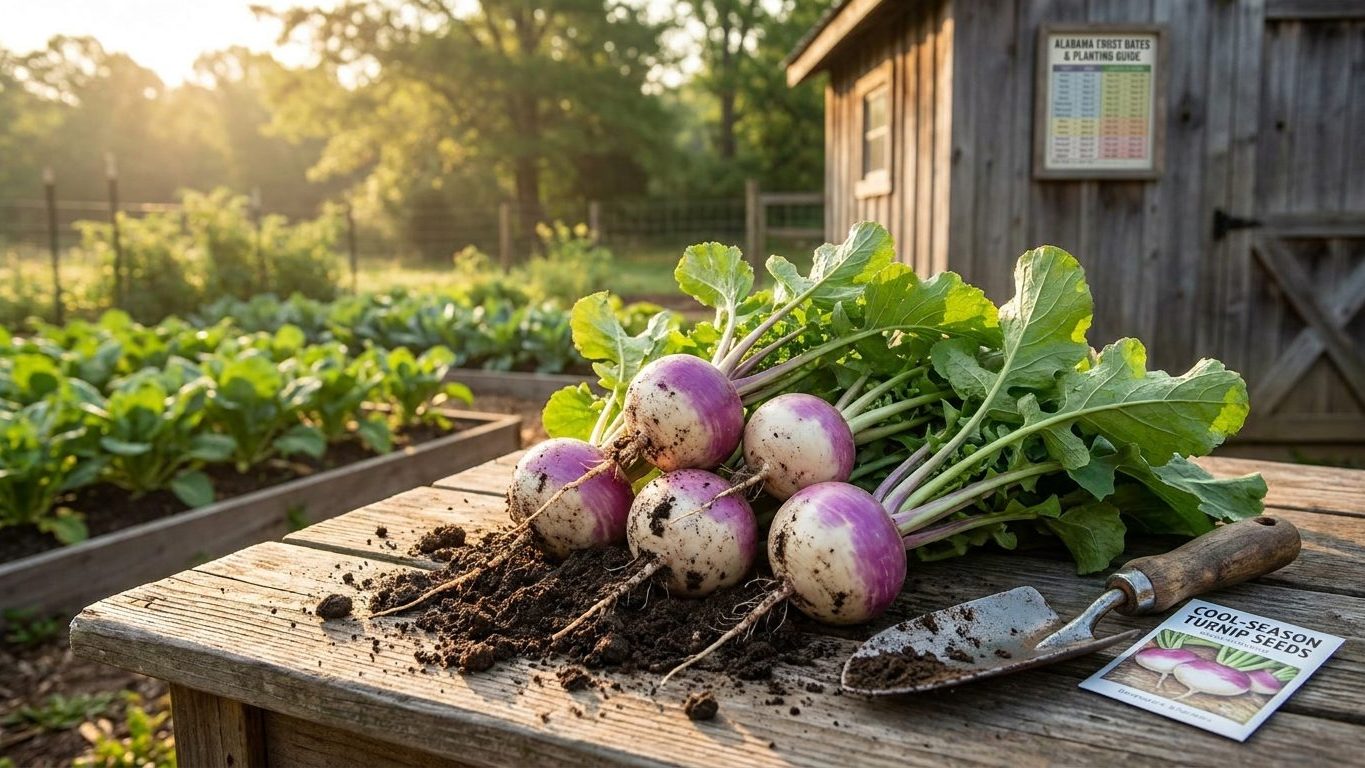

In north Florida, using Jacksonville’s climate data as the reference point, turnips go into the ground in two windows: mid-August through late September for a fall and winter crop, then again from mid-January into February for a quick spring crop before the heat returns. Central and south Florida flip this pattern entirely, since frost there is rare enough that turnips become mostly a winter vegetable, planted from fall through late winter with summer as the season to avoid.
The short answer for Florida
Turnips are a cool-season root crop, and in the Jacksonville area that means working inside the gap between two mild-winter frost windows rather than around one hard freeze date. NOAA’s 1991-2020 normals for station USW00013889 put the first fall freeze at a 30-70% probability between November 26 and December 13, and the last spring freeze in the same probability band between February 16 and March 7. Those dates describe the odds of a 32°F freeze occurring, not a guarantee of one on any given year, and turnip roots shrug off a light frost far better than most vegetables do.
That tolerance changes how the calendar should be read. Rather than treating the fall frost date as a kill deadline, gardeners near Jacksonville can sow the first round in mid-August to late September and let the crop mature straight through the freeze window, since a few nights near 32°F rarely damages an established turnip stand. The second sowing, in mid-January to mid-February, needs to finish before the coldest-month mean daily minimum of 42.9°F starts climbing toward the heat that makes turnip roots turn woody and bitter. Mid-August to late September is the date worth writing on a calendar, because it starts the longer and more reliable of the two windows.
None of this applies south of the Jacksonville region. The USDA Plant Hardiness Zone Map lists Florida spanning zone 8b through 11b, and that range is not a rounding error, it is the difference between a state with a real winter and a state where winter barely registers. This page’s frost data comes from a single inland station in north Florida; it has no equivalent freeze-probability numbers for Orlando, Tampa, or Miami, and borrowing the Jacksonville dates for those cities would be a mistake. Where the growing calendar for those regions is concerned, this page does not have the figures to answer precisely, and says so rather than guessing.
What will not work here

Sowing turnips in early or mid-summer is the most common misstep in north Florida, and the frost data explains why it fails without needing a heat index. If the first reliable freeze doesn’t show up until late November or December, that leaves a stretch of soil that stays warm well into September, and turnip seed germinates poorly, then bolts fast, once soil temperatures sit in the range that a Florida July or August delivers. A crop sown in June is racing a heat clock it cannot win, regardless of watering.
The other failure mode sits at the other end of the calendar. Rutabaga, the slower cousin of the turnip, typically needs somewhere around 90 to 100 days to size up, against roughly 45 to 60 for a standard turnip. Squeeze a rutabaga sowing into the narrow gap between the last spring frost window (February 16 to March 7) and the rapid warm-up that follows, and the math stops working: there simply isn’t enough cool season left before Florida’s spring heat pushes the plant into bolting instead of bulking its root. 90 to 100 days is the number to check against the calendar before choosing rutabaga over turnip for a spring sowing.
A third mistake is treating the coldest-month figure as a threat rather than reassurance. A mean daily minimum of 42.9°F in the coldest month means most nights near Jacksonville never get close to damaging a turnip stand; the crop is bred to take real cold. The danger isn’t frost killing the plant, it’s gardeners pulling the crop early out of unnecessary worry, or leaving the ground bare through winter when it could be growing. Fear of a freeze that turnips can mostly tolerate wastes more of the calendar than the freeze itself does.
Finally, close spacing that works fine in a drier climate becomes a liability once north Florida’s winter humidity settles in. Crowded turnip greens hold moisture on the leaf surface longer after rain or dew, and that’s the setup fungal leaf spot needs. Thinning stands to give air movement matters more here than in a dry-winter state.
What changes across Florida
A hardiness range of 8b to 11b means Florida is not one growing region wearing a single state name, it’s several. The Jacksonville-anchored frost dates in this page describe roughly the northern third of the state; move south and the entire logic of “spring window, fall window” starts to dissolve, because there isn’t a meaningful frost season to bracket a schedule around.
| Region | Approximate USDA zone | Turnip season pattern |
|---|---|---|
| North Florida (Jacksonville area) | 8b-9a | Fall sowing (Aug-Sept) and late-winter sowing (Jan-Feb), bracketing a mild winter with occasional light frost |
| Central Florida | 9b-10a | Frost rare to absent; sowing shifts to Oct through Feb, avoiding the hot, humid growing season entirely |
| South Florida | 10b-11b | Effectively frost-free; turnips become a winter-only crop, with summer treated as the dormant season to skip |
The practical takeaway for a reader in the panhandle or the far north of the state is that the sowing windows on this page apply reasonably well as written. A reader further south should shift both windows later into the calendar year and expect the whole growing period to compress into fewer cooler months, sometimes by as much as six to eight weeks compared with the Jacksonville schedule. This page cannot say which of those zones applies to any individual garden, since zone boundaries shift with elevation, coastal proximity, and urban heat, none of which show up on a statewide dataset. The USDA’s own hardiness zone map is the tool built for that, not a paragraph of state-level averages.
Where to check this for your own county
Florida’s statewide extension service, UF/IFAS, runs its public-facing guidance through Solutions for Your Life, and that’s the site worth bookmarking before locking in a sowing date. Every Florida county has its own extension office feeding into that system, and county agents publish planting calendars built from local frost records and years of variety trials rather than a single inland airport station.
Two things are worth hunting for once there: the local vegetable planting calendar for the specific county, and any list of turnip or rutabaga varieties that county’s trials have flagged as reliable performers in that microclimate. A variety that handles Jacksonville’s winter humidity well may not be the same one recommended two counties over near a coastline or at a slightly different elevation. Search by county name, not by region, since “north Florida” as a search term will return exactly the kind of statewide generalization this page is built on.
That’s not a knock on state-level data, it’s a reminder of what it’s for. A statewide page built from one Jacksonville weather station gives a reasonable starting frame for anyone in that climate zone, but a county extension calendar has the advantage of local soil, local rainfall patterns, and local pest pressure baked into the recommendation. When the two disagree, the county page should win. This page is the broad frame; the county office fills in the details that actually apply to one specific piece of ground.
The Moon calendar is a separate, older custom: see when to plant turnips by the moon, written as tradition rather than fact.
Checking this against your own garden
Calendar dates are a starting estimate, and the garden itself will correct them faster than any weather station can. Three signs matter more than the date on a seed packet.
Soil that feels warm to the back of a hand at planting depth, even in early fall, is still too warm for reliable turnip germination; waiting until it feels cool and slightly damp rather than warm and dry is a better cue than counting days from a calendar date. The first true leaves appearing, as opposed to the rounded seed leaves that show up first, signal that the seedling has settled into active growth, and how long that takes compared with a typical week or two gives a rough read on whether the soil was warm or cool at sowing.
Later in the season, watch for the first flower stalk starting to elongate up from the center of the rosette. That’s the plant switching from building a root to setting seed, usually triggered by lengthening days and rising temperatures together, and it’s the clearest on-the-ground signal that the window for that planting is closing regardless of what a regional frost date suggests. A stalk showing up earlier than expected usually means the local microclimate is running warmer than the county average; later than expected points the other way. Either way, the plant is reporting on its own patch of soil more accurately than any station miles away ever could.