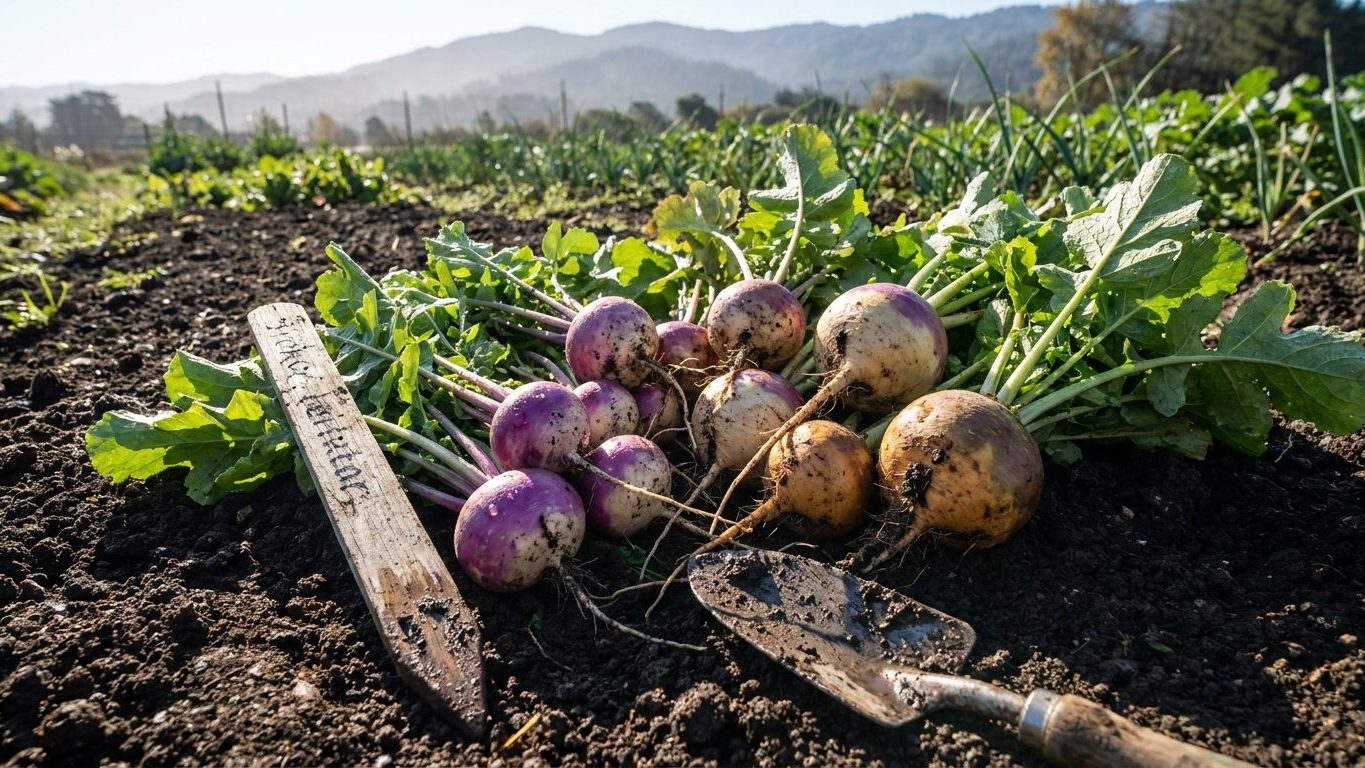

Best varieties turnips Hawaii comes down to elevation and days-to-maturity: fast salad turnips like Hakurei or Tokyo Cross work in nearly every lowland yard, while rutabaga and slow storage turnips only make sense upcountry, where nights stay cooler. There’s no frost date to plan around here, so the whole calendar runs on heat and rainfall instead.
The short answer for Hawaii
Skip the seed catalog descriptions written for mainland gardeners and think in two categories: quick turnips and everything else. In lowland Hawaii, where the coldest month still averages a mean daily minimum of 66.8°F, a turnip has maybe six to eight weeks of tolerable growing conditions before heat, humidity and pest pressure start winning. That rules out anything slow. Varieties maturing in 35 to 45 days, like Hakurei, Tokyo Cross or Scarlet Queen, are the ones that reliably size up before bolting or turning woody.
Rutabaga is a different animal. It typically needs 90 to 100 days of steady, cool growth to bulk up its root, and it sulks badly above 75°F. In most of Hawaii’s populated coastal zones, that window simply doesn’t exist. If you’re gardening at sea level in Honolulu, Hilo, or Kahului, rutabaga is a poor bet no matter which variety you pick. The plant will grow leaves happily in the humidity and heat, but the root stays thin and fibrous instead of swelling.
Where rutabaga does have a shot is upcountry: places like Kula on Maui, Waimea on the Big Island, or the Volcano area, where elevation knocks several degrees off daytime highs and nighttime lows. Even there, growers are working at the edge of what the crop wants, so picking a variety bred for a shorter, tighter maturity window (closer to 80-85 days) improves the odds over the classic 100-day types.
For turnips specifically, there’s also a case for growing them as greens rather than for the root. Types bred for bunching, harvested at three to four weeks for their tops, sidestep the root-bulking problem entirely and tolerate Hawaii’s warmth far better than any variety asked to swell a globe underground. If your goal is a reliable harvest rather than a specific look on the plate, that’s often the path of least resistance.
None of this is about frost tolerance, because frost isn’t part of the equation here. It’s about how many consecutive weeks of relatively cool, evenly moist soil a plant gets before summer heat or a dry spell shuts down root growth. Choose the variety that matches how much of that window your particular yard actually has.
What will not work here

Long-season storage turnips, the kind bred to sit in mainland root cellars through winter, are the first casualty. A variety that needs 60 or 70 days of cool weather to finish is gambling against a Hawaiian summer that arrives whether the plant is ready or not. In lowland gardens, that gamble usually loses: the root stays small, turns pithy, or the plant bolts to seed under the combination of long daylight and warm nights.
Rutabaga grown at sea level fails for a related but distinct reason. Its root formation depends on a sustained stretch of moderate temperatures, and Hawaii’s coastal coldest-month minimum of 66.8°F never dips low enough to trigger that response. The plant isn’t dying, exactly. It’s just never told, by temperature, to start storing energy underground the way it would in a place with a real winter.
Watering on a weekly schedule is another common failure point, and it cuts in two directions depending on where you garden. On the dry, leeward side of any island (think West Hawaii or leeward Oahu), a once-a-week soak lets the topsoil dry out completely between waterings, and turnip roots respond to that stress by turning bitter, cracked, or hollow. On the wet windward side, the opposite problem shows up: soil that never fully drains breeds the fungal and bacterial rots that turnip roots are notoriously prone to, especially clubroot and soft rot, both of which thrive in warm, waterlogged ground.
Tight spacing compounds the windward problem. Crowded turnip rows trap humidity at soil level, and in a climate where relative humidity routinely sits high year-round, that trapped moisture is an invitation to fungal disease long before it would be an issue in a drier state. Growers who follow seed-packet spacing meant for a temperate, drier climate often end up thinning a stand that should never have been planted that close in the first place.
Finally, treating “cool season” as a fixed calendar month is a mistake specific to a place without frost. There’s no last-frost date to count backward from here, so a planting schedule borrowed from a mainland guide (start six weeks before the frost date) has nothing to anchor to. The real constraint is soil temperature and rainfall pattern, which shift by elevation and by island side, not by a date on a calendar.
What changes across Hawaii
Hawaii’s official hardiness range runs from zone 9a to zone 13a on the USDA Plant Hardiness Zone Map, a spread most mainland states never approach. That range is built from a single measurement, average annual extreme minimum temperature, and in Hawaii it maps almost entirely to elevation rather than latitude. The lowland coast around Honolulu sits at the warm end of that scale; go up the slopes of Haleakala, Mauna Kea, or Mauna Loa and the zone number drops fast.
That gradient matters more for Turnips and Rutabaga than for most vegetables, because both crops care intensely about temperature and almost not at all about the tropical foliage growth Hawaii is famous for. A gardener at 3,000 to 4,000 feet upcountry is working with meaningfully cooler nights than someone gardening two miles away but 200 feet above sea level. Those cooler nights are exactly what a rutabaga, or a slower storage turnip, needs to actually form a root worth harvesting.
Windward versus leeward exposure adds a second axis that has nothing to do with elevation. The windward sides of the islands catch trade-wind moisture and stay wetter and cloudier; the leeward sides bake drier and sunnier at the same elevation. A turnip variety that handles a windward Hilo garden’s near-constant moisture may rot in a leeward Kona garden’s dry heat, and vice versa for one bred to tolerate drought stress.
Because the state spans this much range in one small footprint, there’s no single elevation or exposure that represents “Hawaii” the way a single number might represent a smaller, more uniform mainland state. A recommendation that works in Kula won’t necessarily transfer to Waipahu, even though both are technically the same state and the same general growing advice gets written for both. Check where your own elevation and side of the island fall on Hawaii’s hardiness zone map before assuming a variety choice made for one part of the state applies to yours.
Where to check this for your own county
Everything above is a state-level starting point, and Hawaii’s own agricultural extension service exists specifically to narrow that down. The University of Hawaii’s College of Tropical Agriculture and Human Resources runs the state’s Cooperative Extension Service, reachable at ctahr.hawaii.edu. That’s the address to bookmark, not a generic search for Hawaii gardening advice.
What to look for once there: county-specific planting guidance for your island and elevation band, and any variety trial results CTAHR extension agents have published for cool-season crops grown in tropical conditions. Extension offices routinely test which turnip and brassica varieties actually perform under local heat and rainfall, information no seed catalog written for a mainland audience can give you.
It’s also worth asking, directly, whether local agents have data on rutabaga trials at all. Given how narrow the crop’s window is in Hawaii, county-level extension staff may simply say it isn’t a crop they recommend for your area, and that answer is more useful than a seed packet’s optimistic maturity date. Contacting your county extension office before you buy seed can save a season’s worth of wasted effort on a crop that was never going to size up where you live.
A state-wide answer, including everything in this article, is necessarily a compromise across an unusually wide range of microclimates. A county-level or even neighborhood-level answer from someone who has actually trialed these crops on your island beats a general guide every time. Treat this page as the starting framework, and the extension office as the source that fills in the specifics your particular garden needs.
Checking this against your own garden
No calendar, state guide or extension bulletin replaces what your own soil and plants are telling you in real time. Three simple observations will tell you more about your microclimate than any published date.
Start with soil feel at planting depth, about two inches down. If the soil feels warm and slightly dry to the touch rather than cool and damp, turnip seed will germinate fast but the resulting roots may push toward bitterness under continued heat; that’s a signal to lean harder toward the quickest-maturing varieties rather than anything marketed as a storage type.
Second, watch for the first male flowers, the small yellow blooms that show up when a brassica is bolting rather than building root mass. If you see them appear on turnip plants that are only a few weeks old and still small, that’s the plant telling you the growing window closed faster than expected in your particular spot, likely because of heat, day length, or both. It’s useful information for next planting, not a sign anything went wrong with the seed.
Third, track how quickly true leaves (the serrated, more mature leaves that follow the rounded seedling leaves) appear after germination. A fast, vigorous push of true leaves within the first 10 to 14 days generally means conditions are favorable enough to try a slightly longer-season variety next round; a slow, stalled start suggests sticking with the fastest turnips available and treating rutabaga as a non-starter at your elevation.
These three signs, soil feel, flowering timing, and leaf growth speed, tell you more about whether your yard sits at the warm or cool edge of Hawaii’s range than any zone map can, because they’re measuring your actual garden instead of a regional average.