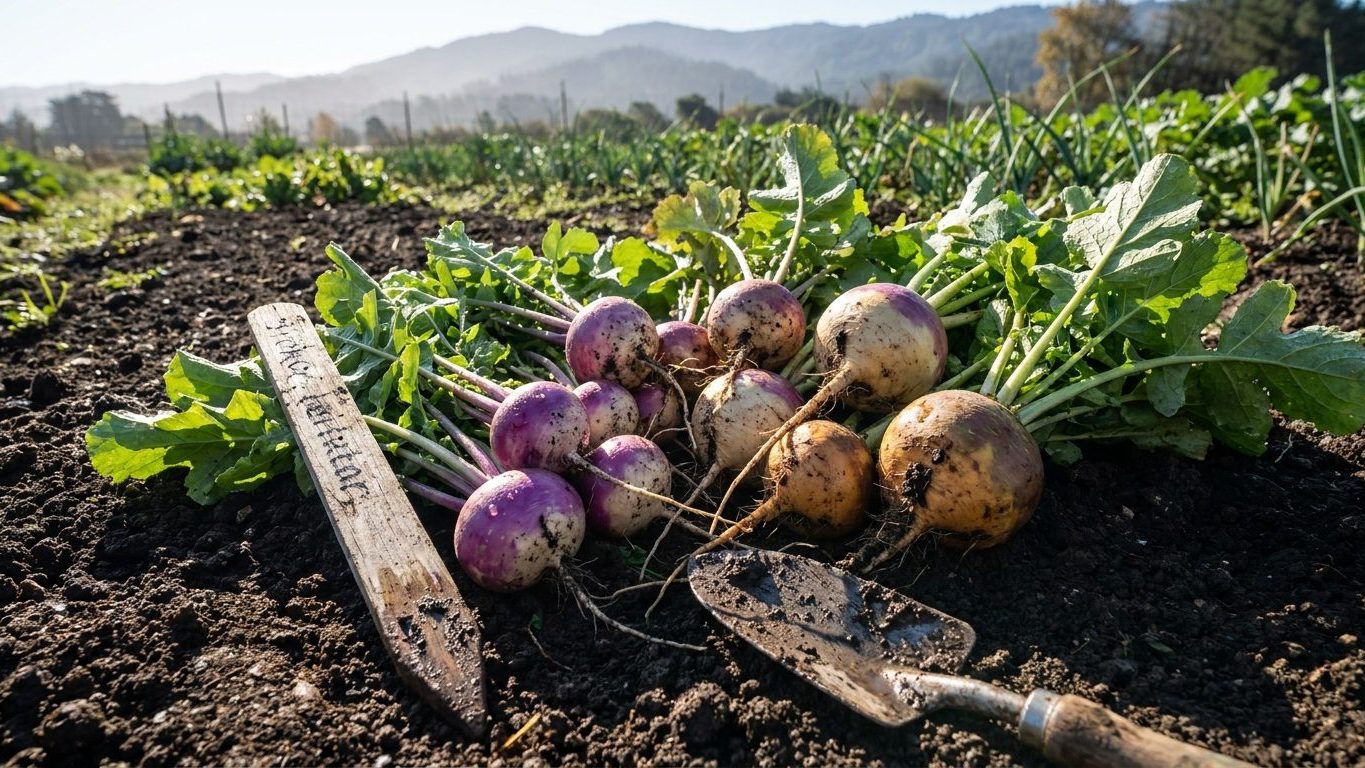

Indiana’s growing season runs long enough for both quick turnips and slower rutabaga, but the split between the two crops comes down to timing, not taste. Fast turnip varieties bred for 40 to 55 days work almost anywhere in the state from spring through fall. Rutabaga, which needs 90 days or more of cool weather to bulk up properly, only fits reliably into the fall planting window.
The short answer for Indiana
Turnips and Rutabaga are not interchangeable choices in Indiana gardens, and the decision starts with counting days. Indianapolis sees its first fall freeze between October 21 and October 30, and its last spring freeze between April 9 and April 21. That gives most of the state a frost-free stretch of roughly five to six months, plenty for turnips planted twice a year but tight for rutabaga if it goes in late.
Quick turnips like Purple Top White Globe or Tokyo Cross mature in 40 to 55 days, which means a gardener can sneak in an early spring crop right after the last frost risk drops and still have time for a second sowing in late summer aimed at that October freeze. Rutabaga varieties such as American Purple Top or Laurentian need closer to 90 to 100 days, and they actually taste better after a light frost sweetens the roots. That means counting back about 100 days from October 21 to find the sowing date, which lands in mid-July for most of the state.
Spring rutabaga is a harder sell here. Plant it too early and the warm early-summer stretch pushes it to bolt before the root ever swells. Indiana’s climate rewards patience with rutabaga and rewards speed with turnips, and treating them as the same crop on the same calendar is the most common mistake home gardeners make with this family.
For a quick decision: if the goal is a spring harvest, pick a fast turnip and get it in the ground as soon as the soil can be worked after the frost window closes. If the goal is a fall harvest with better flavor and longer storage, either turnip or rutabaga will do, but rutabaga needs the earlier July start while turnip can wait until August. Skipping a summer crop of either one is usually the right call statewide, since Indiana’s mid-summer heat and humidity punish both crops with pithy roots and flea beetle pressure that spring and fall plantings mostly avoid.
What will not work here

A slow-maturing rutabaga sown in spring is the single biggest failure pattern in Indiana turnip patches. With only about five months between frost dates in central Indiana, a 100-day rutabaga started in April is racing the July and August heat, and heat is exactly what makes rutabaga go woody and bitter before it sizes up. The root stays small, the flavor turns sharp, and the harvest disappoints compared to the same variety grown as a fall crop.
Weekly watering also fails here more often than gardeners expect. Turnips and Rutabaga are both shallow-rooted and thirsty, and a stretch of Indiana’s typical July dry spell combined with once-a-week watering produces cracked, woody roots even in varieties bred for speed. These crops want steady, shallow moisture, closer to twice a week during hot stretches, not a single deep soak.
Spacing mistakes in humid summers
Indiana’s humidity, especially in the southern third of the state, makes tight spacing a setup for foliar disease. Turnip greens packed in close rows trap moisture and stay damp longer after Indiana’s frequent summer thunderstorms, which invites downy mildew and leaf spot. Thinning early, ideally when true leaves are the size of a quarter, gives air enough room to move through the row and keeps disease pressure down.
Winter survival is the other trap. The coldest month here averages a daily minimum of just 20.9°F, which is well below what an unprotected turnip or rutabaga root can tolerate in open ground once the top growth is gone. Neither crop is winter-hardy in Indiana soil without mulch or row cover, so leaving a fall crop in the ground past a hard freeze without protection means losing the harvest to rot or freeze damage. Pulling or heavily mulching roots before the ground freezes solid is the difference between a stored crop and a lost one.
Finally, planting a full-season rutabaga where a gardener only has a partial season left, such as after a late-cleared summer crop, sets up disappointment. If less than 90 days remain before the average first fall freeze, that patch of ground is better used for a fast turnip than a rutabaga that will never finish sizing up.
What changes across Indiana
Indiana is not one growing zone, and treating it that way is the second-biggest planning error after the rutabaga timing mistake. The USDA Plant Hardiness Zone Map places the state across a spread from zone 5b in the north to zone 7a in the far southern counties along the Ohio River. That is not a small difference. It is roughly two full zones, which translates to a meaningfully different frost calendar depending on where in the state a garden sits.
The frost dates used in this guide, April 9 to April 21 for the last spring freeze and October 21 to October 30 for the first fall freeze, are drawn from the Indianapolis station and represent the middle of the state. Purdue’s own guidance flags that southern Indiana counties typically see their last spring frost earlier and their first fall frost later than the central reference point, sometimes by two weeks or more. That extra stretch of fall matters directly for rutabaga, since two additional weeks of frost-free growing is often the margin between a rutabaga that sizes up properly and one that gets cut short by cold.
Northern Indiana runs the opposite direction. Counties near the Michigan border sit solidly in zone 5b, with a shorter frost-free window than the state average and a first fall freeze that can arrive noticeably before the Indianapolis date. A rutabaga sown on the Indianapolis-based July schedule in a northern county risks running out of season before it finishes sizing up, so gardeners there benefit from moving that sowing date earlier, sometimes into the first week of July rather than mid-July.
There is no single frost date that fits Warsaw and Evansville equally well. Anyone gardening outside the central corridor of the state should treat the dates in this article as a starting estimate and confirm their own zone and frost window using the USDA hardiness zone map rather than assuming the statewide range applies evenly to their county.
Where to check this for your own county
Statewide frost dates and hardiness zone ranges are useful for planning, but they average out real differences between counties, and turnips or rutabaga sown on a county-specific calendar will consistently outperform ones sown on a generic state guide. Purdue University’s Cooperative Extension Service is the authoritative source for Indiana gardeners, and it publishes county-level planting guidance that accounts for local frost patterns far than a statewide average can.
The Purdue Extension can be reached for guidance. Once there, a gardener should look for two specific things: the local vegetable planting calendar for their county office, which adjusts sowing windows for local frost data rather than the Indianapolis reference point used in this article, and any variety trial results for turnips or rutabaga run through Purdue’s horticulture programs, which show which cultivars have actually performed well in Indiana’s soil and climate rather than just in seed catalog descriptions.
County extension offices also field direct questions, and a quick call or email to the local office is often faster than searching through statewide publications. They can confirm the expected last frost date for that specific county, which matters most for anyone near the state’s northern or southern edges where the two-week swing mentioned earlier makes a real difference to rutabaga timing.
This article gives the statewide picture built from Indianapolis climate data, and it is a solid starting point for the middle third of Indiana. But a county recommendation from Purdue Extension will always beat a state-level estimate, especially in the border counties where the frost calendar diverges most from the central reference point. Treat this page as the broad map and the county extension office as the local, more accurate compass.
Checking this against your own garden
Calendar dates are a starting point, not a guarantee, and a gardener’s own observation of their soil and plants will always outrank the frost dates published for a reference station miles away. Three simple checks matter more than any date on this page.
Soil warmth by feel is the first and most reliable signal. Turnip and rutabaga seed germinates poorly in cold, wet soil regardless of what the calendar says, so a gardener should dig down about two inches and feel for soil that is no longer cold to the touch, roughly the temperature of a spring afternoon rather than a winter morning. Cold, sticky soil that clumps in a fist is a sign to wait, even if the frost date has technically passed.
The first true leaves on a young turnip or rutabaga seedling are the second signal worth watching. These appear after the initial rounded seed leaves and look like the toothed, more mature foliage of the mature plant. Their appearance means the root system is established enough to handle thinning without shock, and thinning at this stage, rather than waiting longer, is what prevents the crowded, disease-prone rows discussed earlier.
The third signal is how the plant responds to a stretch of hot, dry weather. If leaves wilt hard by early afternoon even with adequate soil moisture at the roots, that is a sign the local microclimate runs hotter than the general Indiana pattern, whether from a south-facing slope, a heat-trapping driveway nearby, or simply a season running warmer than average. That is the moment to increase watering frequency rather than volume, since these shallow-rooted crops respond better to more frequent light watering than to occasional deep soaking during heat stress.