
The honest answer for Nova Scotia is that no province-specific insect inventory backs this page. What the verified record does carry is the province’s dominant soil profile and the university-sourced carrot requirements that soil either satisfies or fights. In a Podzol soil running strongly acid and imperfectly drained, the root often loses more to soil mechanics and storage handling than to any single bug, and that’s where the real, sourced detail lives.
Which pests attack carrot in Nova Scotia

There is no documented pest species list for carrot tied to Nova Scotia in the verified record behind this page. No service is named here as having logged carrot rot fly, wireworm, or any other insect for this province, so none will be named as fact. Naming a bug because it’s common elsewhere would be exactly the kind of invented detail that makes a page untrustworthy the first time a reader checks it against their own county’s extension bulletin.
What the record does document is the ground carrots are growing in across the province. Nova Scotia’s mapped agricultural soil is most often a Podzol, the acid, leached soil that forms under conifers, covering 53 percent of the mapped surface (Gleysolic soils follow behind it). The median surface pH sits at 5.2, strongly acid, and the texture runs 52 percent sand, 10 percent clay, and 38 percent silt, with organic matter around 2.1 percent and drainage classed as imperfect. That comes from Agriculture and Agri-Food Canada’s Canadian Soil Information Service, reading the Soil Name and Soil Layer tables for the province’s mapped soil components.
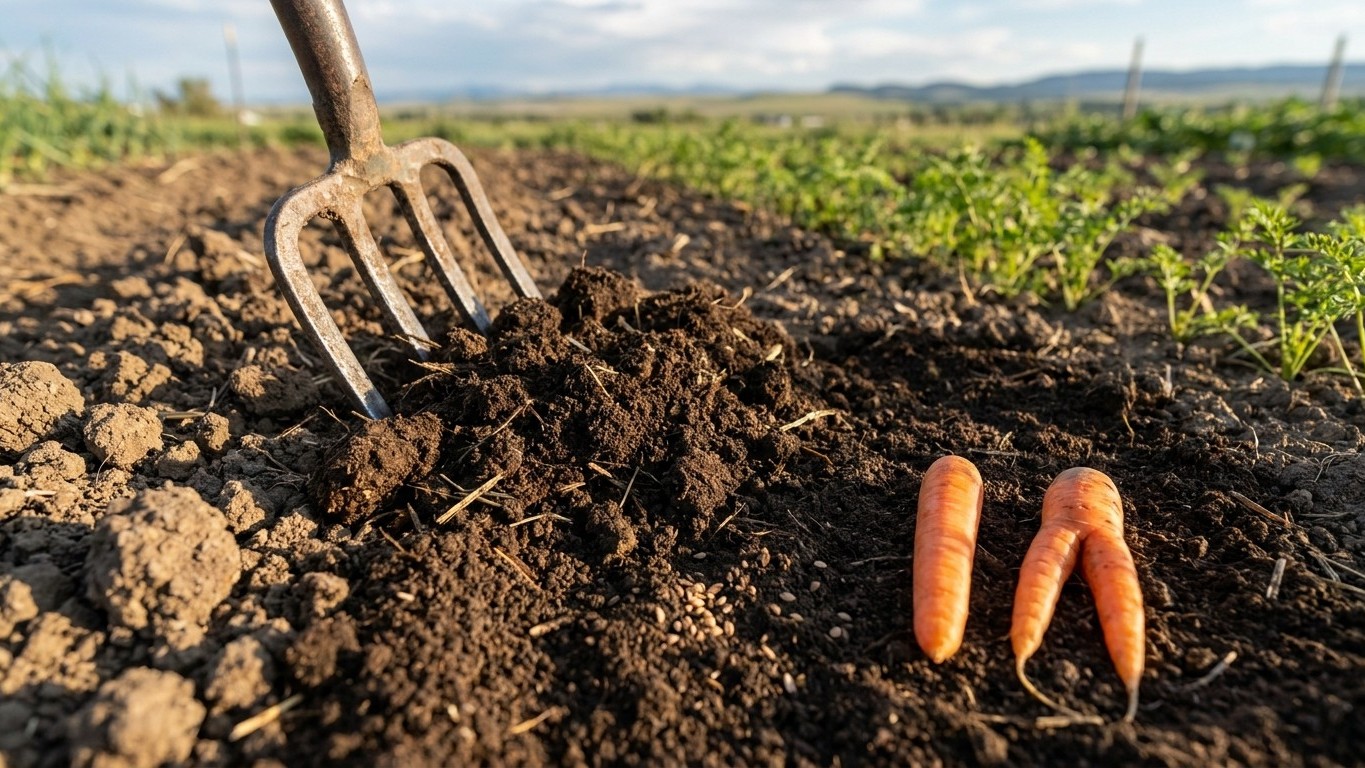
Carrots want the opposite of a heavy, imperfectly drained soil. Utah State University Extension is blunt about it: carrots need deep, sandy, well-drained soil rich in organic matter, and heavy or rocky ground makes the root fork, splitting into forked legs instead of growing straight down. That single sentence explains more damage to a Nova Scotia carrot bed than any insect this page could name without evidence. A garden sitting on the province’s typical imperfectly drained profile is set up for forking before a single pest ever gets involved.
So the honest inventory for this page is short by design: no named insect, one well-sourced soil mechanism, and a storage window that decides how much of the crop actually survives to the kitchen. A reader hunting for a specific bug by name should treat that gap as information, not an oversight, and take the question straight to a local extension office where pest scouting reports for the current season actually exist.
When each one shows up, and what it does first
Without a sourced pest calendar for the province, the timeline that matters here runs from seed to storage, not from one insect’s life cycle to the next. Carrots are sown directly in the ground, never transplanted, so every clock on this crop starts at seeding.
The first sign of trouble in a Podzol-type bed usually shows up underground, invisibly, long before harvest: as the taproot pushes down through a strongly acid, imperfectly drained layer, it meets resistance from compaction or from rock and clay pockets, and that’s when forking begins. There is no visible symptom above ground. A gardener only sees it at pulling time, when a straight carrot turns out to be two or three thin legs fused at the top.
Harvest itself falls in a fairly tight window: Clemson Cooperative Extension puts it at about 65 to 75 days after planting, and that window is where the second kind of loss starts, this one entirely about handling rather than soil. A carrot pulled with its leafy top still attached keeps drawing moisture out of the root for as long as that top stays on, which is why the clock on storage life starts ticking the moment the crop leaves the ground, not when it goes into the fridge.
From there, the sequence is simple and well documented: bunched carrots, tops still on, hold for about 10 to 14 days in storage. Trimmed carrots, tops cut off at pulling, last dramatically longer under the same cold, humid conditions. Nothing about that sequence depends on the month on the calendar or a frost date; it depends on what the gardener does with the tops within hours of harvest. That’s the one piece of this page’s timeline that’s fully sourced, and it matters more to the final yield than most insects would.
Telling the damage apart from everything else
A forked or oddly shaped carrot gets blamed on grubs more often than it should. The distinguishing test is simple: pull one carrot early and look at the texture and shape of the fork. A soil-caused fork splits cleanly into two or three root legs, usually where the taproot hit a stone, a clay lens, or a patch of compaction; there’s no tunnel, no frass, no soft brown channel through the flesh. A wound made by feeding leaves a hollowed track or a discolored channel, a different problem entirely, one this page’s verified facts don’t cover and one a local extension office can identify from a sample.
Wilting tops in the field get blamed on pests too, when the more common cause on this province’s imperfectly drained ground is simply excess or uneven moisture around the root zone. The soil’s own drainage class, imperfect, means water can sit longer around the root after rain than a gardener expects, and that alone can produce stress symptoms that look like something is attacking the plant when nothing is.
Storage failures are their own category and easy to misdiagnose as a field problem that followed the crop indoors. A carrot going soft, sprouting, or wilting within a few days of coming out of the crisper almost always traces back to temperature, not to anything that happened in the garden.
| Symptom | Likely cause | What settles it |
|---|---|---|
| Forked, split root | Compacted, rocky, or clay-heavy soil pocket | Dig near the fork; look for a stone or hardpan layer, not a tunnel |
| Wilting tops in the bed | Imperfect drainage holding water around roots | Check soil moisture a day after rain; no insect trail on pulled roots |
| Soft, limp storage roots within days | Storage held above 33°F | Check the storage temperature, not the crop |
| Bunched carrots wilting fast | Tops left on, still drawing moisture | Compare against trimmed carrots from the same harvest |
None of this replaces an actual look at a damaged root by someone trained to read it. A tunnel, a soft rot with a smell, or a sticky residue on the leaves are all reasons to bag a sample and take it to an extension office rather than guess from a symptom list online.
What actually works here, and what is a waste of time
Given the province’s typical soil, the highest-value fix has nothing to do with sprays and everything to do with the bed itself. Utah State University Extension’s advice for heavy ground applies directly to a Podzol running 10 percent clay and imperfect drainage: work in plenty of compost and double-dig the bed, or better yet, build a raised bed filled with a lighter, sandier mix. That single step does more to prevent forking than anything applied after the seed goes in.
The single biggest storage mistake is holding carrots anywhere near 50°F instead of the 33°F the crop actually needs, since that’s barely above freezing and far colder than most refrigerator crispers run without adjustment. A few degrees of difference there is the gap between carrots that hold for months and carrots that go soft in a couple of weeks.
Cutting the tops off at harvest, immediately, is free and is the difference between a 10 to 14 day shelf life and a much longer one. Leaving the tops on for a “fresher” look in storage does the opposite of what it seems to promise.
What’s a waste of time, based on what’s actually sourced here: guessing at an insect species and treating for it without a confirmed identification, since this page’s verified record names none for the province and a wrong guess wastes both money and a growing season. Adding sand to heavy soil without organic matter is another half-measure; texture and fertility both need correcting together, not one alone. And chasing a pest problem in storage when the real culprit is a few degrees of temperature just delays the actual fix.
Where to check this for your own county
The province’s soil data in this article comes from a national mapping survey, not a county-by-county pest report, and that gap matters. A single median pH of 5.2 across the mapped agricultural regions of Nova Scotia says nothing about one particular garden, since river bottoms, drained wetland, and any soil a builder has moved or filled can sit far outside that median. The same logic applies to pests: what’s documented at a provincial or national level doesn’t tell a gardener what’s actually feeding in their own rows this season.
A soil test remains the fastest way to settle the forking question for a specific bed, since it replaces a provincial median with an actual number from the reader’s own dirt. For anything that looks like insect damage rather than a soil problem, the right next step is a county or municipal agricultural resource office, or a provincial extension service, where a sample can be looked at directly and matched against what’s actually being reported in the area that season.
Pest presence inside one province varies as much as soil does between one field and the next, and a species active in one county’s carrot patch may be a non-issue two counties over. Treat any general pest guidance, including the absence of one on this page, as a starting point rather than a verdict on what’s in a specific garden, and let a local sample and a local office make the actual call.
Common questions
Does Nova Scotia have a published list of carrot pests?
Not in the verified record behind this page. No provincial service is named here as documenting specific insect pests on carrot for Nova Scotia, so none is listed as fact. A local extension office is the right place to ask for current-season pest reports.
Why do carrots fork in Nova Scotia gardens?
Forking traces mainly to soil texture and drainage. The province’s mapped agricultural soil runs 10 percent clay with imperfect drainage, and Utah State University Extension notes that heavy or rocky soil makes the taproot split rather than grow straight.
What temperature actually keeps carrots fresh in storage?
Clemson Cooperative Extension recommends 33°F with high humidity. That’s just above freezing, well below a typical refrigerator crisper drawer unless it’s specifically adjusted, and the gap explains most premature softening.
Should carrot tops stay on during storage?
No. Leaving the tops attached lets the leaves keep pulling moisture from the root, which is why bunched carrots with tops on hold for only about 10 to 14 days, versus a much longer window once the tops are trimmed off at harvest.