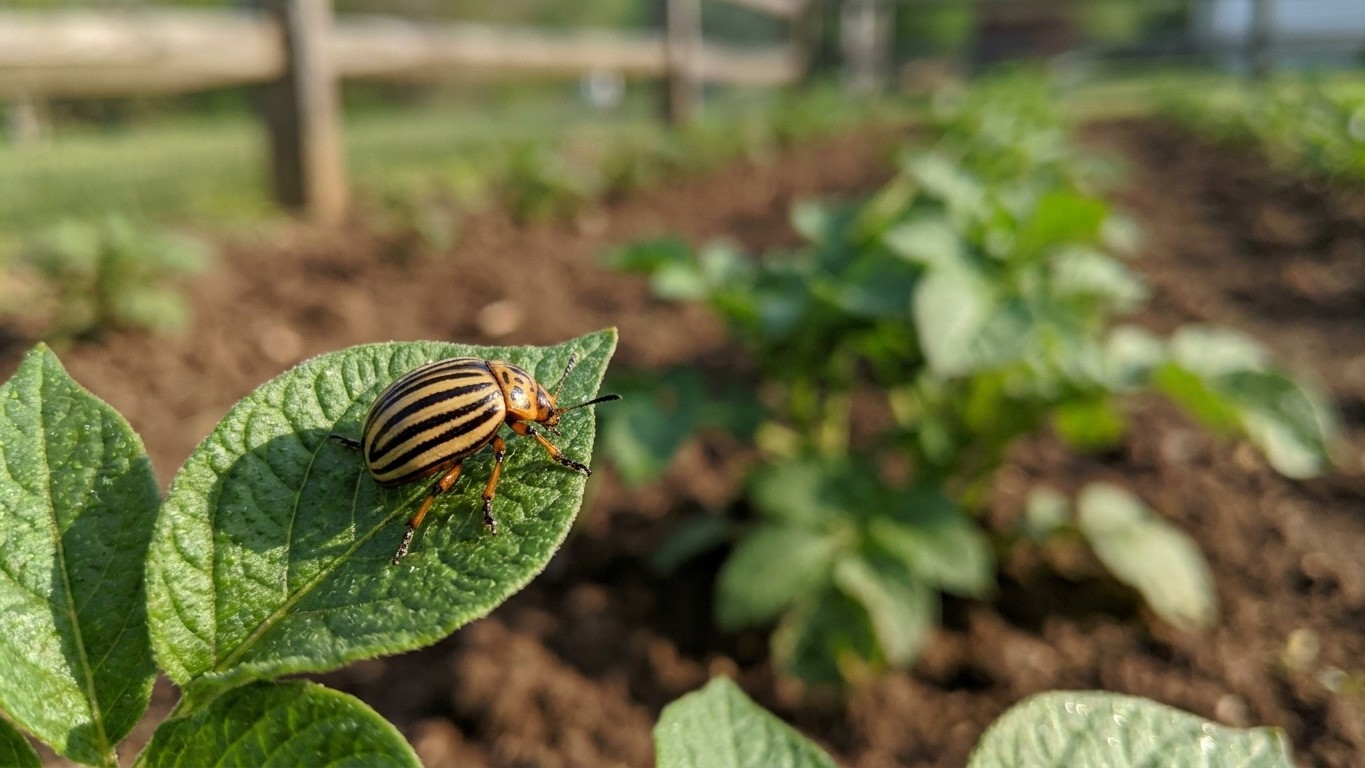

Colorado potato beetles show up in Pennsylvania gardens and farm fields as soon as soil temperatures climb past 50°F, which typically lands between late April and mid-May depending on the region. Once they arrive, they don’t leave quietly. The insects overwinter as adults buried a few inches underground, then crawl out hungry and ready to mate the moment the weather turns. What stops them isn’t a single product but a layered approach: crop rotation, physical barriers, targeted biological insecticides, and careful rotation of chemical modes of action, because this beetle has a well-documented habit of shrugging off pesticides that worked fine the year before.
When Colorado Potato Beetles Show Up in Pennsylvania
Timing follows soil temperature, not the calendar. In southeastern Pennsylvania, where soils warm faster, adults often emerge by the last week of April. Growers in the Laurel Highlands or the northern tier counties might not see activity until mid-May. Penn State Extension entomologists track this through degree-day models, but for a home gardener the simplest cue is watching when your potato or eggplant seedlings first push through the soil, because the beetles time their emergence to coincide with young host plants.
The state usually supports two full generations per season, sometimes a partial third in unusually warm years like several recent summers that pushed well into the 80s through September. The first generation of adults lays eggs in tight clusters on the undersides of leaves, typically 20 to 40 eggs per cluster, orange-yellow and easy to miss if you’re not flipping leaves regularly. Those eggs hatch in four to nine days depending on temperature, and the larvae that emerge do the real damage. A second wave of adults appears by mid to late summer, and those beetles are the ones that eventually burrow back into the soil for winter, sometimes traveling several hundred feet to find loose, well-drained ground near a fence line or garden edge.
Why Early Detection Matters More Than Late-Season Spraying
Spotting the first adults in April or early May and acting immediately prevents the population explosion that defines a bad beetle year. One overwintered female can lay upward of 300 to 500 eggs over her lifetime. Skip the first two weeks of scouting and you’re not managing a handful of beetles anymore, you’re managing their grandchildren.
Identifying the Beetle at Every Life Stage
Adults are hard to confuse with anything else feeding on potato foliage. They’re about 3/8 inch long, rounded, with a yellowish-orange body and ten black stripes running down the wing covers, which is exactly what the species name decemlineata refers to. The head has irregular black markings, and the whole insect has a slightly domed, ladybug-like shape but noticeably larger.
Larvae look nothing like the adults. They’re humpbacked, soft-bodied, and start out dark red before fading to a brick or salmon color as they grow, with two rows of black spots along each side. These larvae are the destructive stage: a single fourth-instar larva can eat several square inches of foliage before pupating, and a heavy infestation strips a potato patch down to bare stems within days. Eggs, as mentioned, are bright orange-yellow and glued in upright clusters, usually on the lower third of the plant where adults prefer to feed and mate.
Confusion sometimes happens with the false potato beetle, which looks nearly identical but has a pale stripe running down the center of its back that the true Colorado potato beetle lacks. It’s a minor pest by comparison and rarely requires control.
What Actually Stops Colorado Potato Beetles
No single tactic keeps this beetle in check for an entire season. Effective control in Pennsylvania combines cultural practices, biological tools, and, when needed, insecticides applied with resistance management in mind.
Cultural and Physical Controls
Crop rotation remains the cheapest and most reliable first line of defense. Because overwintered adults typically walk to the nearest host plant rather than fly long distances early in spring, moving your potato or eggplant bed even 100 to 200 feet from last year’s location can cut early infestation significantly. Rotating out of solanaceous crops (potatoes, eggplant, tomatoes, peppers) for at least one season on the same plot helps break the local population cycle.
Floating row covers placed over young plants at planting time block the first wave of walking adults, but they need to come off before flowering if the crop requires pollination, and any beetles trapped underneath after that point will feed unchecked. Straw mulch has shown some benefit too. Research from northeastern land-grant universities found that a thick straw mulch layer around potato plants can interfere with beetle movement and slightly reduce colonization compared to bare soil, likely because it disrupts the visual and chemical cues adults use to locate host plants.
Hand-picking adults and squashing egg clusters is tedious but genuinely effective on a garden scale. Checking plants every two to three days during peak emergence in May, and dropping any adults into a bucket of soapy water, keeps small plots manageable without any spray at all.
Biological Controls Worth Knowing
Several natural enemies help keep populations down, though rarely enough on their own to prevent damage in a dedicated potato patch. Spined soldier bugs and certain ground beetles prey on eggs and small larvae. Ladybird beetles occasionally feed on eggs as well. A parasitic tachinid fly, Myiopharus doryphorae, attacks larvae and adults in parts of the Northeast, though its impact varies year to year and isn’t something a grower can reliably count on.
The most practical biological tool for homeowners is Bacillus thuringiensis subspecies tenebrionis (sometimes labeled san diego), a naturally occurring bacterium formulated specifically for leaf beetles like this one. It works only against young larvae that ingest treated foliage, so timing matters: applying it once larvae have reached the later, larger instars is largely a waste of product. Spinosad, derived from soil bacteria, offers another option with a favorable safety profile for a home vegetable garden and reasonable effectiveness against both larvae and adults when applied at first sign of feeding.
The Resistance Problem
Colorado potato beetle has earned a reputation among entomologists as one of the most pesticide-resistant insects in North America. It was among the first insects documented to develop resistance to DDT back in the 1950s, and since then populations in various regions have shown reduced sensitivity to organophosphates, carbamates, pyrethroids, and even some neonicotinoids after repeated use. Pennsylvania State University’s Department of Entomology, which maintains ongoing research on regional beetle management, recommends rotating insecticide classes by mode of action group rather than relying on the same product family season after season, precisely because local populations can adapt within just a few years of consistent use.
For a home garden, that translates into a simple rule: don’t reach for the same spray bottle every single time. Alternating a Bt-based product, spinosad, and, if pressure is severe, a labeled synthetic option in a different chemical class gives the beetle less opportunity to build up tolerance on your specific property.
Building a Season-Long Management Plan
Scouting weekly from late April through early June catches the overwintered adults before they lay their first big batch of eggs. Checking again in July targets the second generation before it produces beetles that will overwinter and start the cycle over next spring. Removing volunteer potato plants that sprout from missed tubers, and clearing plant debris from the garden in fall, reduces both food sources and overwintering habitat right where beetles are most likely to settle in.
Vacuuming beetles off small plots with a handheld or shop vacuum has become a surprisingly common trick among market gardeners in the region, offering a fast, chemical-free way to knock down adult numbers on a warm morning when beetles are sluggish and easy to collect. It won’t replace a full management plan, but paired with rotation, mulch, and timely Bt applications, it closes one more gap the beetle might otherwise use to rebuild its numbers before the next generation gets started.