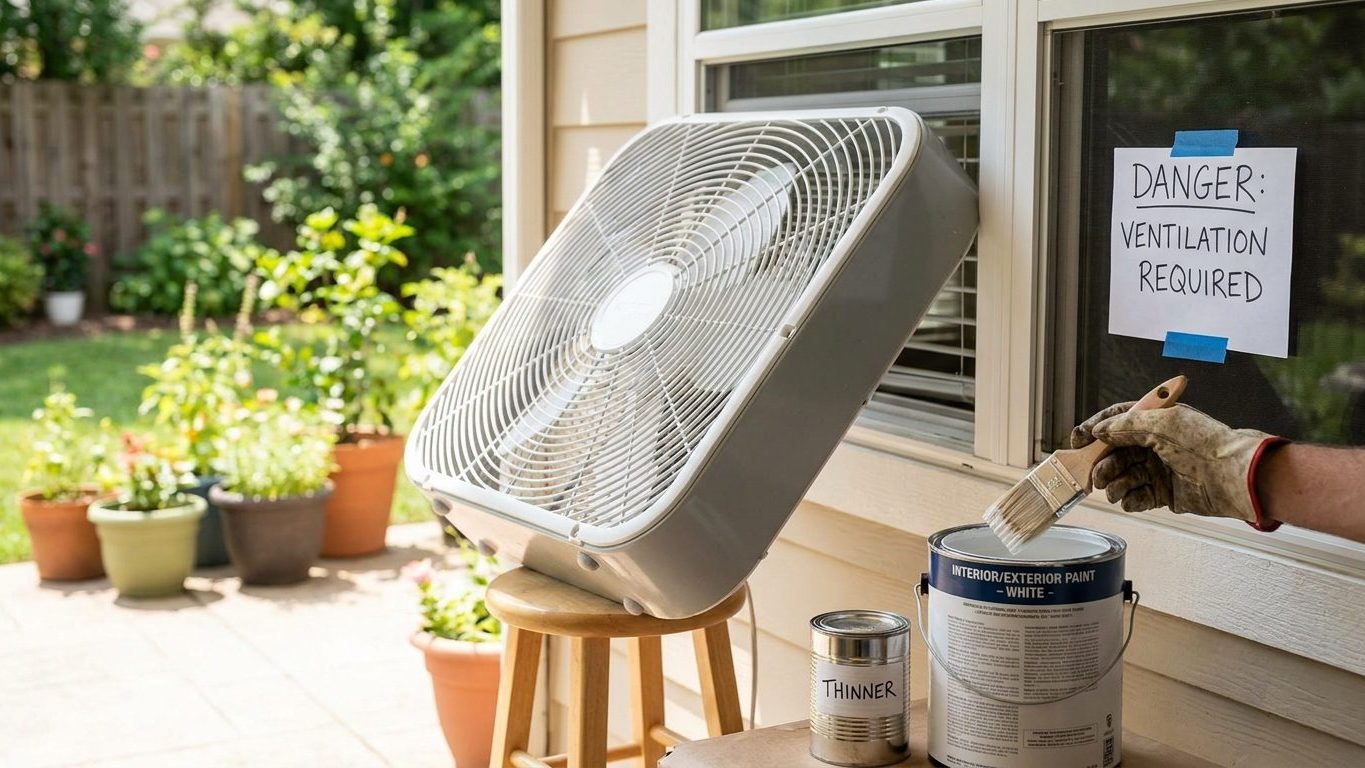

A closed bedroom door at the end of a paint job is how people end up back in that room a few hours later with a headache and no idea why. The paint didn’t cause that by drying, it caused it by sitting in still air while the solvents kept leaving the film with nowhere to go. Open two air paths on opposite sides of the room before you pry the lid, and keep air moving the entire time the paint is wet and for hours after you think the job is done.
What is actually going on

The smell of fresh paint is the least useful signal in the room. What matters is vapor accumulation: solvents and other volatile compounds evaporate out of the paint film as it dries, and in a closed room that vapor has nowhere to go. The concentration in the air keeps rising for hours after you stop rolling, not just while the roller is moving, because the wet film keeps releasing compounds long after the visible wet sheen disappears.
Water-based paints release less of this than oil-based or solvent-based coatings, but less is not none. A gallon of any interior paint puts a real load of volatile organic compounds into the air of the room it’s applied in, and a sealed room, especially a small bathroom or a bedroom with the door shut, can build that load to a level that causes headache, dizziness, nausea, or eye and throat irritation well before it smells overpowering to the person doing the painting. Children, older adults, anyone with asthma or another respiratory condition, and pets in the house are affected at lower concentrations than a healthy adult holding the roller, which is why the room needs to actually clear even if the painter feels fine standing in it.
Why this isn’t just a comfort issue
Ventilation while painting is not optional and it is not about making the room pleasant to work in. In an enclosed space with no airflow, solvent-based paints can also raise vapor concentration to a point where it becomes a fire risk near an open flame, a pilot light, or a spark, on top of the health risk. That risk drops sharply the moment air is actually moving through the room, which is a different thing from a window being open. A window open with nothing pushing or pulling air through it barely exchanges air at all in a still room.
Temperature and humidity change how fast that vapor leaves the paint film, not whether it needs to leave. Warm, dry air speeds evaporation off the surface, which can make the top of the film feel dry while solvent is still working its way up from underneath. Cool, humid air slows the whole process down, so the room holds vapor at a lower concentration for a longer stretch of time instead of a sharp spike. Either way the air in the room needs somewhere to go besides back into your lungs.
Many of the solvents used in oil-based and specialty paints are heavier than the surrounding air, so vapor from an open can left in a basement, crawlspace, or low-ceilinged room tends to pool near the floor rather than clearing on its own. That matters for anyone working low, kneeling to cut in a baseboard or painting a stair stringer, since the concentration at floor level can be higher than what you’d notice standing up.
Doing it
Proper ventilation means air actually moving through the room, in one opening and out another, not just a window cracked for fresh air. A single opening lets a little exchange happen right around the frame and leaves the rest of the room still. Cross-ventilation, one opening acting as an intake and another as an exhaust, is what actually clears a room.
| Step | What to do | What happens if you skip it |
|---|---|---|
| Set up the airflow first | Open two points on opposite or adjacent walls, one for air in and one for air out, and put a fan in one of them before opening the paint. | Without a real path through the room, air near the window barely exchanges and the rest of the room stays stagnant. |
| Keep it running while you work | Leave the fan and openings going for the whole time you’re applying paint, not just at the start. | Concentration climbs the moment airflow stops, even for a short break. |
| Handle a one-window room | Point a fan in the window blowing out, and crack the door to the rest of the house so replacement air has somewhere to come from. | One window with no fan and a closed door creates a sealed box with a single hole in it, which moves almost no air. |
| Keep ventilating between coats | Continue running the fan and openings through the recoat period, not just while the roller is in your hand. | The film keeps releasing vapor while it sets up, long after the visible work has stopped. |
| Don’t shut the room down at day’s end | Leave the ventilation running for a stretch after you finish, and don’t shut the door on a freshly painted room right away. | Closing the room right when you’re done traps the highest concentration of vapor against the most vulnerable, least-cured part of the job. |
| Watch for symptoms, not the clock | Stop and leave the room if you get a headache, feel lightheaded, or your eyes start stinging. | Pushing through symptoms in a small or poorly vented room raises exposure right when it’s telling you to back off. |
None of this requires special equipment. A box fan in a window, a second window or door cracked on the far side of the room, and the discipline to leave both running longer than feels necessary will move more air than any amount of waiting for the smell to fade. If the room shares forced-air heating or cooling with the rest of the house, close the vents to that room while you paint so the system doesn’t pull vapor into the ductwork and redistribute it elsewhere.
What it looks like when it goes wrong
Poor airflow doesn’t just make the room unpleasant to be in, it shows up in the finish. In a stagnant room, moisture and solvent stay close to the surface of the paint instead of clearing away, and on oil-based or specialty finishes that can produce blushing, a milky or cloudy haze across the dried film where the surface should be even and clear. Light blushing sometimes fades as the room finally airs out and the film keeps curing, but a bad case usually means sanding back and recoating the affected area once the airflow problem is fixed.
Stagnant, humid air also slows the film’s set-up time well beyond what a well-ventilated room would see, and a slow-setting film left sitting in still air collects dust, lint, and insects that land on it and stick. That’s a different problem than roller marks and stipple that show after drying, which come from application technique rather than airflow, but the two often turn up on the same wall when someone paints a closed room in a hurry. A light dusting of debris on an otherwise sound film can sometimes be knocked back with fine sanding once fully cured, then recoated. A film thick with embedded lint or insects usually has to be sanded back further or, in bad spots, scraped and redone.
The defect that can’t be sanded out
The one failure with no light fix is wrinkling, where a skin forms on the surface of the film while solvent is still trapped underneath, usually because the room was sealed up to speed drying with heat but no actual air exchange. The surface looks textured or crinkled rather than smooth, sometimes with a raised pattern. Wrinkled paint has to be removed down to a sound layer by mechanical sanding or scraping before recoating. There’s no light touch-up for it, because the defect is trapped underneath the surface you’re looking at, not sitting on top of it.
A room that still smells strongly of paint long after a well-ventilated room would have cleared is usually a sign that the film itself is holding solvent it never got the chance to release, not that the paint is unusually strong. Opening the room up properly at that point, rather than waiting it out with the door shut, is often what finally lets it finish curing evenly instead of staying soft and prone to marking under light pressure.
What to settle before you open the tin
Work out the airflow path before you touch the lid: which opening will be the intake, which will be the exhaust, and whether a fan needs to sit in one of them for the whole job. Sketch this out ahead of time if the room only has one exterior wall, since that’s the case where a fan paired with a cracked interior door matters most.
Check the weather for the day, since a storm that forces windows shut partway through a coat leaves you finishing in a sealed room. If the forecast makes reliable cross-ventilation impossible, move the job to a day when it isn’t.
Think about who else is in the house. Anyone with asthma, another respiratory condition, or who is pregnant, along with infants and pets, should stay out of the room while the paint is wet and while it’s airing out afterward, not just while the fan happens to be running.
If the surface you’re about to paint is on a building old enough that its paint history is unknown, and the job involves any sanding, scraping, or heat to prepare it, stop before you disturb that surface and find out whether it needs to be handled as a lead paint job first. That’s a separate set of precautions from ventilation and it has to be settled before work starts, not worked out mid-job.
Last, make sure the surface prep covered under interior painting preparation is finished, since ventilation only protects you during the parts of the job that come after it. Caulking gaps and cracks, covered separately in caulking the gaps that make a room look unfinished, should already be done and cured before you’re relying on airflow to carry off paint fumes instead of caulk odor and joint compound dust as well.
Common questions
Can I just run a fan and leave the windows closed?
No, a fan without an actual air path in and out mostly recirculates the same air around the room. It needs somewhere to pull fresh air from and somewhere to push the vapor-laden air out to, which means at least one opening in addition to the fan.
Is latex paint safe to use without any ventilation?
Water-based paint releases fewer volatile compounds than oil-based paint, but it isn’t free of them, and a sealed room still lets that lower level build up over time. Use the same cross-ventilation approach, just know the margin for a small lapse is bigger than it is with an oil-based product.
How do I know when it’s safe to close the room back up?
Go by your senses and the film, not the clock. If there’s still any paint odor, or the surface still feels soft or tacky rather than firm, the room needs more time with air moving through it, since a film that looks dry can still be releasing vapor underneath.
Do I need a respirator for a normal indoor paint job?
For a well-ventilated room with standard interior paint, most people don’t need one, since the ventilation itself is what’s controlling exposure. If you’re spraying instead of rolling, working in a room you can’t ventilate well, or sanding old paint, that changes the equation and a properly rated respirator becomes worth having on hand.