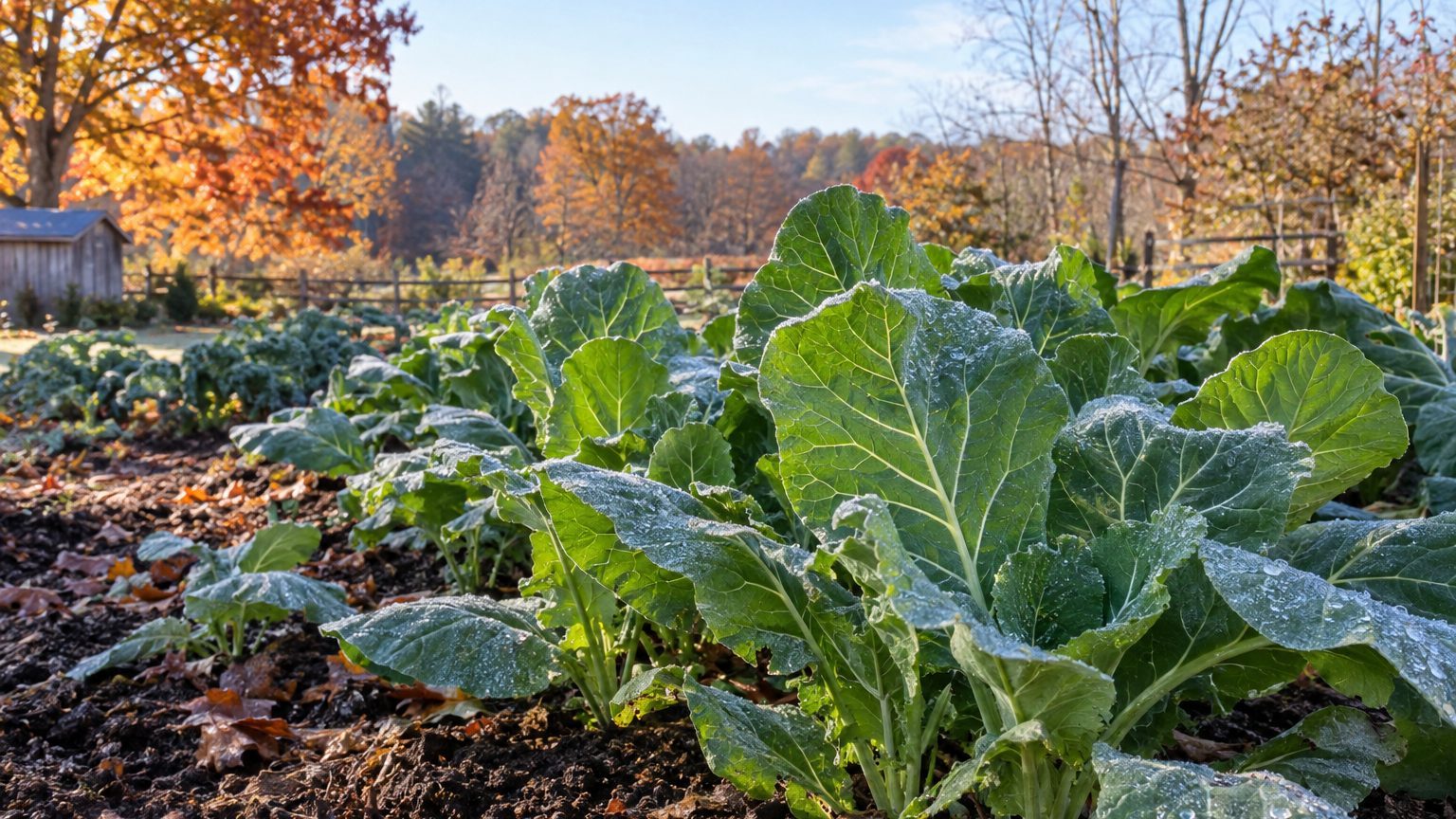

In Anchorage, the window for direct sowing or transplanting collards outside runs from May 12 through late summer, bounded by a last spring frost that lands May 3 to May 12 and a first fall frost arriving September 22 to October 1. That gives roughly 143 frost-free days to grow a crop that most varieties finish in 55 to 75 days from transplant, which is tight but workable if you start early indoors.
The short answer for Alaska
Those frost dates are not a guarantee. They come from NOAA’s 1991-2020 climate normals for station USW00026451, built on a 30 to 70 percent probability band for a 32°F freeze. A May 3 frost is plausible on the early end of that window, and a frost risk lingering past May 12 is equally plausible on the late end. What the dates tell you is when the odds tip in your favor, not when the risk disappears entirely.
For collards, that means treating the last-frost window as a starting line for transplants, not for seed. Start seed indoors four to six weeks before your target set-out date, so you are moving four-to-six-inch seedlings into the garden right around when frost risk drops, rather than sowing bare seed into cold soil and waiting on it to sprout. Direct sowing works too, but it costs you two to three weeks that this climate does not have to spare.
On the back end, count backward from the first fall frost. A collard variety listed at 60 days to maturity needs those 60 days completed before the September 22 to October 1 window opens, plus a buffer, since collards slow down as daylight and soil temperature drop through September. Anchorage’s roughly 143 frost-free days sound short next to a Southern growing season, but the region compensates with nearly 19 hours of daylight around the summer solstice, which pushes growth rates that a shorter, darker season elsewhere would not support.
The practical sowing calendar, then, looks like this: seed indoors in early to mid-April, harden off seedlings in the last two weeks before your local frost-free date, and transplant as soon as that date arrives in your specific spot. Successive sowings for a fall crop should stop by early July, giving even a 75-day variety enough runway to finish before frost shuts the season down. This is the Anchorage-area calendar specifically. Other parts of the state run on an entirely different clock, which the next section gets into.
What will not work here

Slow, old-style collard varieties bred for a long Southern season are the first casualty here. A variety that needs 85 days from transplant to first harvest, sown right at the May frost-free date, is asking to finish around the second week of August in ideal conditions, but any cool stretch or cloudy week pushes that into September, right as the first fall frost becomes a real threat. In a region with 143 frost-free days, an 85-day variety leaves almost no margin for a rough patch of weather, and Southcentral Alaska gets those.
Direct-sowing a fall succession too late is the second failure mode. Waiting until mid-July to try a second round of seed, the way a gardener in a longer-season state might, does not work in Anchorage. Seed sown that late needs to germinate, establish, and bulk up before the light and heat start dropping off in late August, and the arithmetic simply does not close before the September 22 frost window opens. The fix is to have that second sowing in the ground by early July at the latest, not mid-summer.
Treating collards as a plant that overwinters in the ground outdoors also fails here. The coldest month’s average daily minimum sits at 11.0°F, well below what an unprotected collard plant survives. Some Southern growers leave collards standing through a mild winter for a sweeter post-frost harvest; that approach does not translate to a place where the coldest month’s typical low is in the low teens. Anything left in open ground past the first hard freezes of October is not coming back.
Finally, assuming this calendar applies statewide is its own kind of failure, and it is the subject of the next section.
What changes across Alaska
Alaska’s USDA hardiness zone range spans 1a to 8a, one of the widest spreads of any state, and that range is built on average annual extreme minimum temperatures, not on season length directly, but the two track closely enough to matter for a sowing calendar. A gardener at the milder end of that range, in parts of the southeast coast, is working with a longer frost-free season and can likely push both the spring sowing date earlier and the fall harvest window later than an Anchorage calendar assumes. A gardener toward the colder end, across much of the Interior and the north, is working with a season that can be weeks shorter on both ends, sometimes compressed into two or three summer months.
This is not a case where one adjustment fits the whole state. The Anchorage-area dates in this article come from a single reference station and describe conditions typical of one of the mildest inhabited parts of Alaska. A reader gardening in the Interior, where winters run colder and the frost-free window opens later and closes earlier, needs to shift the entire calendar later in spring and earlier in fall, likely relying on cold frames, high tunnels, or transplants started even further ahead indoors to make a harvest possible at all.
Rather than guess at that adjustment from a state-level average, check the USDA Plant Hardiness Zone Map for the specific zone at your address. The map is built for exactly this problem: a state fact that is true nowhere in particular and a garden that needs a number specific to its own coordinates. Look up the zone, note the difference between that zone and Anchorage’s milder position on the 1a-to-8a range, and adjust the calendar above accordingly, later for a colder zone, potentially earlier for a milder coastal one.
Where to check this for your own county
The Anchorage frost dates and hardiness range in this article describe the state broadly, using one reference station. Your county is very likely different, sometimes by a matter of days, sometimes by a matter of weeks. The University of Alaska Fairbanks Cooperative Extension Service maintains the state’s land-grant extension program, and its site at https://www.uaf.edu/ces/ is the place to find a planting calendar built for your district office rather than for the Anchorage station used here.
When you get there, look specifically for two things. First, a district-level or regional planting calendar, since UAF Cooperative Extension operates offices across the state and typically publishes guidance broken out by region rather than a single statewide date. Second, look for any list of collard or leafy green varieties that local extension agents have trialled in your area. A variety that performs well in Southcentral trials is not automatically the right pick for the Interior or the Southeast panhandle, and county-level or district-level trial data reflects actual local performance in a way a statewide article cannot.
A county or district recommendation from a Cooperative Extension office beats a state-level page every time, because it accounts for local soil, local microclimate, and local frost behavior that a single reference station cannot capture. This page is the state-level version. Treat it as a starting framework, then let your district extension office’s specific dates and variety lists override anything here that conflicts with what they publish.
Some gardeners also time this by the Moon: when to plant collard greens by the moon, as almanac tradition rather than fact.
Checking this against your own garden
Every date in this article comes from historical averages, and averages miss the particular patch of ground you are actually planting into. Three direct observations will tell you more about your own microclimate than any calendar.
Feel the soil before you trust the calendar date. Push a finger two to three inches into the bed where you plan to transplant; if it feels cold and damp rather than merely cool, the soil has not warmed enough yet, regardless of what the frost-free date says, and collard roots will sit and sulk rather than grow. A bed in full sun against a south-facing wall often warms a full week or two ahead of an open, shaded plot even in the same yard.
Watch for the first true leaves after germination or transplant shock. Seedlings that push out true leaves (the second set, shaped like miniature collard leaves rather than the rounded first seed leaves) within a week or two of transplanting are growing on schedule; a longer stall suggests the soil or air is still too cold for that particular spot, a signal worth noting for next year’s timing.
Late in the season, watch for the first flush of flower stalks, or bolting. Collards that bolt early are usually responding to a hot spell or root stress, both of which point to a spot with less soil moisture retention or more heat exposure than the rest of the garden. A plant that bolts a full month ahead of its neighbors is telling you something specific about that one corner of the yard, information no regional sowing calendar can give you.