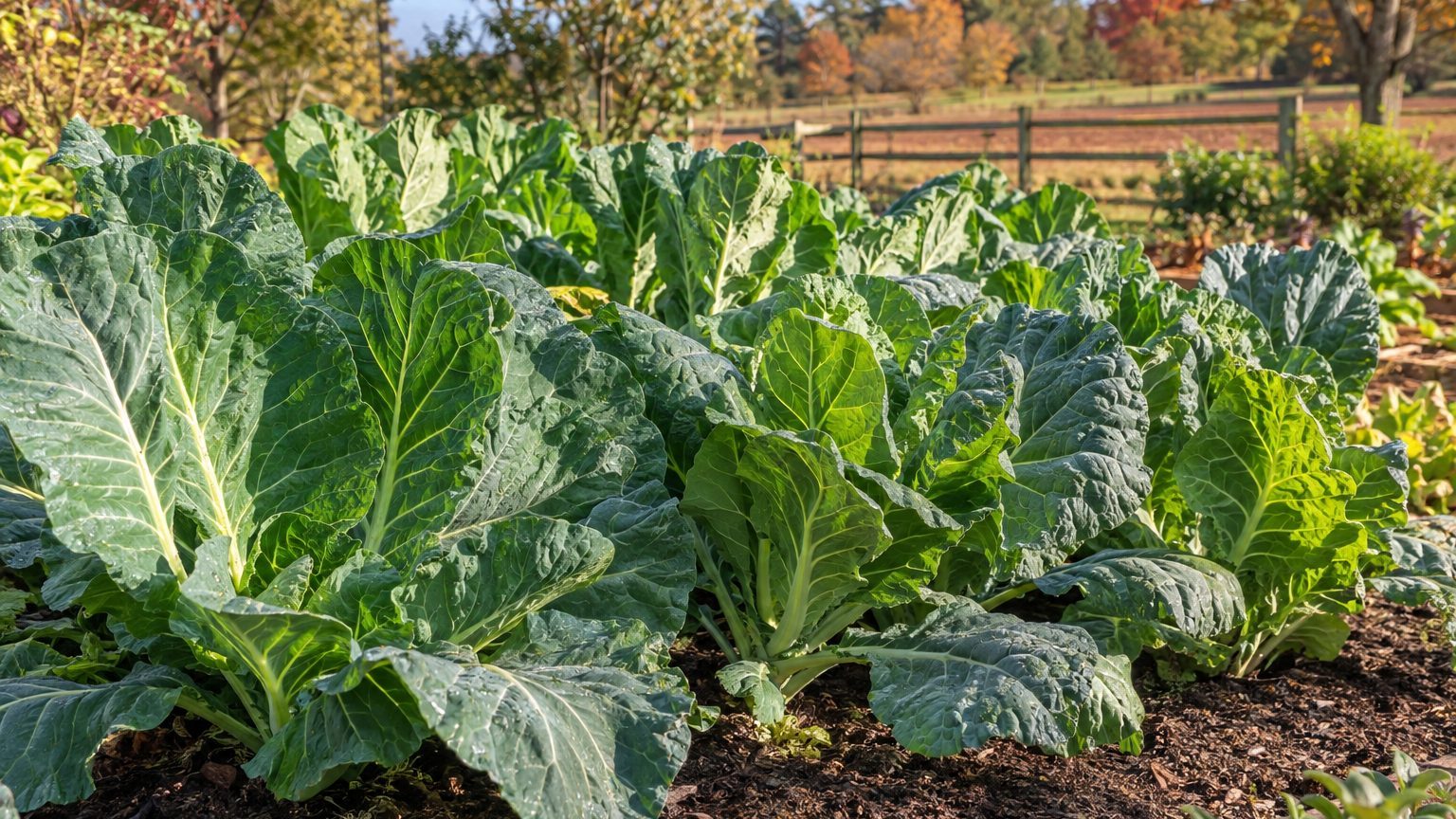

British Columbia’s coastal gardens run mild and long: a frost-free window that stretches from mid-March to mid-November, paired with a winter that rarely drops much below freezing on average. That combination favors slow, large-framed heirloom collards worth cutting from for months, plus a handful of cold-hardy kales and mustards built for damp, mild winters rather than the quick dwarf hybrids suited to harsher, shorter seasons elsewhere.
The short answer for British Columbia
The mean frost-free window at Vancouver International Airport, the province’s reference climate station, runs from March 18 to November 10, 237 days between the average last spring frost and the average first fall frost. That’s a long season by Canadian standards, paired with a mild winter: the coldest month here averages a daily minimum of just 0.8°C, placing the reference city in Canadian hardiness zone 9a. Those two figures together point to one clear strategy: choose the slower, larger-framed collards that need real time to size up, not the fast dwarf types bred for regions where the season slams shut early.
Open-pollinated heading types like Georgia Southern and Morris Heading were selected for exactly this kind of long, cool-leaning growing stretch. They take longer to bulk up than compact dwarf varieties, but a 237-day window gives them room to do it, and the region’s mild autumn means outer leaves can keep coming well past the point where a shorter-season garden would already be shut down by frost. Compact types such as Vates or Champion still earn a spot here, especially in small raised beds or containers where a sprawling heading plant doesn’t fit, but they aren’t a necessity the way they are in a province with a six-week growing window instead of an eight-month one.
| Variety type | Growth habit | Fit for coastal BC’s season |
|---|---|---|
| Heirloom heading types (Georgia Southern, Morris Heading) | Large, upright, slow to mature | Best match, since the season is long enough to let them fill out fully |
| Dwarf/compact types (Vates, Champion) | Low, tight rosette | Good for small beds; matures with plenty of season to spare |
| Fast hybrid types bred for short seasons | Quick to bulk, quick to bolt | Wastes the extra weeks the region actually offers |
Mustard and turnip greens, and cold-hardy kales, round out the picture for readers who want variety beyond collards proper. What all three share with a good collard variety here is cold tolerance that carries a planting into the mild BC winter, which matters more on this coast than the heat tolerance that dominates decisions further inland or further south.
What will not work here

The single biggest trap on this page is treating March 18 as a safe sow-outside date. It isn’t. It’s a mean, calculated from decades of records at Vancouver International Airport, which means in roughly half of those years the last frost fell later than that date, sometimes by weeks. A gardener who directly sows tender seedlings the week of March 18 without any protection is betting on the better half of that split. What actually fails here isn’t the collard plant itself, since mature collards shrug off a light frost fine, it’s newly germinated seedlings or fresh transplants set out right at the mean date, in a year that happens to land on the late side of it.
The same trap runs in reverse come fall. The mean first frost is November 10, but the coldest month here still only averages a minimum of 0.8°C, barely below freezing on the coldest days of an average winter. Gardeners who pull their collards the moment a fall frost warning shows up in the forecast, treating that mean date like a hard closing bell, are walking away from weeks of usable harvest in a climate mild enough that hardy greens often keep producing leaves well past November 10, especially under even light row cover.
Fast hybrid varieties bred for regions with a short window and an early hard freeze don’t fail outright on this coast, but they underperform. They’re built to rush to a harvestable size before conditions turn, and in a 237-day season with a mild winter behind it, that speed buys nothing while often costing flavor and leaf size compared to a slower heading type given the same stretch of time to grow. A variety chosen purely for heat tolerance is solving a problem this coastal climate doesn’t especially have, at the expense of the cold hardiness that actually decides how a planting fares through a wet winter here.
Close spacing sized for a drier, less humid garden struggles on this coast too, where persistent damp air favors fungal leaf spot on crowded plants no matter which variety is in the ground.
What changes across British Columbia
Every figure in this page’s first section, the March 18 frost date, the November 10 frost date, the 9a hardiness zone, describes one place: Vancouver International Airport, on the mild south coast. British Columbia is not one climate, and treating that reference station as a stand-in for the whole province is the fastest way to lose a planting to a frost the coast itself never sees.
Move away from the immediate coast, up the Fraser Valley, into the southern interior, or north toward Prince George, and the picture changes fast. Elevation and distance from the moderating ocean both push the last spring frost later and the first fall frost earlier, shrinking that 237-day window from the coast in ways a page built on a single station has no way to quantify for any specific inland town. The Canadian hardiness zone drops too, in places by several full zone numbers, which matters directly for whether an overwintered collard planting can limp through the cold season outdoors or needs to be finished and cleared before winter arrives. The Canadian zone system also factors in more than minimum temperature alone, including snow cover and wind, so two towns with a similar winter low can still land in different zones.
None of this makes the coastal numbers wrong. It makes them local. A reader gardening within a few miles of Vancouver, Victoria, or the immediate Fraser delta is working close to the conditions described here. A reader in Kelowna, Kamloops, the Kootenays, or anywhere north of Prince George is gardening a materially colder, shorter season, and should treat every date on this page as a coastal reference point to adjust from, not a number to copy directly. Check the province’s plant hardiness map for the zone that actually applies to a specific address before choosing a variety on the strength of this page alone.
Where to check this for your own county
BC’s Ministry of Agriculture and Food publishes provincial growing guidance directly, and it’s the next stop for anyone gardening outside the immediate Vancouver area: https://www2.gov.bc.ca/gov/content/industry/agriculture-seafood. This page draws its numbers from a single climate station and a single reference city, and provincial guidance built from BC’s own agriculture ministry reflects local trial data in a way a single-station page never can.
Look for two things once there: a regional or seasonal planting calendar, which adjusts the dates on this page for a specific area of the province rather than the coastal reference station alone, and any list of varieties actually trialled by the ministry or by regional agricultural programs across BC’s growing areas. A variety recommended after local trials in the Okanagan or the Fraser Valley carries more weight for a reader there than a general heirloom-versus-hybrid call made from provincial averages alone.
Local seed companies and farm co-ops operating in BC often carry that same trial knowledge informally, through catalog notes on which collard and kale varieties have actually performed in coastal versus interior conditions. That’s not a substitute for the ministry’s own guidance, but it’s a useful cross-check, especially in years when trial data hasn’t caught up with a newer variety on the market.
The rule holds the way it does anywhere: a recommendation built from one region beats a recommendation built from a whole province, and a recommendation built from a whole province beats one built from a single reference city on the far side of it. This page is the provincial layer, a starting point rather than a final answer for any one garden.
Checking this against your own garden
Every date on this page is an average pulled from decades of records at one airport. A reader’s own soil, seedlings, and plants will always outrank it, and three simple checks confirm what’s actually happening in a specific yard.
Start with the soil itself. Grab a handful from where the collards will go and squeeze it. Cold, wet soil that clumps into a sticky ball rather than crumbling apart means the ground hasn’t caught up to the calendar yet, regardless of whether March 18 has come and gone. Soil that’s warmer and breaks apart readily is the actual green light, whether that arrives weeks before or after the mean date depending on that particular spot’s sun exposure and drainage.
Next, watch the seedlings rather than the sowing date. Cotyledons, the first rounded leaves that emerge from the seed, don’t say much on their own; wait for the first true leaves, the crinkled, distinctly collard-shaped growth that follows, before thinning or transplanting. How fast they show up, quicker in a warm spring, slower in a cool one, is a direct read on how the current season is actually running in that spot, independent of any provincial average.
Last, watch for a central flower stalk starting to elongate on any overwintered plants in late winter. That’s the plant declaring its own season is ending, and it does it on its own schedule, driven by that garden’s specific microclimate rather than by the November 10 or March 18 dates published here. A stalk that shows up earlier or later than expected is useful information for next year’s planting, in a way no single reference station three time zones away can ever provide for one particular address.