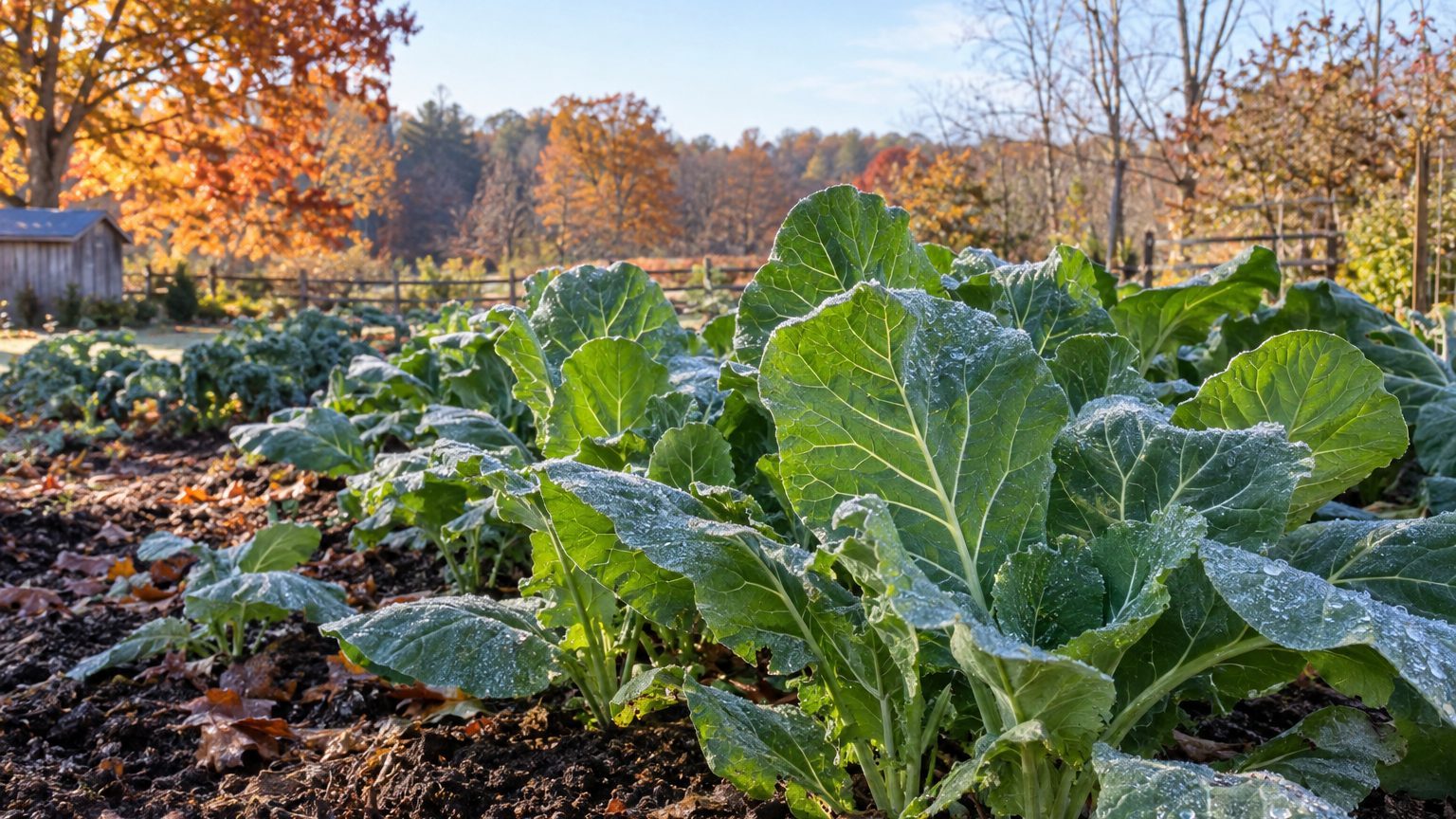

The short answer: in Connecticut, the most reliable window for collards is a direct-seeded fall crop sown from mid-July through mid-August, timed against the region’s first fall frost. Spring plantings work too, but they run a tighter, riskier calendar tied to a slower-arriving thaw.
The short answer for Connecticut
Connecticut’s first fall frost lands between October 28 and November 10, based on 30-70% freeze-probability normals from NOAA’s 1991-2020 data at the Bridgeport station. Counting backward from that window gives collards enough time to reach usable leaf size (collards typically need 55 to 85 days depending on the variety) if seed goes in the ground before the soil cools too far. That’s the logic behind sowing collard seeds outdoors between July 15 and August 15 for a fall harvest that runs right up to, and past, that first frost.
A spring planting is possible too, but it has to work around the state’s last spring frost, which falls between April 2 and April 12 at the same coastal reference station. Collards tolerate a light frost better than most greens, so gardeners often direct-seed or set transplants two to three weeks before that date rather than after it, banking on the crop’s own cold tolerance to cover the gap. The spring window is shorter and less forgiving than the fall one, mostly because soil temperature, not air temperature, decides when seed actually germinates, and Connecticut’s clay-heavy inland soils warm more slowly than the coast suggests.
Both frost dates come from a single coastal station, Bridgeport, sitting on Long Island Sound. That matters more than it sounds like it should. Bridgeport is the mildest reporting point in the state, so its frost dates describe the best-case scenario for Connecticut, not the average one. Anyone gardening away from the coast is working with a shorter frost-free season than these numbers imply, a point worth carrying into every other section of this page.
Nothing here should be read as a guarantee. A 30-70% freeze probability window means exactly what it says: there’s meaningful chance of a damaging freeze on either side of those dates, not a hard boundary. Treat mid-July to mid-August as the working target for a fall crop, and treat the first two weeks of April as the outer edge for spring seeding near the coast, with the understanding that both numbers are drawn from the mildest corner of the state.
What will not work here

The single biggest miscalculation gardeners make with collards in Connecticut is sowing a slow variety too late in the fall window and expecting it to outrun the frost. If seed goes in the ground on August 15 and the first freeze lands on October 28 in an early year, that’s roughly 74 days of growing time. An 85-day variety sown at the tail end of that window simply will not finish before a hard freeze knocks it back. Choosing a variety matched to the days actually available matters more here than in states with a longer fall shoulder season; the The Best Collards and Greens for Connecticut page breaks down which types finish fast enough for a late sowing and which need the earlier end of the window.
The second failure mode runs the other direction: treating collards as a plant-it-once-and-forget crop through a Connecticut winter. The mean daily minimum temperature in the coldest month here is 24.4°F, a figure from NOAA’s 1991-2020 normals that reflects the typical overnight low, not a rare record cold snap. Collards can shrug off an isolated light frost and even taste better for it, but a sustained run of nights near 24.4°F without any row cover or mulch will eventually kill unprotected plants outright. Gardeners who leave a fall crop in the ground expecting a slow winter harvest into January, without any protection, are usually disappointed by early-to-mid December.
A third mismatch shows up with spring sowing pushed too early. Connecticut’s clay and loam soils, especially inland, hold cold and wet longer than the calendar date suggests. Seed dropped into soil that’s still cold and saturated in mid-March, chasing an “early start,” tends to rot or germinate unevenly rather than get ahead of the season. The fix isn’t a earlier date on a page like this one; it’s waiting for the soil itself to signal readiness, which the last section of this page covers directly.
Finally, close spacing paired with a humid Connecticut fall is a reliable way to invite fungal leaf disease on a crop that’s otherwise easygoing. The state’s autumn air holds more moisture than its summer does, and tightly packed collard rows trap that moisture against the leaves overnight. Wider spacing than the seed packet’s minimum, especially on a fall planting, costs nothing and heads off a problem that shows up as blackened, spotted leaves right when the crop should be at its best.
What changes across Connecticut
Connecticut is not one climate, and the USDA Plant Hardiness Zone Map (2023 update, built on 1991-2020 normals) makes that explicit: the state spans zone 6a to 7b. That’s a meaningful spread for a state this size, and it exists mainly because of two things working against each other: the warming effect of Long Island Sound along the coast, and elevation gain moving into the northwest hills and the Litchfield Hills uplands. A single sowing date printed for “Connecticut” is, by definition, describing one end of that range and not the other.
The frost dates and coldest-month figure cited in the sections above come from Bridgeport, a coastal station, which sits at the milder end of that 6a-7b spread. Gardeners in the northwest corner of the state, or at any real elevation, are working with a shorter frost-free season on both ends: spring frost lingers later into April than the coastal date suggests, and fall frost can arrive noticeably ahead of the October 28 to November 10 window. In practical terms, that means shifting the fall sowing window earlier, not later, if the goal is to finish the crop before frost rather than race it.
There’s no single number that captures how much to shift, because the range itself, 6a to 7b, spans roughly a two-zone difference across the state, and hardiness zones aren’t a linear stand-in for frost dates anyway; they measure extreme winter minimums, not the timing of the first and last freeze. The honest answer is that a reader in the northwest hills should treat the coastal dates on this page as a starting point to move earlier, not a number to copy directly. How much earlier depends on local elevation and microclimate more than on anything a statewide page can specify.
This is exactly the kind of variation a reader needs to place themselves within, rather than guess at from a state-level article. The next section points to where that placement actually happens.
Where to check this for your own county
The University of Connecticut’s Cooperative Extension System, part of the USDA’s land-grant university network, is the right next stop, and it’s reachable at https://extension.uconn.edu/. This page has deliberately stayed at the state level, using the mildest coastal station’s data as its reference point. A county-level extension office works from local trial data and local frost records, which is a genuinely different, and more reliable, source of guidance than anything a statewide article can offer.
Two things are worth looking for once there. First, a local or county-specific planting calendar, if the extension office publishes one, since it will reflect the actual frost timing for that part of the state rather than the coastal Bridgeport figures used above. Second, any list of collard or Southern greens varieties that UConn Extension has trialled in Connecticut conditions specifically, since a variety that performs well in a Georgia trial garden doesn’t automatically perform the same way against a Connecticut fall.
A county recommendation beats a state one every time, because it accounts for the elevation, soil, and microclimate variation this page can only describe in general terms. Nothing here should be read as a substitute for that local guidance. Think of this page as the wide-angle version, useful for understanding the mechanics of frost dates and hardiness zones, but not the final word on any single garden’s calendar.
For gardeners who want the deeper mechanics behind the numbers used throughout this page, the broader Growing Collards in Connecticut guide covers soil preparation, spacing, and season-long care in more depth than a sowing calendar alone can.
Some gardeners also time this by the Moon: when to plant collard greens by the moon, as almanac tradition rather than fact.
Checking this against your own garden
Every date on this page is a regional average built from a single coastal weather station. A gardener’s own observations, checked against their specific plot, will beat any calendar printed here, because they’re measuring the actual microclimate the seed is going into.
The first check is soil warmth, felt rather than measured. Cold, clammy soil that still feels like early spring, even in April, is a sign the ground hasn’t caught up to the calendar yet; collard seed sown into that soil tends to sit and rot rather than germinate. Waiting until the soil feels closer to room temperature at a two-inch depth is a better signal than any printed date, especially inland where clay holds cold longer than the coastal frost dates imply.
The second check is the first true leaf pair. Collard seedlings emerge with two small, rounded seed leaves first, and the true leaves that follow, with the ridged shape collards are known for, are the sign the plant has moved past its most fragile stage. That’s the point where thinning or transplanting can happen with less risk of losing the seedling to a stray cold night.
The third signal to watch for is the first leaf touched by frost, since collards genuinely sweeten after a light freeze rather than decline. A garden that hits a light frost in late September, well ahead of the coastal window’s late-October start, is telling its owner something useful: that particular plot runs colder than the regional average, and next year’s sowing should move earlier to match it.