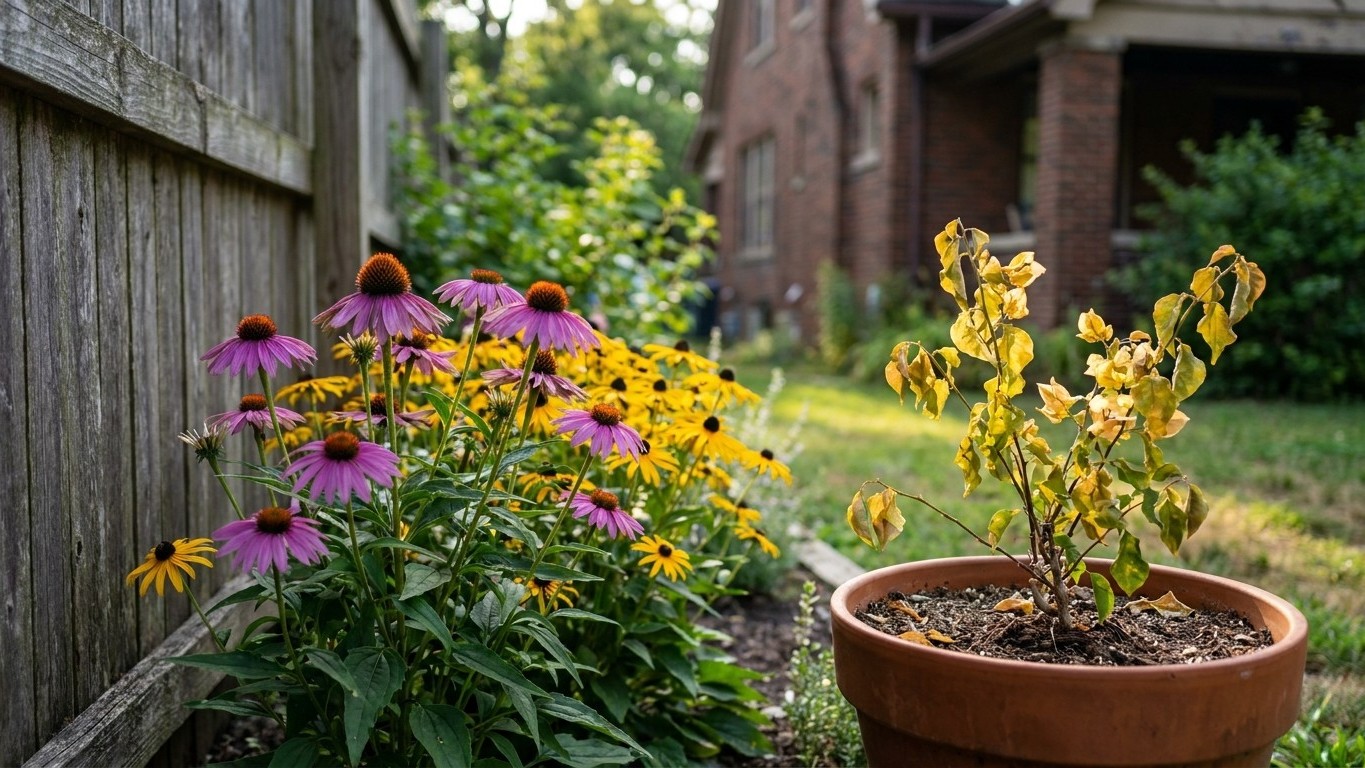

Flowers that thrive in Ohio are the ones built for both ends of the state’s climate: cold winters rated at USDA zones 5b to 6b, and humid summers that average 15.3 days a year above 90F at the Columbus reference station, according to NOAA’s 1991-2020 climate normals. Coneflower, black-eyed Susan, daylily, garden phlox and sedum handle both extremes across nearly every county. Before you buy anything, check the hardiness zone printed on the plant tag against your own county, since a perennial rated for zone 7 or warmer is not built to survive a typical Ohio winter.
What thrives in Ohio

Coneflower, Russian sage and catmint pull through an Ohio summer without sulking; hydrangeas and delicate bedding annuals often don’t. That split comes down to clay soil, a wet spring followed by a dry August, and roughly 15 days a year at or above 90F with humidity riding along. The plants that last here store energy underground or carry tough, narrow, oil-rich leaves that shed moisture instead of trapping it against the stem.
Summer brings the opposite test. Columbus averages 15.3 days a year at or above 90F, per the same NOAA NCEI normals, and humidity rides along with the heat across most of the state. Flowers that collapse in mid-July are usually failing on humidity and root rot as much as on raw temperature. Look for foliage that stays upright and dry-looking in heat, like the narrow, silvery leaves of Russian sage (Perovskia atriplicifolia) or the tough, deeply lobed leaves of coneflower, rather than broad, soft leaves that trap moisture against the stem and invite fungal disease.
The families that carry these traits
Three plant families supply most of what does well here. The daisy family, Asteraceae, gives Ohio gardeners coneflower, black-eyed Susan, aster and Shasta daisy, all of which tolerate heat, drought and clay soil without complaint. The mint family, Lamiaceae, gives salvia, catmint and bee balm, and its aromatic, oil-rich foliage shrugs off both humidity and the deer that eat everything else. The iris and lily relatives store energy in bulbs or rhizomes underground, which lets them come back from a hard freeze without any special protection.
Drought tolerance matters more than gardeners expect in a state that gets regular summer rain, because a wet spring followed by a dry August is a common pattern in Ohio, and a plant bred for constant moisture struggles with that swing even in a state that is not classically dry. Gardeners in the state’s warmer southern counties can push the calendar and plant palette further than those near Lake Erie, where cold air pools longer into spring and frost lingers. If you garden outside the Columbus area, treat every figure on this page as a starting point and check the local reading for your own county, since Ohio is not one climate from Cincinnati to Cleveland. Our Ohio guides break conditions down by region for exactly that reason.
Native plants worth the space
A native plant has spent thousands of years adjusting to the freeze-thaw cycles, clay soils and summer humidity of the eastern and midwestern United States, so it arrives already matched to most of what Ohio throws at it. That head start shows up as lower water bills and less fuss once the plant is established, usually by its second full growing season. Established is the key word here: a native planted this spring still needs regular watering through its first summer while the root system pushes down past the topsoil into the clay beneath.
Purple coneflower (Echinacea purpurea) and black-eyed Susan (Rudbeckia hirta) are the two most widely planted natives of the wider region, and for good reason: both bloom for months, self-seed modestly without becoming a nuisance, and feed a wide range of bees and butterflies. Butterfly milkweed (Asclepias tuberosa), with its bright orange summer flowers, is the required host plant for monarch butterfly caterpillars, which makes planting it one of the few garden choices that is also a direct act of habitat repair rather than just decoration. Wild bergamot (Monarda fistulosa) draws hummingbirds and native bees with its lavender, shaggy blooms, and its minty foliage resists the deer browsing that frustrates gardeners growing hosta and daylily nearby.
For late-season color, New England aster (Symphyotrichum novae-angliae) and joe-pye weed (Eutrochium purpureum) bloom into fall when most of the border has already finished, feeding pollinators that are stocking up before winter. Cardinal flower (Lobelia cardinalis) prefers consistently damp soil and rewards a low, wet spot in the yard that most other flowers struggle in, with true scarlet-red flower spikes that hummingbirds find from a distance.
- Purple coneflower and black-eyed Susan: long bloom window, generalist bees and butterflies
- Butterfly milkweed: the sole host plant for monarch caterpillars
- Wild bergamot: hummingbirds and native bees, deer-resistant foliage
- New England aster and joe-pye weed: late-season nectar before frost
- Cardinal flower: hummingbird-pollinated, needs consistently moist soil
None of these need the soil amendments or winter mulch that many nursery hybrids demand, because they evolved without them. That makes a native-heavy bed one of the lowest-maintenance choices available to an Ohio gardener, not because natives are indestructible, but because the plant and the climate were never strangers to begin with.
Perennials that come back

At Ohio’s zone 5b-6b range, a perennial’s tag needs to read hardy to zone 6 or lower before you can count on it returning after winter, and gardeners in the state’s colder northern counties should read that as zone 5 to be safe. Peony, daylily, hosta, garden phlox, Shasta daisy and sedum all clear that bar easily and are planted throughout the state as reliable, dig-once perennials that only get bigger with age. Coneflower and black-eyed Susan, covered above as natives, also fall into this reliable group and often outlive the gardener who planted them.
Reading a tag against your own zone
Reading a plant tag against your own zone is the single habit that prevents the most expensive mistake in perennial gardening: buying a plant that looks perfect in the garden center in May and is dead by the following April. A tag reading “zones 7 to 10” is not being coy about its limits. It means the plant’s roots are not built to survive a winter where the coldest month averages down to 22F at night, the figure NOAA’s 1991-2020 normals record for the Columbus reference station. Treat anything rated above zone 6b as an annual here, unless you plan to dig it up and store it indoors over winter.
Several popular garden center flowers are true perennials, just not in Ohio. Lantana, commonly sold in hanging baskets and rated hardy to around zone 9, is grown here as a one-season annual and composted at frost rather than overwintered outdoors. Tropical hibiscus, with its dinner-plate blooms, survives winter outdoors only from about zone 9 south, so an Ohio gardener who wants to keep one brings it inside as a houseplant before the first hard freeze. Dahlia is hardy to roughly zone 8, which means Ohio gardeners who want to keep a favorite variety year after year dig the tubers after the first fall frost and store them indoors over winter rather than leaving them in the ground.
This is also where the wider climate map matters when you are shopping or comparing notes with family elsewhere. A gardener in Georgia can leave many of these same plants in the ground year-round, which is worth knowing if you are reading up on flowers that thrive in Georgia before deciding what to bring home to Ohio instead. Here, the safe assumption is that anything short of solid zone 6 hardiness needs either replacing every spring or a winter spent indoors.
Putting a border together
A border reads well when it is layered by height, short to tall front to back, or short to tall around the edges of an island bed, so nothing hides behind its neighbor. Put low edging plants like catmint or creeping phlox at the front, mid-height bloomers like coneflower and shorter phlox varieties in the middle third, and tall anchors like joe-pye weed or the taller garden phlox cultivars at the back or center. Leave real space at planting, even though a new bed looks sparse for the first year, because a perennial sold in a one-gallon pot is usually a third of its eventual mature spread, and crowding it now means digging and dividing the whole bed in three years instead of five.
Succession of bloom across the season
Ohio State University Extension’s gardening calendar puts the state’s last spring frost, at the Columbus reference point in zone 6a, between May 5 and May 15, and the first fall frost between October 5 and October 15. That gives a working season of roughly five months to plan a border around, and a bed that only blooms in July wastes most of it. Stagger bloom times so something is always in flower through that whole stretch:
| Bloom period | Flower | Typical height |
|---|---|---|
| Spring | Peony | 2 to 3 feet |
| Early summer | Catmint | 1 to 2 feet |
| Mid-summer | Garden phlox | 3 to 4 feet |
| Mid-summer | Coneflower | 2 to 3 feet |
| Late summer to fall | Sedum | 1 to 2 feet |
| Fall | New England aster | 3 to 5 feet |
Repeating a color at intervals down the border, rather than grouping every plant of one shade into a single clump, is what makes a bed look designed instead of assembled from leftover six-packs. Three clumps of the same purple coneflower spaced along a twenty-foot border pull the eye down its length. One clump stuck at the end does not do the same work, no matter how healthy that one clump is.
Gardeners further north, in states with a shorter frost-free window like South Dakota, plan around a tighter season and lean harder on fast bloomers that finish before an early fall frost arrives, a constraint worth understanding if you are comparing what grows in flowers that thrive in South Dakota against Ohio’s longer run between frosts. Ohio’s roughly five-month window, per OSU Extension’s calendar, gives more room for the spring-to-fall succession described above than a shorter-season state allows.
Local help
Ohio State University Extension runs the state’s Master Gardener Volunteer program, which trains local volunteers to answer county-by-county questions, from soil type to microclimate frost pockets near rivers and lakes. Contact your county’s office through OSU Extension for a plant list built for your specific area rather than a statewide average, and to find the nearest Master Gardener plant clinic or sale. Bring your county name when you call or email, since recommendations differ meaningfully between the state’s northern and southern halves.
Common questions
Is it too late to plant perennials in fall in Ohio?
Not if you get them in well before the ground freezes. Perennials planted several weeks ahead of the first fall frost, which OSU Extension puts between October 5 and October 15 for the Columbus area, have time to establish some root growth before winter shuts things down. Planting right at that frost window is riskier and works better for spring instead.
Can I start flower seeds indoors before Ohio’s last frost date?
Yes, and most seed packets already tell you how many weeks before your last frost to start indoors under lights. Count back from OSU Extension’s last-spring-frost window of May 5 to May 15 for the Columbus reference area, and remember that other parts of the state finish frost later or earlier, so adjust by a few days if you are gardening well north or south of Columbus.
What happens if I plant too early and a late frost hits my flowers?
Tender annuals and newly planted tropicals can be damaged or killed outright by a frost after planting, which is exactly why OSU Extension’s May 5 to May 15 window exists as a guideline rather than a single date. Keep a lightweight frost cloth or an old sheet on hand for the first couple of weeks after you plant, since a late cold snap inside that window is common, not rare.
Do I need to cut perennials back in fall, or wait until spring?
Either works for plant health, but waiting until spring leaves seed heads for birds and hollow stems for overwintering native bees, which matters more for a native-heavy border than a bed of hybrids. Cut back in fall only if a plant showed disease that year, since diseased foliage left standing over winter can reinfect the same spot next season.
Related guides
- Flowers That Actually Thrive in Michigan, and the Ones That Struggle
- Flowers That Actually Thrive in Pennsylvania, and the Ones That Struggle
- Flowers That Actually Thrive in South Dakota, and the Ones That Struggle