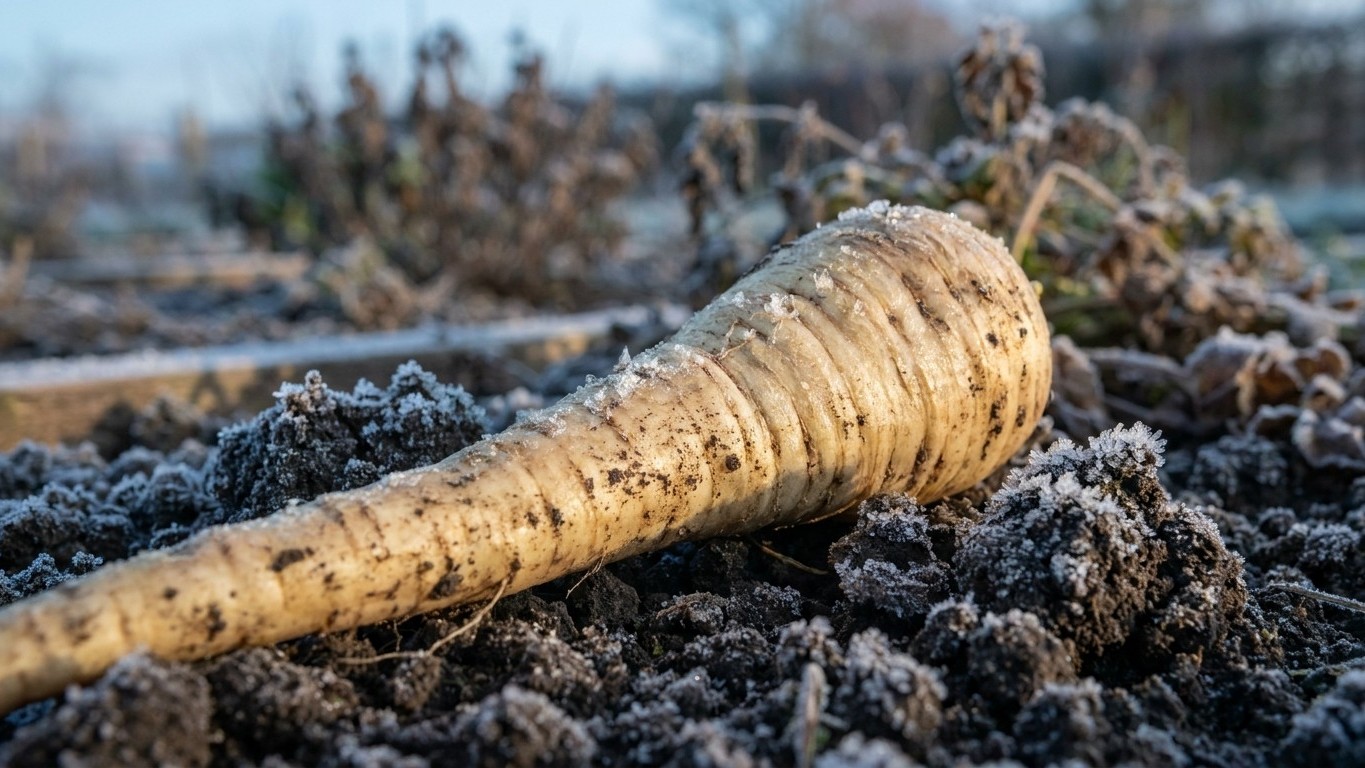

Four of the pests documented for Yukon gardens can go after parsnips: aphids, cutworms, root maggots and slugs. The fifth name on the list, spruce beetle, belongs to the forest. The timing matters as much as the names. Cutworms and slugs hit small seedlings, aphids build on leaves as the plants fill out, and root maggots work underground where you won’t see them until you dig. All of it runs on a short clock.
Which pests attack parsnip in Yukon

The list comes from UAF Cooperative Extension, the Alaska service, which is the neighboring-state source this site uses for Yukon. It documents five pests: aphids, cutworms, root maggots, slugs and spruce beetle. That is a short list, and this page adds nothing to it. A short list is not proof that nothing else turns up in a Yukon garden. It only means this is what the service documents here.
Not all five eat a parsnip. Cross spruce beetle off the garden list. It is a tree pest that lives under spruce bark, and a root vegetable gives it nothing to work with. If you see beetle damage on spruce near your property, that is a forestry matter and says nothing about your vegetable bed.
That leaves four, and they split by where they feed. Cutworms and slugs chew at or above the soil line, mostly on young plants. Aphids sit on foliage and sap it. Root maggots go for the root itself, which is the part you are growing the crop for.
The crop’s own calendar explains why the list matters. Utah State University Extension, in its guide to parsnips in the garden, puts parsnips at 100 to 120 days from seeding. They are sown in place, so the plants stand in the bed the whole time, from bare soil through frost. That is a long exposure, and each of the four pests gets its turn somewhere in it. The same guide recommends deep sandy soil, and says heavy soil must be double dug. Ground that suits the root also gives it a better chance of shrugging off a small nibble.
When each one shows up, and what it does first
Start with the frost window, because everything else hangs on it. At the Whitehorse A station, Environment and Climate Change Canada’s Canadian Climate Normals put the average last spring frost on June 5 and the average first fall frost on August 25. Those are mean dates, not safe dates. In one year out of two the last spring frost falls later than June 5. Northern and upland districts run weeks behind the station. Between the two mean dates lie roughly 81 days, and a parsnip wants 100 to 120 from seeding. So the crop is sown 2 to 3 weeks before the last frost, and it finishes its growth in cool weather with frost arriving on its own schedule. The When to Sow Parsnips in Yukon page works through that timing in detail.
Count from the day you sow, not from a month on the calendar. Germination takes 14 to 21 days, so bare soil in the first stretch is normal. Nothing has eaten your seeds yet.
Seedling stage: cutworms and slugs
Cutworms come first. What you see is a seedling that was standing yesterday and is now cut off at the soil line, or gone entirely. Slugs leave ragged holes in the first leaves and a dried, silvery trail across the soil or leaf. Both do their worst once the seedlings are up and tender, and slugs get worse in wet spells.
Leaf stage: aphids
Aphids arrive when there is soft new growth to feed on. The first sign is usually curled or crinkled leaves, sometimes a sticky sheen, and clusters of small insects on the youngest foliage or the underside of leaves. Check there before you decide anything.
Root stage: root maggots
Root maggots are the quiet ones. Above ground you may see foliage that looks tired or wilts, but the confirming sign is at the root: tunnels and rough, scarred channels in the flesh. Often you learn this only when you pull the first parsnip.
One limit is worth stating. The source names these pests but does not publish date-by-date activity for Yukon. So the calendar above is relative to plant stage, and it is a pattern to watch for, not a dated schedule.
Telling the damage apart from everything else
A wilted, yellow or misshapen parsnip has plenty of possible explanations besides insects. Look at what distinguishes each sign before you treat anything.
| What you see | Possible causes | What settles it |
|---|---|---|
| Bare soil, no seedlings | Not germinated yet, or seedlings eaten | Inside 14 to 21 days from sowing, wait. After that, look for cut stems at the soil line. |
| Holes in young leaves | Slug feeding, other chewing | Slime trails, or feeding that shows up overnight |
| Curled, sticky leaves | Aphids, or water stress | Insects on the underside of leaves. Water stress recovers after a drink. |
| Yellowing leaves, no insects | Nutrient shortage, or too much or too little water | Soil moisture at root depth. A local soil test. |
| Wilting tops | Root maggots, dry soil, waterlogged soil | Dig one root and check for tunnels. Check how wet the soil is. |
| Forked or stunted roots | Heavy or stony ground, or overwatering | Stones or a compacted layer at the fork points, versus soil that stays wet |
| Roots that taste bland | Too few frosty weeks | See Will Parsnips Sweeten in Yukon? |
| Cut tops, snapped roots | A hoe, a boot, an animal | Clean, straight edges rather than chewed ones |
Two rows deserve extra care. Forking has two separate causes, heavy or stony ground and overwatering, and the fix for one can make the other worse. Blandness is not a pest problem at all. Sweetening needs several weeks of frosty weather, so a parsnip that is fine but plain has a weather story, not an insect story.
Dig one plant and look at the root before you do anything else. A photo of the leaves, the soil and the cut root will let UAF Cooperative Extension tell you what fits. This page cannot say what is in your garden, and it should not try.
What actually works here, and what is a waste of time
On a season this short, a physical barrier put down at the right time beats a treatment applied late. Cover the bed the day you sow, with a lightweight row cover and the edges sealed with soil. Root maggot adults have to reach the soil surface to lay eggs, and the cover keeps them off. It also blocks winged aphids from arriving on the first leaves. Leave it on through the seedling weeks, when the crop is most vulnerable. Because you sow before the last frost, this is also the stage when the cover helps hold the bed a little warmer.
For cutworms, a collar around each seedling stops the cut at the soil line. Slugs respond to hand-picking in the evening and to removing the boards, stones and debris they hide under. Water in the morning so the surface dries before dark. A hard spray of water on aphid clusters knocks many of them off with no product involved.
Timing does the rest. Sowing on the early side of the window gives the crop its full 100 to 120 days. Sowing late to dodge an insect trades a small risk for a bigger one, because the 81-day average frost-free stretch is already shorter than the crop’s needs.
Several habits waste effort. Spraying without knowing what is eating the plants usually hits the wrong target. Re-sowing on day ten because the row looks empty ignores the 14 to 21 day germination window. Extra watering “to help” can produce forked roots and feed slugs. And counting on winter to clean the bed is a gamble. The coldest month at Whitehorse has a mean daily minimum of -19.2 °C, but that is an average of daily lows, not a record low, and it tells you nothing about what a particular bed shelters.
This site names no products and gives no rates. What is registered for home gardeners varies, and UAF Cooperative Extension is the place to ask.
Where to check this for your own county
Go to UAF Cooperative Extension and find its office nearest you. Yukon is not divided into counties, so ask for the local office that covers your community rather than looking for a county listing. Pest pressure changes within a territory, sometimes from one valley to the next. A list documented for the region tells you what can happen. It does not tell you what is in your rows.
The same goes for the frost figures used here. The June 5 and August 25 dates are means from one station, Whitehorse A. If you garden north of it or at elevation, your window may open and close weeks away from those dates. Record your own last and first frost in a notebook for a season or two, and use that to check the guidance against your own ground.
For the wider crop picture, start with the Growing Parsnips in Yukon guide.
Your next step is simple. On sowing day, write the date down. Then if something looks wrong, you can tell an extension agent exactly how many days the plants have been in the ground, with a photo and one dug root in hand.
Common questions
Is spruce beetle a risk to my parsnips?
No. UAF Cooperative Extension lists it among the pests documented for the area, but it attacks spruce trees. It has no feeding interest in a root vegetable bed.
Why haven’t my parsnip seeds come up?
Germination takes 14 to 21 days. Bare soil inside that window is normal. Past it, look for cut stems at the soil line before you assume the seed failed.
Do I have to spray for these pests?
This site does not prescribe pesticides. Barriers, collars, hand-picking and a well-timed sowing come first. If you think treatment is needed, ask UAF Cooperative Extension what is registered for home gardens where you live.
Will pests keep my parsnips from getting sweet?
Sweetening comes from several weeks of cool, frosty weather that convert stored starch to sugar, according to Utah State University Extension. Pests do not drive it. A damaged root can still be sweet, and a perfect one can still be bland.