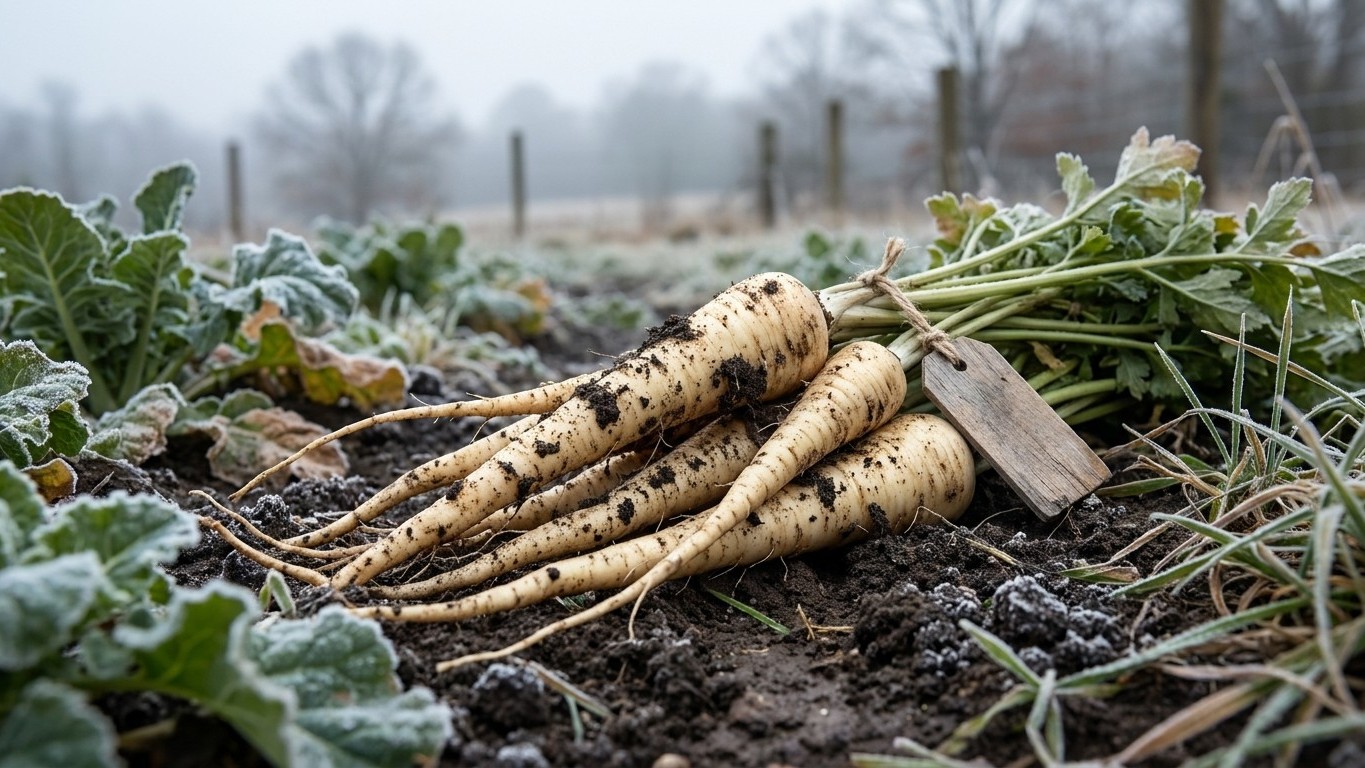

Yes, but only if you leave the roots in cold ground long enough to feel it. Whitehorse’s coldest month averages a mean minimum of -2.6°F, plenty of exposure to trigger the starch-to-sugar shift a parsnip needs. The real question in Yukon isn’t whether frost arrives. It’s whether the root has finished sizing up before that frost locks the whole garden solid.
The short answer
Start with the number that actually decides this: a mean daily minimum of -2.6°F in the coldest month. That’s not a record low pulled from one brutal night. It’s the average low across the whole month, which means Yukon gardens see weeks, not days, of hard freezing air settling into the soil each winter. For a crop that converts stored starch into sugar specifically in response to cold, that’s about as generous an exposure as a garden gets in North America.
This matters because sweetening and surviving are two different questions, and gardeners mix them up constantly. A hardiness zone rating tells you whether a perennial plant will live through winter. Parsnips are grown as an annual root crop, dug up and eaten, so the zone number is close to irrelevant here. What decides flavor is frost exposure while the root is still in the ground: several sustained cold snaps, not a single light nip that barely dents the topsoil. Whitehorse’s climate normals show exactly that kind of sustained cold arriving reliably once fall turns.
So on the frost-exposure question alone, Yukon has no shortage. A parsnip left in this ground through several weeks of real cold will sweeten, and it will sweeten more decisively than one grown somewhere with a mild, hedging winter that dips below freezing a handful of nights and then bounces back. Growers in warmer coastal or southern climates often end up with a fine-looking parsnip that never quite gets sweet, because their winters don’t hold the cold long enough. That’s not the Yukon problem.
The Yukon problem sits earlier in the calendar, and it’s a timing one rather than a temperature one. Getting a root to full size before that cold arrives, and getting it there without the ground freezing so fast the harvest turns into a losing race, is the part that takes planning. The cold itself isn’t in question. Whether the plant is ready to receive it is the part worth working out before you drop a single seed. The next section walks through that arithmetic, because it’s tighter than a lot of gardeners assume when they first check the frost dates.
Does the season fit?
Parsnips are sown directly into the ground where they’ll grow, not started indoors and transplanted, and the clock for the 100 to 120 days they need starts the day you drop seed, not the day green shows above soil. Line up Yukon’s frost dates against that requirement and the fit is close, not comfortable.
- Set the sowing date. Utah State University Extension recommends sowing 2 to 3 weeks before the last expected spring frost. With Yukon’s average last spring frost falling on June 5, that points to a sowing window around mid to late May.
- Allow for germination. Parsnip seed is notoriously slow, taking 14 to 21 days to emerge. Sown in mid to late May, seedlings won’t show above ground until roughly the start of June, right around when that average last frost is still landing.
- Add the days to maturity. The 100 to 120 day window runs from the seeding date, not from emergence. From a mid to late May sowing, 100 days lands in the last week of August; 120 days pushes into mid-September.
- Compare against the average first fall frost. Whitehorse’s average first fall frost falls on August 25. That’s before the 100-day mark finishes and well before the 120-day mark.
- Read what that means. The frost-free stretch between those two average dates runs about 81 days, which is shorter than even the fastest-maturing end of the parsnip’s 100 to 120 day requirement.
None of that is automatically fatal, because parsnip tops shrug off light frost and the root keeps sizing in cool soil after the air has already turned cold. But it does mean the crop finishes its growing, and starts its sweetening, right at the edge of the season rather than with room to spare. And both frost dates here are averages: in one year out of two, the real frost lands later than the mean, which helps; in the other half, it lands earlier, which tightens an already snug window further.
| Metric | Value |
|---|---|
| Average last spring frost | June 5 |
| Average first fall frost | August 25 |
| Average frost-free window | ~81 days |
| Parsnip days to maturity | 100 to 120 days |
The practical read: sow as early as the soil can be worked, ideally right at that mid-May mark rather than waiting for a calendar date, since every extra week banked before germination even starts is a week the root doesn’t have to find later.
What goes wrong here
- Forked or split roots from heavy or stony native ground. A parsnip is a single taproot pushing straight down; any rock, clay lump, or compacted layer splits it into forks. Utah State University Extension calls for deep, sandy soil, and where the native ground is heavier, recommends double digging the bed before sowing so the root has clear, loosened soil to travel through.
- Forked roots from overwatering. This is a separate cause from heavy soil, not the same problem twice. Too much water encourages the root to branch in search of drier pockets rather than driving straight down. Keep watering steady and moderate rather than heavy and irregular, especially once the root has sized past the seedling stage.
- A season that runs out before the root finishes sizing. With only about 81 frost-free days against a 100 to 120 day requirement, a late sowing or a slow, cold spring can leave roots undersized when the ground starts to lock up. The remedy is sowing at the earliest workable date rather than the safest-feeling one, and accepting that the root will finish its growth into and through the first frosts rather than well ahead of them.
- Ground freezing too fast and too deep to harvest. Unlike milder territories, where the risk is a winter too gentle to sweeten the crop at all, Yukon’s risk runs the other way: a hard, early freeze can lock the topsoil before you’ve dug the roots out. A heavy mulch layer over the row, applied once the first frosts arrive, slows that freeze and buys extra digging days without undoing the sweetening the cold has already started.
Common questions
Do parsnips need to be replanted every year in Yukon?
Yes. Parsnips are grown as an annual root crop and are sown fresh from seed each season, directly in the bed where they’ll mature, rather than left to regrow or transplanted from starts.
Can I start parsnip seed indoors to get a head start on Yukon’s short window?
Utah State University Extension’s guidance is for direct, in-place sowing. Parsnips form a single long taproot that resents disturbance, so transplanting seedlings tends to produce the same forking problem caused by heavy soil or overwatering, undoing the head start you were trying to gain.
When is the right time to harvest for the sweetest flavor?
The sweetening comes from exposure to sustained cold while the root sits in the ground, so leaving parsnips through several weeks of frosty fall weather, rather than pulling them at the first light nip, is what develops the flavor. Given how fast Yukon ground can lock up once real cold sets in, plan to harvest promptly once that hard freeze arrives rather than waiting further.
What soil prep matters most before sowing in Yukon?
Deep, sandy soil is the starting point Utah State University Extension recommends, and where native ground runs heavy or stony, double digging the bed ahead of sowing clears the path a straight taproot needs. Treat that as a starting point to adapt to your own ground, not a fixed diagnosis of what your particular soil needs.