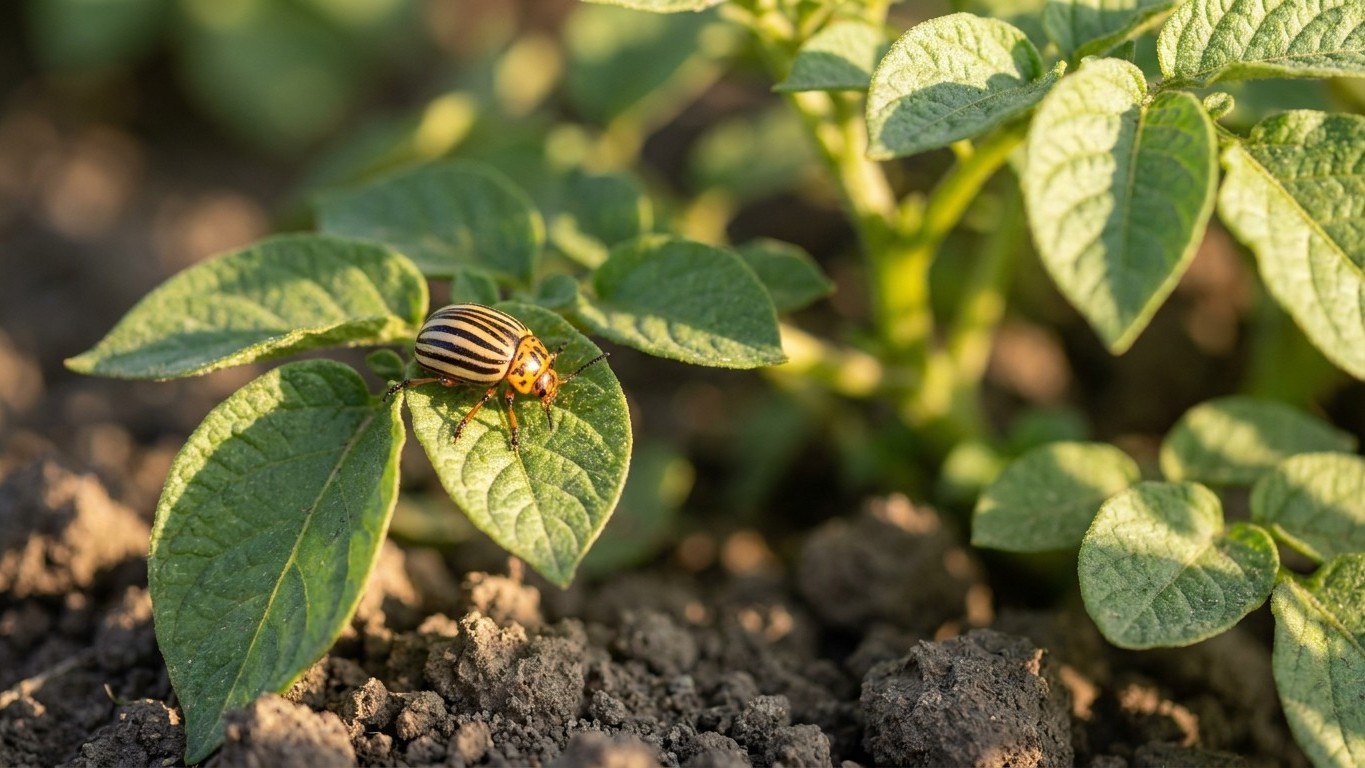

Texas A&M AgriLife Extension documents 13 entries of vegetable pests in Texas, and only about half of them bother a potato patch. The rest are squash, cabbage and corn specialists that happen to share the list. Timing matters as much as identity here. Houston’s last spring frost falls between February 4 and March 1, and most of the insects below move in once the soil warms after that window closes.
Which pests attack potato in Texas

The entries on the Texas A&M AgriLife Extension list are: cabbage looper and diamondback moth; corn earworm; fire ants; flea beetles and cucumber beetles; grasshoppers; leaffooted bug; melon aphid and other aphids; pickleworm and melonworm; root-knot nematodes; spider mites; squash bug; squash vine borer; and whiteflies. It is a general vegetable-garden list, not a potato list, so it needs sorting before you use it.
The ones that belong in a potato row
Flea beetles chew leaves on many garden crops, and potato foliage is on the menu. Melon aphid and other aphids feed on almost anything soft and green. Spider mites and whiteflies do the same from the underside of leaves. Grasshoppers are generalists that will eat what is nearest. Below ground, root-knot nematodes attack roots and can mar tubers, and fire ants are on the list because they gnaw into things buried in the soil.
The ones to set aside
Squash bug, squash vine borer, pickleworm and melonworm are cucurbit pests. They are named for squash, melons and cucumbers, and a potato plant offers them nothing they want. The same goes for cabbage looper and diamondback moth, which are named for the cabbage family, and for the cucumber beetle half of the flea-beetle pairing. Corn earworm is named for corn. Leaffooted bug goes after fruit, and the part of a potato you eat is a tuber, not a fruit.
The service documents a limited set for Texas gardens. A pest you have read about in another state or in a seed catalog may be missing from this list. That does not prove it is absent from your yard, only that this source does not vouch for it. Treat the list as a starting point for questions to your county office, not as a complete census.
When each one shows up, and what it does first
Every date here is pinned to a frost window, and the window is a Houston one. At Houston’s Bush Intercontinental station (IAH), the last 32°F freeze in spring lands somewhere between February 4 and March 1, the band where the odds run from 30 to 70 percent, according to NOAA NCEI Climate Normals. Count everything below from your own last frost, not from Houston’s.
Flea beetles come first because they need almost nothing. As shoots break through and the first true leaves open, the earliest sign is a scatter of tiny round holes, as if the leaf had been hit with birdshot. Young plants take the worst of it, since there is so little leaf to spare.
Aphids arrive close behind, once the days are reliably mild. You will not see the insect first. You will see new leaves that curl or look crumpled, and a sticky sheen on the foliage below them. Turn a leaf over and the cause is usually clustered along the veins.
Whiteflies and spider mites belong to the warm stretch, when the frost window is well behind you and heat builds. Whiteflies lift off in a small cloud when you brush the plant. Mites give themselves away with pale stippling on the leaf surface, and sometimes fine webbing when the infestation is heavy. Neither shows much in cool weather.
Grasshoppers turn up later still. Their damage is coarser: ragged edges and whole bites out of leaves, often starting at the row’s border nearest to weedy ground. Fire ants are quieter. You may see mounds at the base of plants, but the real evidence is at digging time, in tubers with shallow pits or hollowed spots.
Root-knot nematodes announce themselves last, and by then it is too late for a fix. Above ground, plants in a patch look stunted or yellow, with no clear pattern. When you dig, roots carry swollen knots and tubers may be bumpy. Whatever you find, it is worth pairing this calendar with When to Plant Potatoes in Texas: Counting Back From Your Last Frost, since planting date decides which of these overlap with a tender young crop.
Telling the damage apart from everything else
Half the “bug damage” that gardeners photograph turns out to be water stress, a nutrient problem, a disease or a hoe. The table lists what to look for, and what separates the look-alikes. It does not tell you what is in your garden, because a photo and a paragraph cannot do that.
| What you see | Possible causes | What separates them |
|---|---|---|
| Small round holes in leaves | Flea beetles; hail; wind-blown grit | Insect holes appear on scattered leaves with clean edges; hail damage is torn and shows up all at once after a storm |
| Curled, sticky new leaves | Aphids; herbicide drift; uneven watering | Look under the leaf for live insects or shed skins; drift usually distorts many plants and species in the same direction |
| Pale stippling, dull leaves | Spider mites; drought stress; sun scald | A hand lens shows mites or fine webbing; water stress fades once soil is moist again |
| Yellowing, wilting plants | Nematodes; nutrient shortage; too much or too little water; disease | Dig one plant and check roots for knots; check soil moisture at root depth; compare the pattern in the row |
| Ragged leaf margins | Grasshoppers; leaf disease; hail | Chewed edges are cleanly bitten; disease spots have their own borders and color changes |
| Bumpy, pitted or hollowed tubers | Nematodes; fire ants; growth cracks; a shovel or fork | Look for fresh, sharp-edged cuts versus rounded, healed ones; check roots for knots; note whether soil around the tuber holds mounds |
One habit resolves most of these: look at the underside of the leaf and the roots before concluding anything. A green tuber, by the way, is sun exposure, not an insect. Take a fresh sample of the plant, roots included, to your county extension office before you treat anything. A spray applied to a water problem does nothing, and a wrong guess can make a mite problem worse by killing the insects that were eating the mites.
What actually works here, and what is a waste of time
A physical barrier set before the pests arrive beats almost any treatment. Floating row cover laid over the row right after planting keeps flea beetles and other leaf feeders away from tender shoots. Potatoes are harvested for tubers, so the cover does not block anything you need. The catch is that the edges must be sealed against the soil, and the cover must go on before the first insect, not after the first holes.
Hilling does double duty. Mounding soil around the stems keeps tubers covered, which prevents greening and limits what is exposed to soil pests. Rotation matters for the underground problems. Root-knot nematodes build up where susceptible crops repeat, so moving the potato bed each season is one of the few tools against them. Prompt digging when the crop is ready also cuts the time tubers sit in soil where fire ants and nematodes are active.
Weekly scouting is the unglamorous core of it. A quick look under leaves catches aphids, whiteflies and mites while a strong stream of water from the hose can still knock them back. Since Houston’s frost window is early and mild, a crop that goes in on time is up and growing before the worst of the warm-season pests peak. That is the argument for getting the calendar right, and for choosing a variety by season class. The page on Potato Varieties That Suit Texas covers that, and Growing Potatoes in Texas covers the rest of the season.
Several things waste time. Spraying at the first sight of a single insect wipes out helpers along with pests. Treating a problem you have not identified is pure guesswork. Planting grocery-store potatoes as seed is a bigger risk than it looks, because uncertified seed carries virus, and no later care undoes that. This site names no products and gives no rates. Texas A&M AgriLife Extension is the source for what is registered and legal in Texas.
Where to check this for your own county
Texas A&M AgriLife Extension runs an office in every county, and that office is where a state-level list becomes a local answer. Staff there can look at a leaf, a root or a photo and tell you what is common in your area this season. They also know which treatments are registered in Texas, which no national website can settle for you.
Presence varies inside Texas. The state spans four USDA zones, and the frost figures above are Houston’s mild Gulf end. The Panhandle freezes months earlier and later than Houston, and the Hill Country and North Texas each differ again. Even within Houston the gap is real: Hobby airport runs about two weeks milder than IAH. A pest documented at the state level says nothing about what is on the plants in your yard.
Bring a sample rather than a description. Cut a whole affected plant, roots and all, seal it in a bag, and take a few photos of the damage in place. Note when you planted and when the symptom first appeared. Then contact your county office and ask what they see locally in potatoes this season.
Common questions
Do squash bugs and squash vine borers eat potatoes?
Texas A&M AgriLife Extension documents both as pests of the squash family, and they are not listed here as potato pests. If you see them, they are almost certainly on nearby squash, not on your potatoes.
When should I start looking for pests?
Start when shoots push through the soil. In Houston, that follows a last frost that lands between February 4 and March 1, but your own date will differ. Check leaf undersides weekly from emergence onward.
Does row cover work on potatoes?
It can, because potatoes are grown for tubers and do not need insects to set a crop. Put it on right after planting, seal the edges, and expect it to help against leaf feeders, not against pests already in the soil.
Are bumpy tubers always nematodes?
No. Growth cracks, mechanical damage and other causes can look similar. Check the roots for knots and take a whole plant to your county extension office, which can tell you what is behind it.