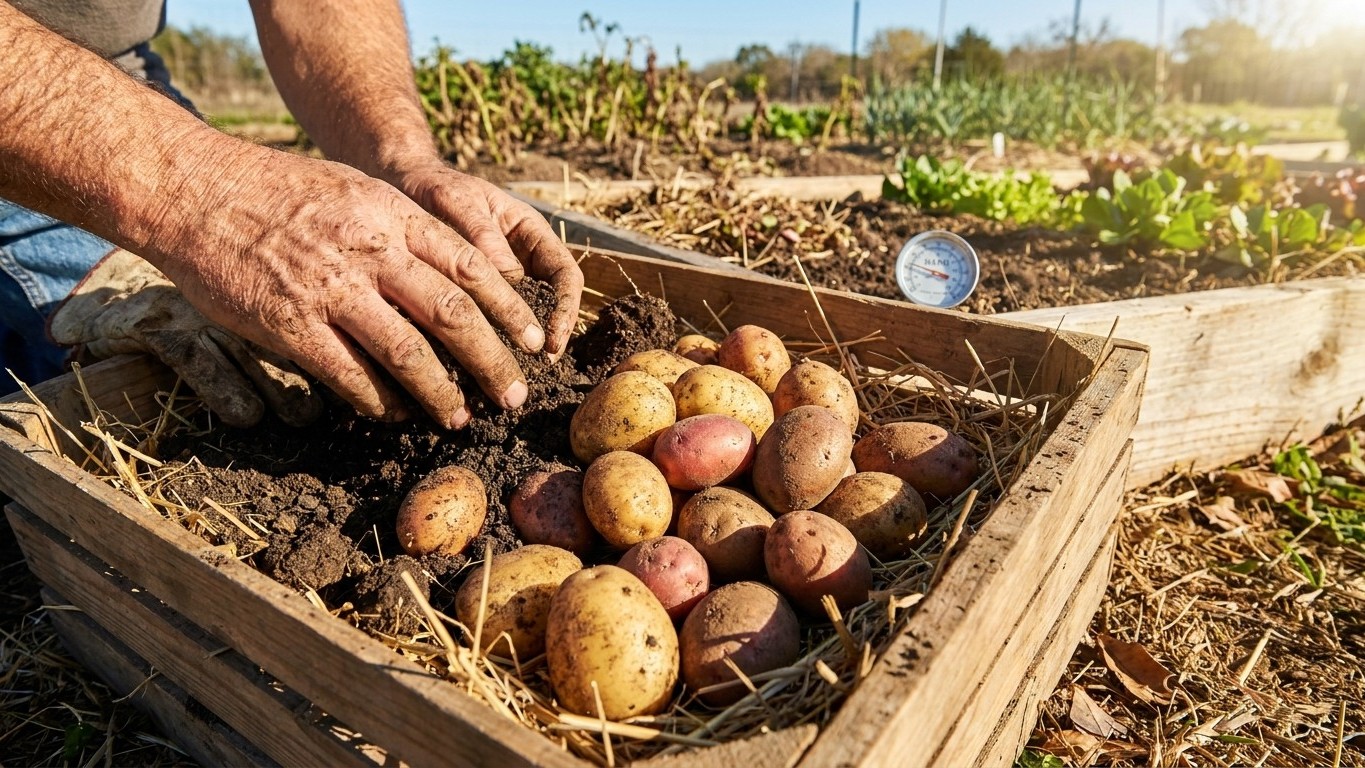

Texas gardeners get the best results from early and mid-season potatoes planted for a spring harvest, not a summer one. The reason is temperature, not variety preference: soil above 90 F stops tuber sizing outright, according to Utah State University Extension. Since potatoes go in the ground once soil hits 50 F, timing beats brand loyalty every time.
The short answer
Skip the search for one perfect variety and focus on season class instead. Utah State University Extension and the University of Maine Cooperative Extension both classify potatoes as early, mid-season, or late, based on how quickly they bulk up once conditions are right, and that classification is the one number Texas growers can actually plan around. Days-to-maturity figures don’t exist in either source’s published guidance, so any calendar built on a specific day count is guesswork dressed up as data.
What does exist, and matters more here, is the 90 F soil ceiling. Once soil crosses that line, tuber set and fill shut down, and no amount of irrigation reverses it. In a state where summer soil temperatures blow past that mark for weeks at a stretch, the practical answer is to plant early-season and mid-season types that can size up and come out of the ground before the heat locks in, rather than late-season types that need a longer stretch of cool soil to finish.
Use is the other half of the answer, since Utah State and Maine both publish what each class is generally suited for rather than labeling texture directly. Early types tend to get recommended for boiling and general table use. Mid-season types show up more often in baking guidance. Late-season types, the ones that need the longest cool stretch, are the hardest fit for most of Texas simply because the clock runs out before the heat does.
| Season class | Typical published use | Fit for Texas soil-heat pattern |
|---|---|---|
| Early | Boiling, general table use | Best fit; sizes up before soil crosses 90 F |
| Mid-season | Baking | Workable if planted at the earliest safe soil temperature |
| Late | Baking, storage | Riskiest; often runs into 90 F soil before finishing |
None of this replaces a local check. Reference city matters: the frost figures usable here come from NOAA’s 1991-2020 Climate Normals for station USW00012960, which sits at Houston’s Bush Intercontinental Airport (IAH). That’s a Gulf Coast reading, and it should never stand in for the Panhandle, the Hill Country, or North Texas, each of which runs on its own freeze calendar.
What actually decides it
Two mechanisms run this whole decision, and once a gardener understands them, almost any Texas planting question answers itself, including ones this page never touches.
The heat ceiling
Tubers are underground organs, and they respond to soil temperature, not air temperature. Utah State University Extension’s fact sheet on potatoes states plainly that soils above 90 F inhibit tuber set and fill. That’s a hard stop, not a slowdown that watering or shade cloth can talk down. A plant that looks green and healthy above ground can still be doing nothing useful below ground if the soil under it has crossed that line. This is why a long, hot growing season doesn’t help potatoes the way it helps tomatoes or peppers: more heat past the ceiling is just wasted time, and in parts of Texas that log many weeks above 90 F soil, that wasted time can be most of the summer.
The planting window
The University of Maine Cooperative Extension’s Bulletin #2077 and Utah State both point to the same planting rule: potatoes go in once soil reaches 50 F, and that point falls 14 to 21 days before the last frost date. That’s counterintuitive at first (planting before the last frost, on purpose) but it works because potato sprouts tolerate cool soil far better than they tolerate a soil ceiling of 90 F later. For Houston, using the NOAA IAH normals, the last spring frost falls between February 4 and March 1, which pushes the planting window into mid-to-late January for that specific station. A grower in the Panhandle or the Hill Country is working from a completely different frost calendar, and this page doesn’t carry those numbers. The mechanism is portable even though the date isn’t: find the local last-frost date, count back 14 to 21 days, and that’s the planting target, wherever in Texas the garden sits.
How to do it
- Find the local last spring frost date from a station near the garden, not a statewide average; a Houston-based reading like the NOAA IAH normals only applies to that reference city.
- Count back 14 to 21 days from that local frost date to set the planting target, per University of Maine Cooperative Extension guidance.
- Check actual soil temperature with a soil thermometer rather than relying on the calendar alone; planting begins once soil reaches 50 F, per Utah State University Extension.
- Buy certified seed potatoes rather than grocery-store tubers or saved stock; uncertified seed carries virus that can silently cut yield even when the plant looks fine.
- Choose an early or mid-season variety based on how it’s described for use, boiling or baking, since neither source publishes a days-to-maturity figure to plan against.
- Plant and hill as usual, keeping the row loose enough that tubers stay covered as they form.
- Track soil temperature through the season and plan the harvest before it climbs past 90 F, since fill stops at that point regardless of how the plant looks above ground.
What goes wrong
- Planting by the last-frost date alone, without the 14-to-21-day setback. That timing waits too long, and soil is often already well past 50 F by the actual frost date, cutting the window before tubers get started. Fix it by counting backward from frost, not planting on it.
- Using a Houston frost date for a garden in another part of the state. Texas spans four USDA zones, and the Panhandle freezes earlier in fall and later in spring than the Gulf Coast does. Pull a local reading instead of borrowing Houston’s window.
- Saving seed potatoes from a previous harvest or buying from a grocery bin. Uncertified seed can carry virus that reduces vigor and yield without any obvious symptom on the plant. Buy certified seed potatoes each season instead.
- Trying to water through a heat wave to save a late-planted crop. Once soil crosses 90 F, tuber set and fill stop regardless of moisture; irrigation doesn’t undo the ceiling. Harvest what’s there and replant earlier the next cycle.
- Choosing a late-season variety for a short cool window. Late types need the longest run of cool soil to finish, and much of Texas simply doesn’t offer that stretch before soil heats up. Lean toward early or mid-season types instead.
Common questions
Can potatoes be grown for a fall harvest in Texas instead of spring?
The published mechanism here concerns spring planting relative to the last frost and the 90 F soil ceiling; a fall planting calendar isn’t covered by the sources used on this page, so no figure is given for it.
Does mulching lower soil temperature enough to beat the 90 F ceiling?
Neither Utah State University Extension nor the University of Maine Cooperative Extension publishes a specific soil-cooling effect for mulch in relation to the 90 F threshold, so that claim isn’t made here.
Is it safe to plant potato pieces before the last frost date?
Yes, that’s the point of the 14-to-21-day setback described by the University of Maine Cooperative Extension; sprouts tolerate cool soil far better than tubers tolerate heat later in the season.
Why does certified seed matter if the tubers look healthy?
Virus in uncertified seed often shows no visible symptom while still reducing vigor and yield underground, which is why certified seed is the standard recommendation rather than a precaution for obviously diseased stock.