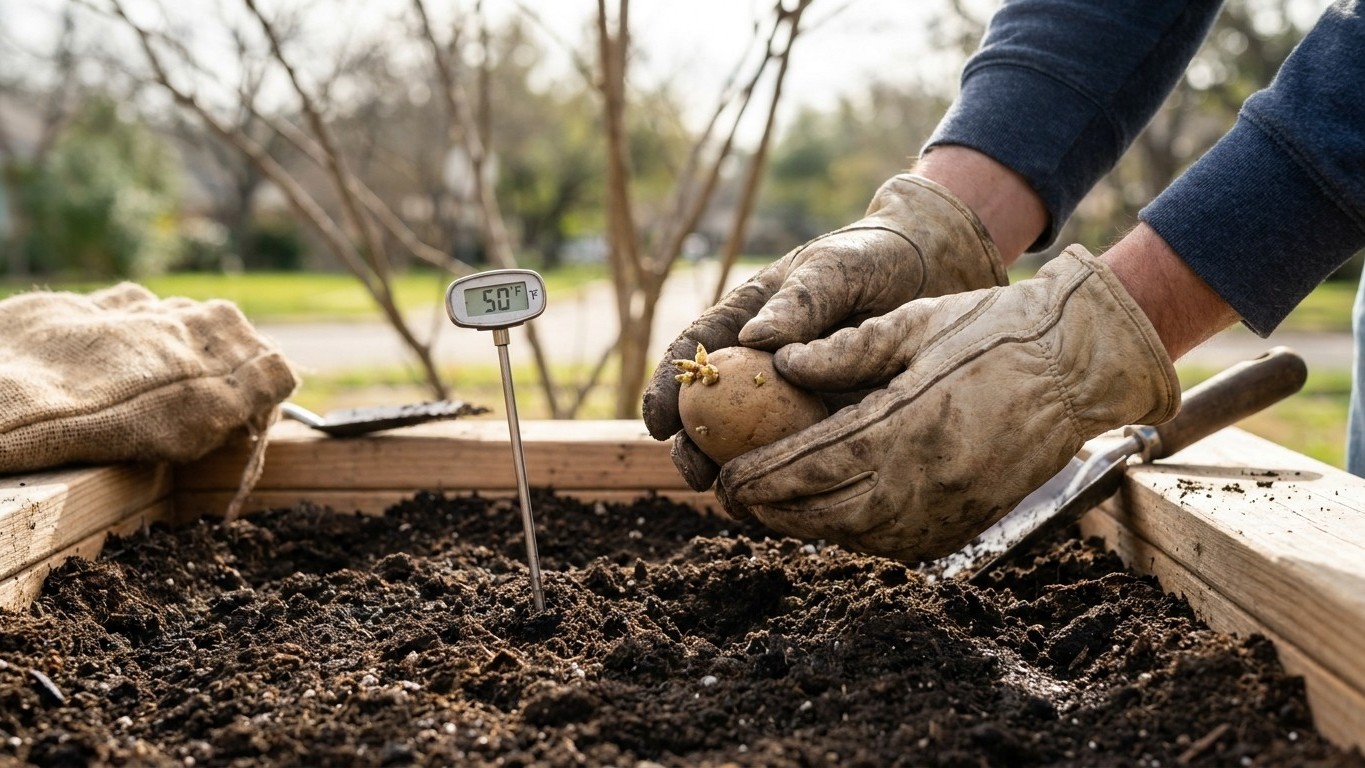

For the Houston area, the counting-back math lands on a planting window in the second half of January to mid-February: take the NOAA last-frost range of February 4 to March 1 for station USW00012960 at Bush Intercontinental, then subtract the 14 to 21 days potatoes need to reach the 50 F soil temperature they require. That’s one reference point on a state that stretches from the Panhandle to the Rio Grande Valley, and the gap between those two ends is the whole story.
The short answer
NOAA’s 1991-2020 Climate Normals put the last spring frost at Bush Intercontinental Airport (station USW00012960) somewhere in the window of February 4 to March 1, based on the years when a 32 F freeze had between a 30 and 70 percent chance of occurring. That’s the probability band NOAA publishes, not a guaranteed date, and it’s specific to that one station.
Potatoes go in the ground once soil temperature hits 50 F, and that point arrives 14 to 21 days before the last frost date, according to Utah State University Extension. Applied to the Houston window, that pushes actual planting back into late January through mid-February, depending on where in that frost range a given year falls and how fast the soil warms.
Two things narrow that further. Houston’s Hobby Airport, just south of downtown, runs about two weeks milder than Bush Intercontinental. A gardener near Hobby can reasonably expect to plant earlier than one near IAH, even though both are inside the same metro area. That’s not a small rounding error. Two weeks is close to half of the entire counting-back window.
The bigger caution: Texas covers four USDA hardiness zones, and Houston sits at the mild Gulf end of that range. The Panhandle around Amarillo freezes for the last time months later in spring and starts freezing again months earlier in fall. Hill Country and North Texas fall somewhere between the two. None of those figures are published in the source used for this page, so this article can only speak to the Houston/IAH reference point with any precision. Treating a Houston window as a statewide planting calendar is the single most common mistake gardeners make when they see “Texas” printed on a seed catalog or a planting chart.
What this means practically: if a gardener is planting near Houston, count back from the IAH window above, lean toward the earlier end near Hobby, and toward the later end further north or inland from the coast. If a gardener is anywhere else in Texas, this page’s Houston figure is not the number to use. The mechanism, though, the reason to count backward from frost at all, and the reason there’s an upper limit too, works the same everywhere in the state.
What actually decides it
Two separate temperature thresholds run this crop, and they pull in opposite directions. One sets how early a gardener can plant. The other sets how late is too late. Missing either one costs a harvest, and neither shows up if a gardener is only watching the calendar instead of the soil and the season ahead.
The cold floor: 50 F soil
A seed potato planted into cold, wet soil doesn’t wait patiently. It sits there and rots, or the sprout that does emerge gets nipped by a late freeze before the plant has any reserves to recover. Fifty degrees Fahrenheit in the soil, not the air, is the threshold Utah State University Extension identifies as the point where seed pieces sprout reliably. Air temperature can feel like spring on a sunny February afternoon while the soil eight inches down is still telling a different story. That’s why the 14-to-21-day window before last frost is a range and not a fixed number: it depends on how quickly a particular piece of ground warms, which itself depends on soil type, mulch, sun exposure, and whether the bed sits on a slope that drains cold air or a low spot that collects it.
The heat ceiling: 90 F soil
The other threshold matters even more in Texas than it does further north, and it’s the one gardeners most often ignore. Tuber set and fill, the actual process of a potato plant turning underground stems into the potatoes a gardener eventually digs, is inhibited once soil temperatures climb above 90 F, per Utah State University Extension and the University of Maine Cooperative Extension’s Bulletin #2077. Watering more doesn’t reverse it. The plant can look green and healthy above ground while producing next to nothing below.
That heat ceiling is the real reason the early planting window matters so much in a state where summer soil temperatures blow past 90 F for weeks at a stretch in most regions. The goal in Texas isn’t to time a summer crop around the heat. It’s to get the crop planted early enough that tubers are already sized and filled before the soil crosses that line. A gardener working backward from a Panhandle frost date, where the ceiling arrives later in the season, has more room to work with than one working backward from a Gulf Coast frost date, where the ceiling can arrive uncomfortably soon after planting.
How to do it
- Find the last-frost reference for the nearest weather station, understanding that a station 20 miles away, or even one on the other side of the same city, can carry a meaningfully different date.
- Count backward 14 to 21 days from that last-frost date to estimate when soil is likely to reach 50 F, using the shorter end of the range in a mild, well-drained bed and the longer end in heavier or shadier soil.
- Check the actual soil temperature at planting depth rather than relying on the calculated date alone; a soil thermometer removes the guesswork the frost-date math can’t fully resolve.
- Buy certified seed potatoes rather than grocery-store or saved potatoes. Certified seed is inspected for virus; uncertified seed carries it silently and can carry a season’s worst problem into a bed that otherwise did everything right.
- Choose a season class, early, mid-season, or late, based on how much time is likely to pass before soil temperatures climb toward that 90 F ceiling in the local area, rather than chasing a specific variety name without knowing its class.
- Plant seed pieces once soil temperature at planting depth reaches 50 F, not before, even if the calculated calendar date has already arrived.
- Watch soil temperature through the growing season, and expect tuber sizing to slow or stop once it consistently pushes past 90 F, regardless of how well the plant is watered.
What goes wrong
- Planting by air temperature instead of soil temperature. A warm spring afternoon feels like planting weather, but the soil at seed-piece depth often lags behind the air by days or weeks. Check soil temperature directly rather than trusting how the day feels.
- Using a statewide or generic “Texas” planting date. A date built for one region, or one pulled from a source that doesn’t specify a station, ignores that Texas spans four USDA zones with frost dates months apart. Find the nearest station’s own figures rather than a single number meant to cover the whole state.
- Ignoring the Houston-area station gap. Even within one metro area, Hobby Airport runs about two weeks milder than Bush Intercontinental. A gardener using the wrong station’s date can plant two weeks later than necessary, cutting into the window before soil heat shuts tuber growth down.
- Treating watering as a fix for heat stress. Once soil crosses roughly 90 F, tuber set and fill slow regardless of irrigation. The remedy is timing, planting early enough that sizing happens before that threshold arrives, not compensating for it after the fact.
- Planting saved or grocery-store potatoes. These carry virus that certified seed is inspected against. The fix is straightforward: buy certified seed potatoes each season rather than reusing tubers from a previous harvest or the produce aisle.
- Choosing a variety by name without knowing its season class. Days-to-maturity figures for potato varieties aren’t published by Utah State University Extension or the University of Maine Cooperative Extension, so relying on an unverified maturity number can leave a gardener guessing. Ask instead whether the variety is early, mid-season, or late, and match that class to the length of the cool window available.
Common questions
Can I use the Houston frost dates if I garden near Dallas or Amarillo?
No. The February 4 to March 1 window applies to NOAA station USW00012960 at Bush Intercontinental Airport in Houston. North Texas and the Panhandle have their own last-frost dates, not published in this source, and they fall considerably later in spring.
Is air temperature a good enough substitute for checking soil temperature?
No. Soil at planting depth warms more slowly than the air above it, especially in shaded, heavy, or poorly drained beds. Utah State University Extension identifies 50 F soil temperature, not air temperature, as the planting trigger.
Why does it matter whether I use certified seed potatoes?
Uncertified seed, including grocery-store potatoes, can carry plant virus that isn’t visible at planting time. Certified seed potatoes are inspected specifically to screen that out before they ever reach a garden bed.
What happens if my potatoes are still in the ground when soil hits 90 F?
Tuber set and fill are inhibited above that threshold, according to Utah State University Extension and the University of Maine Cooperative Extension. Watering more won’t reverse the slowdown; the only real remedy is planting early enough that sizing is mostly complete before soil temperatures climb that high.