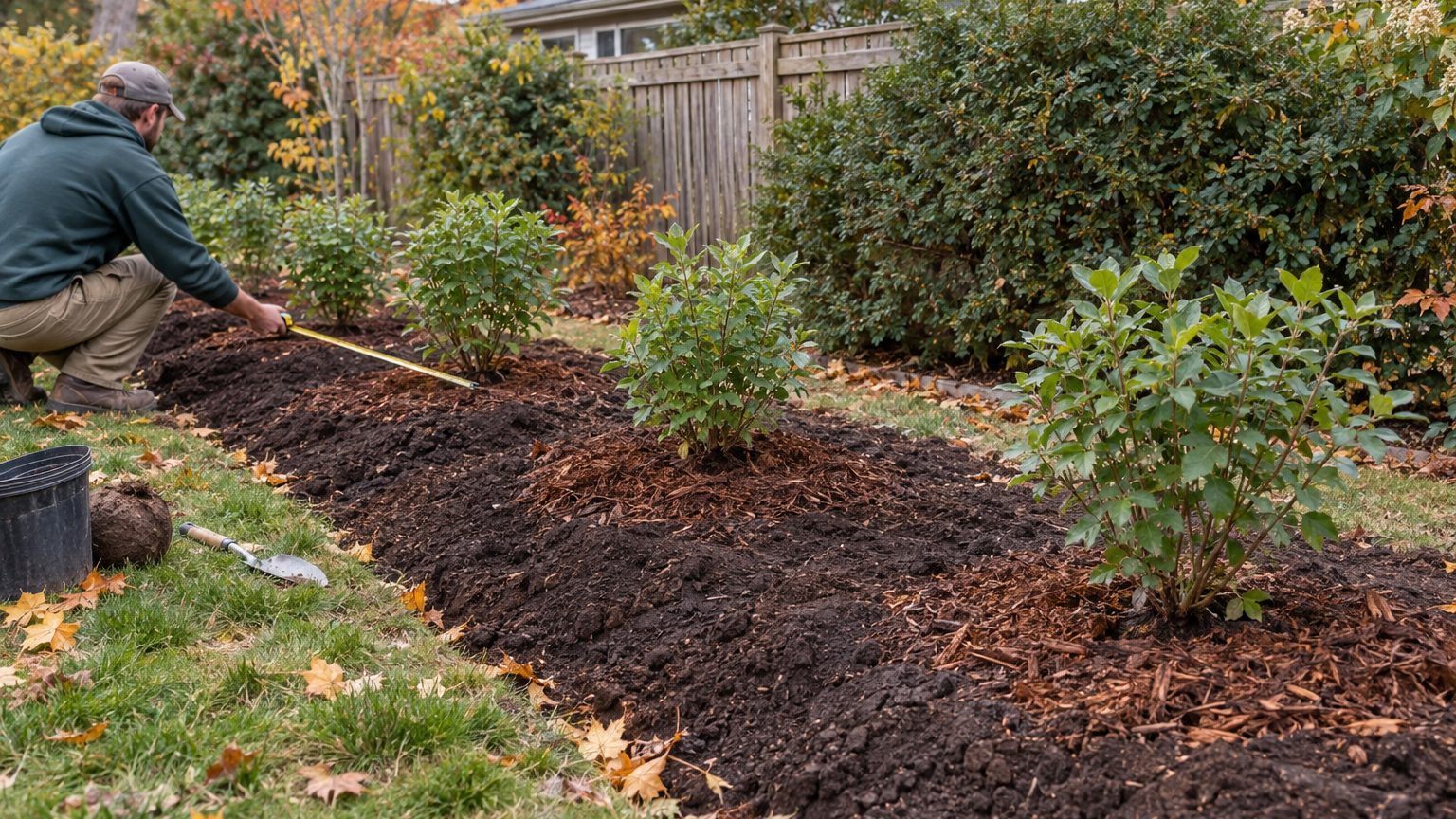

Plant arrowwood viburnum at half to two-thirds of the mature width printed on the label of the cultivar you are buying. Skip the species width. The type species can spread 6 to 10 feet untrimmed, and that is a ceiling, not a spacing. A cultivar labeled 5 feet wide goes in 30 to 40 inches apart, center to center. It grows in USDA zones 3 to 8 and makes a 6 to 10 foot hedge. More on the wider picture is in our guide to Hedges.
How far apart to plant arrowwood viburnum
The arithmetic
Find the mature width on the plant tag or the grower’s description. Multiply it by 0.5 for the tight end of the range and by roughly 0.67 for the generous end. Half suits a screen you want closed as fast as possible. Two-thirds suits a hedge you want to stay healthy longest. Most people should land somewhere between the two, leaning toward the wider number when the site is open and the plants will get decent light on all sides.
Work it through with a cultivar whose tag reads 5 feet wide at maturity. Five feet is 60 inches. Half of 60 is 30 inches. Two-thirds of 60 is 40 inches. The number that goes on the shopping list is 30 to 40 inches apart, measured from the center of one plant to the center of the next, not from edge to edge.
The table below runs the same sum on three made-up label widths so you can see how the range scales. Substitute your own number.
| If the label says (mature width) | Half (fast screen) | Two-thirds (longest-lived) |
|---|---|---|
| 4 feet (48 in) | 24 inches | 32 inches |
| 5 feet (60 in) | 30 inches | 40 inches |
| 6 feet (72 in) | 36 inches | 48 inches |
Why the species width is not the number
The 6 to 10 foot figure describes a plant left alone, with no clippers and no neighbors. It is the upper bound of what an unclipped arrowwood does. Hedges are usually built from selected cultivars, and many of those are considerably narrower than the type species, then held in shape by pruning. Space a clipped cultivar by the species number and you get gaps that take years to fill, even with growth of 12 to 24 inches a year.
So the label in your hand beats any general figure, including the ones on this page. If a nursery sells the plants only as “arrowwood viburnum” with no cultivar name, ask which cultivar it is before you dig. The NC State Extension Gardener Plant Toolbox lists mature dimensions for many selections, which makes it a fair place to check a name against a width.
What planting them closer really buys you
About a year. Take the 5-foot cultivar again: the gap between half spacing and two-thirds spacing is 10 inches per plant. At 12 to 24 inches of growth a year, a hedge planted at 40 inches catches up to one planted at 30 in roughly a single season. That is the whole prize for crowding.
The price comes later. Plants squeezed together compete for water and nutrients at the root, and the lower branches lose light first, so the base thins. Foliage that never dries out holds damp, still air in the middle of the hedge, and that is the kind of microclimate where canker and blight get a foothold. A row that looks full in year three can look leggy and patchy in year twelve, and no amount of clipping puts leaves back on bare lower stems.
The beetle raises the stakes
Arrowwood has one enemy that matters more than the rest. Viburnum leaf beetle skeletonises the leaves, and repeated defoliation kills a plant in two or three seasons. A plant that is already fighting neighbors at the root has less in reserve to rebuild after a stripping. A crowded, dense hedge is also harder to inspect, and spotting the damage early is most of your defense. Give each plant room, and you can walk the row and look at the leaves.
The sensible move is to plant nearer two-thirds than half and accept the extra year of gaps. Fill them for that season with a temporary screen, such as a fence panel or a row of tall annuals, if privacy cannot wait.
A thin base is fixable
Arrowwood has one big advantage over evergreen hedges. It carries dormant buds under the bark, so it regrows from old, bare brown wood. A hedge that has gone leggy or overgrown can be cut back hard and it will come back, which a conifer generally cannot do. Do that renovation right after flowering, so the new growth has the whole season to harden. The calendar for that shifts by weeks across the country, so let your own frost dates set it and check your state’s cooperative extension service for the local timing.
One row or two
A single row is what most gardens need. It gives a 6 to 10 foot hedge, takes the least ground, and costs the least to plant and maintain. Choose it for a property line, a foundation edge, or any strip where the hedge is a boundary rather than a wall.
A staggered double row is a different animal. Two rows are offset so each plant in the back sits behind a gap in the front. The arithmetic is simple. Planting each row at the two-thirds spacing (40 inches in our 5-foot example) puts a plant every 20 inches along the run, which means roughly twice the plants for the same length. The hedge also takes about twice the width. If you set the rows the same distance apart as the plants within a row, 40 inches, the planting bed is 40 inches wide on day one. At maturity, add the cultivar’s 60 inches and the unclipped footprint reaches about 8 feet 4 inches. Clipping trims that down, but you still have to leave the room.
Pick the double row only when all of these are true:
- You have the width to spare, including space to reach both sides with clippers.
- You want a thick, dense screen from the ground up as fast as possible, against a road or a neighbor’s view.
- You are prepared to buy, plant and water twice as many shrubs.
If even one of those is missing, go back to a single row. A single row that is spaced properly will fill in, and it leaves you the choice to add a second later. Readers comparing evergreen alternatives can look at how the same logic plays out in How Far Apart to Plant Arborvitae for a Hedge and How Far Apart to Plant Cherry laurel for a Hedge.
Working out how many plants you need
Measure the run in feet and convert your spacing to feet as well. Then follow three steps:
- Divide the run length by the spacing.
- Round up to the next whole number if the result has a fraction.
- Add one, because a row needs a plant at both ends.
A 60-foot run at 40-inch spacing (3.33 feet) gives 60 divided by 3.33, which is 18. Add one and you need 19 plants. That is the number to take to the nursery, and you can price it locally by size and source.
Corners and setbacks
A corner changes the count because the plant at the turn belongs to both legs. Calculate each leg separately, add the two totals, then subtract one. Two 30-foot legs at the same 40-inch spacing give 9 plus 1, or 10 per leg. That is 20 in all, minus the shared corner plant, so 19, the same as the straight run of equal length.
The setback from the boundary deserves as much thought as the count. Whatever the plan says, the plant will reach its full mature width, and a shrub does not stop at the property line. Measure from the boundary to the center of the plant, and leave at least half of the cultivar’s mature width, which is 30 inches for our 5-foot example. Add room for a ladder or a pair of clippers if you plan to work from that side. Local ordinances and homeowners’ association rules sometimes set their own minimums, so check with your town or the association before you mark the line.
Common questions
Can I use the species width as my spacing?
No. The 6 to 10 foot figure is the most an untrimmed, unpruned plant will do, and hedge cultivars are often narrower and get clipped. Use half to two-thirds of the width on your cultivar’s label.
How tall will the hedge get, and how fast?
As a hedge, arrowwood viburnum reaches 6 to 10 feet. It grows 12 to 24 inches a year, so a small start takes several seasons to reach screening height.
When should I prune or renovate it?
Right after flowering. Because the plant regrows from old wood, a hard cutback is survivable. The exact timing depends on your frost dates, so ask your state’s cooperative extension service.
Will it grow in my area?
Arrowwood viburnum is hardy in USDA zones 3 to 8, according to the NC State Extension Gardener Plant Toolbox. Find your zone before you buy, and watch for viburnum leaf beetle, which can kill a plant in two or three seasons of repeated defoliation.