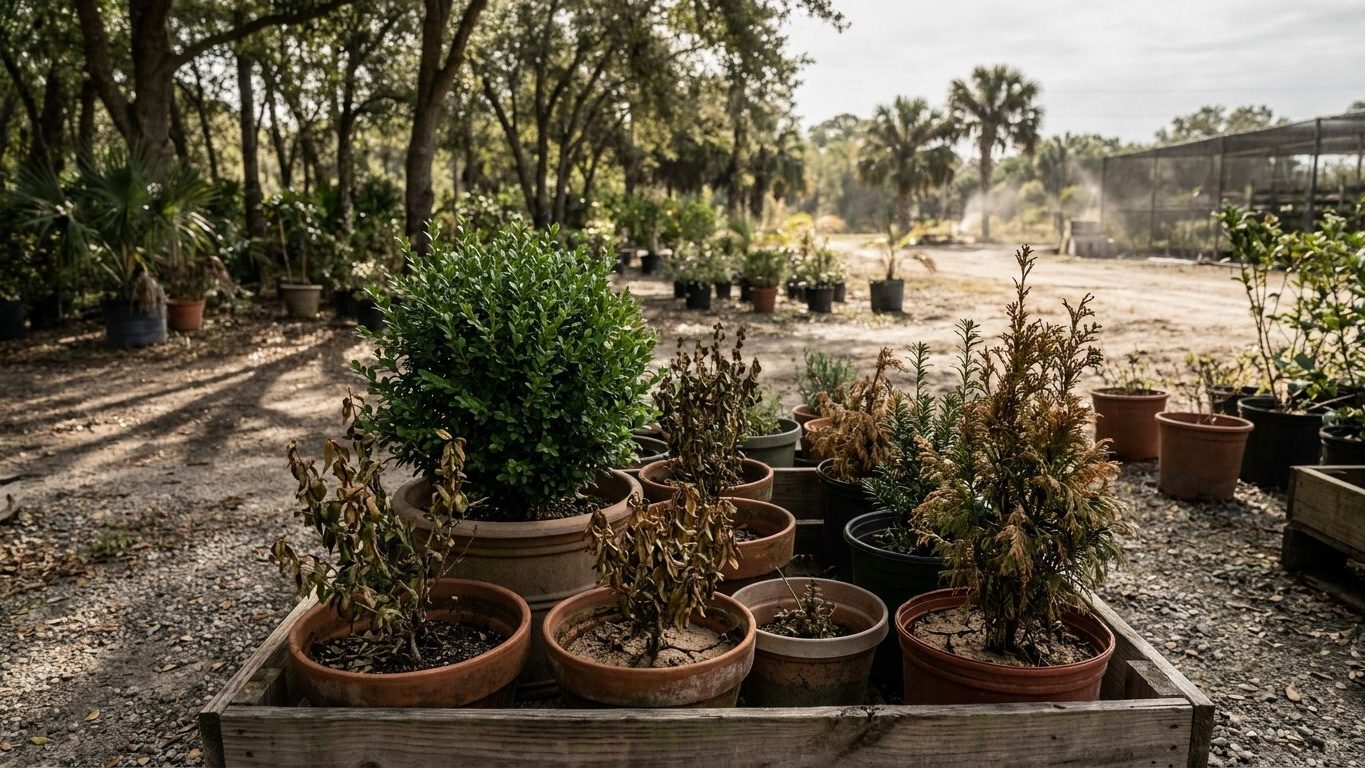

Nine of the 12 hedge species hold across all of Michigan. Three hold only in part of it, and none fail everywhere. Michigan spans zones 4a to 6b on the USDA system, a wide enough range that boxwood, Leyland cypress and cherry laurel need a zone check before you buy. The other nine plants matter just as much, because several can never be cut back once they outgrow their spot.
What actually holds in Michigan
Start with what will not survive everywhere, since that mistake is the expensive one. Leyland cypress (x Hesperotropsis leylandii) and cherry laurel (Prunus laurocerasus) are listed only for zones 6a and 6b. Boxwood (Buxus sempervirens) is listed for 5a through 6b. A gardener in zone 4 who plants any of the three is betting against the climate.
| Plant | Holds in | Growth | Regrows from old wood |
|---|---|---|---|
| Boxwood | 5a, 5b, 6a, 6b | 3 to 6 inches a year | Yes |
| Cherry laurel | 6a, 6b | 1 to 2 feet a year | Yes |
| Leyland cypress | 6a, 6b | 3 to 4 feet a year | No |
Reading the zone number honestly
The USDA Plant Hardiness Zone Map (2023 edition, built on 1991-2020 normals) rests on one variable: the average annual extreme minimum temperature. It says nothing about wind, a late freeze after buds open, or a winter colder than average. “Holds” here means survives. A plant sitting at the edge of its listed range may live and still look rough every March.
Michigan’s zone also varies from one part of the state to another, so use the map for your own ZIP code rather than trusting a statewide label. Neighbors show the same split. Our guide to Hedge Plants for Massachusetts: What Holds, and What Only Looks Hardy covers a state with its own patchwork of zones, and Hedge Plants for Washington: What Holds, and What Only Looks Hardy shows how differently the same species behave in a mild maritime climate.
The nine that hold statewide
These are hardy from zone 4a through 6b: American hornbeam, inkberry holly, winterberry holly, eastern red cedar, privet, yew (Taxus x media), arborvitae, eastern hemlock and arrowwood viburnum. They split into evergreens (inkberry, red cedar, yew, arborvitae, hemlock), deciduous hedges (hornbeam, winterberry, arrowwood viburnum), and privet, which the list gives no leaf habit for. Winterberry is the one to know about: it loses its leaves in winter, so it screens only in the growing season. Inkberry is the evergreen holly of the pair.
For the full picture of how hedges work, see the Hedges hub.
The hedges you can never cut back down
Three of the twelve species do not regrow from old wood: Leyland cypress, eastern red cedar and arborvitae. Cut into bare, leafless interior growth and the branch stays bare. There is no second chance. If the hedge outgrows its space, the only fix is removal.
That changes how you shop. Arborvitae (Thuja occidentalis) grows 6 to 9 inches a year and reaches 4 to 15 feet as a hedge. Pick a size that matches the height you want and let it fill in, because you cannot reduce it later. Prune it in late winter before growth starts, or in midsummer, and only trim the green.
Eastern red cedar (Juniperus virginiana) grows 12 to 24 inches a year and reaches 8 to 20 feet as a screen. Light cuts only, in late winter. It holds in every Michigan zone, but a plant that adds up to two feet a year and cannot be cut back hard will outgrow a narrow side yard fast.
Leyland cypress is the sharpest case. It grows 3 to 4 feet a year toward 15 to 25 feet, it holds only in 6a and 6b, and it does not regrow from old wood. It is fast, it is limited to the warmest Michigan zones, and it is unforgiving. Prune it between late spring and midsummer, and start early, while the plants are still small.
The ones you can rescue
Everything else in the set regrows from old wood, so a neglected hedge can be cut back hard and rebuilt. That includes yew, boxwood, privet, cherry laurel, hornbeam, both hollies, arrowwood viburnum and even hemlock, though hemlock is on the list for light cuts only. Timing still matters, and each has its own window:
- Boxwood: late spring, after the last frost
- Privet: twice a season, spring and midsummer
- Yew: late spring, after the new growth hardens
- Hornbeam: midsummer, after the first flush
- Arrowwood viburnum: right after flowering
The last spring frost is around April 30 in the Detroit area and early to mid May across most of the Lower Peninsula. So “after the last frost” for boxwood means waiting until May in much of the state. Do not shear these plants now, at the end of September. Cutting this late pushes tender growth that the first fall frost can catch. That frost falls between October 6 and 21 in zone 6a.
Matching the plant to the job
A hedge and a screen are different jobs. A 3-foot formal edge and a 20-foot windbreak ask for different plants, and the growth rates tell you which is which before you buy. A plant that adds 2 feet a year is a screen. One that adds 3 to 6 inches is a hedge you will still be shaping in a decade.
| Job | Plants | Height |
|---|---|---|
| Low formal edge | Boxwood (zones 5a and warmer), yew | Boxwood 2 to 6 feet, yew 3 to 8 feet |
| Tall evergreen screen | Eastern red cedar, hemlock, Leyland cypress (6a, 6b only) | 8 to 25 feet |
| Mid-height, mixed | Inkberry, arborvitae, privet | 4 to 15 feet |
| Deciduous, informal | Hornbeam, winterberry, arrowwood viburnum | 5 to 15 feet |
Speed is the trap. Leyland cypress at 3 to 4 feet a year and privet at 2 to 3 feet a year fill a gap quickly, but privet needs cutting twice a season to stay tidy. Yew and inkberry at 6 to 12 inches a year are slow, and slow plants are the ones that stay the size you planted them for.
Hemlock deserves a second look for a tall, dense evergreen screen. It grows 12 to 24 inches a year, reaches 10 to 20 feet, holds in all Michigan zones, and, unlike red cedar and arborvitae, regrows from old wood. It takes light cuts, in late spring.
Winterberry, hornbeam and arrowwood viburnum suit a loose boundary rather than a clipped wall. Winterberry and inkberry are both hollies but behave differently: one drops its leaves, one keeps them. Pick the one that matches what you want to see in January.
The ground you are planting into
Michigan’s official state soil is the Kalkaska series, named by state law in 1990. It is a Spodosol: sandy, acid, strongly leached, typically under conifers. USDA NRCS records for the surface horizon show a pH of about 4.7 (strongly acid), 86 percent sand, 5 percent clay, 9 percent silt, and it is somewhat excessively drained. That is what much of the state’s ground tends to do: shed water quickly and run acid.
That soil represents the state. It is not necessarily what is under your yard. The same record lists organic matter at about 75.0 percent, which means the mapped surface is a natural organic layer, forest litter rather than garden ground. A cultivated bed will not look like that. River bottoms, hill country and any lot a builder has scraped or filled can be completely different, and a pH of 4.7 is the state soil’s figure, not yours.
What follows for a hedge is mostly about water. In fast-draining sand, a new planting dries out quickly, so the first seasons of watering matter more than the plant choice. Heavy or compacted fill behaves the opposite way and holds water around roots. Acid ground suits some species and not others, and this is where a soil test earns its cost.
MSU Extension is the place to start. Its outreach directory at canr.msu.edu/outreach connects you to your county office, and a test tells you your actual pH before you plant a row of anything. With the first fall frost due between October 6 and 21 in zone 6a, this is the month to send the sample and decide, not to plant in a rush.
Common questions
Which hedge plants hold across all of Michigan?
Nine of the 12 species do: American hornbeam, inkberry holly, winterberry holly, eastern red cedar, privet, yew, arborvitae, eastern hemlock and arrowwood viburnum. All are hardy from zone 4a through 6b on the USDA system.
Can I grow boxwood in northern Michigan?
Only where your zone is 5a or warmer. Boxwood is listed for 5a through 6b, so a zone 4 site falls outside its range. Check your ZIP code on the USDA map before buying.
Which hedges can never be cut back hard?
Leyland cypress, eastern red cedar and arborvitae. None regrows from old wood, so buy the size you want and trim only the green growth.
Do I need to change Michigan’s sandy, acid soil before planting?
Not automatically. The state soil, Kalkaska, is sandy and acid, but your yard may differ. Get a soil test through your county MSU Extension office, and plan on regular watering for a new hedge in fast-draining sand.