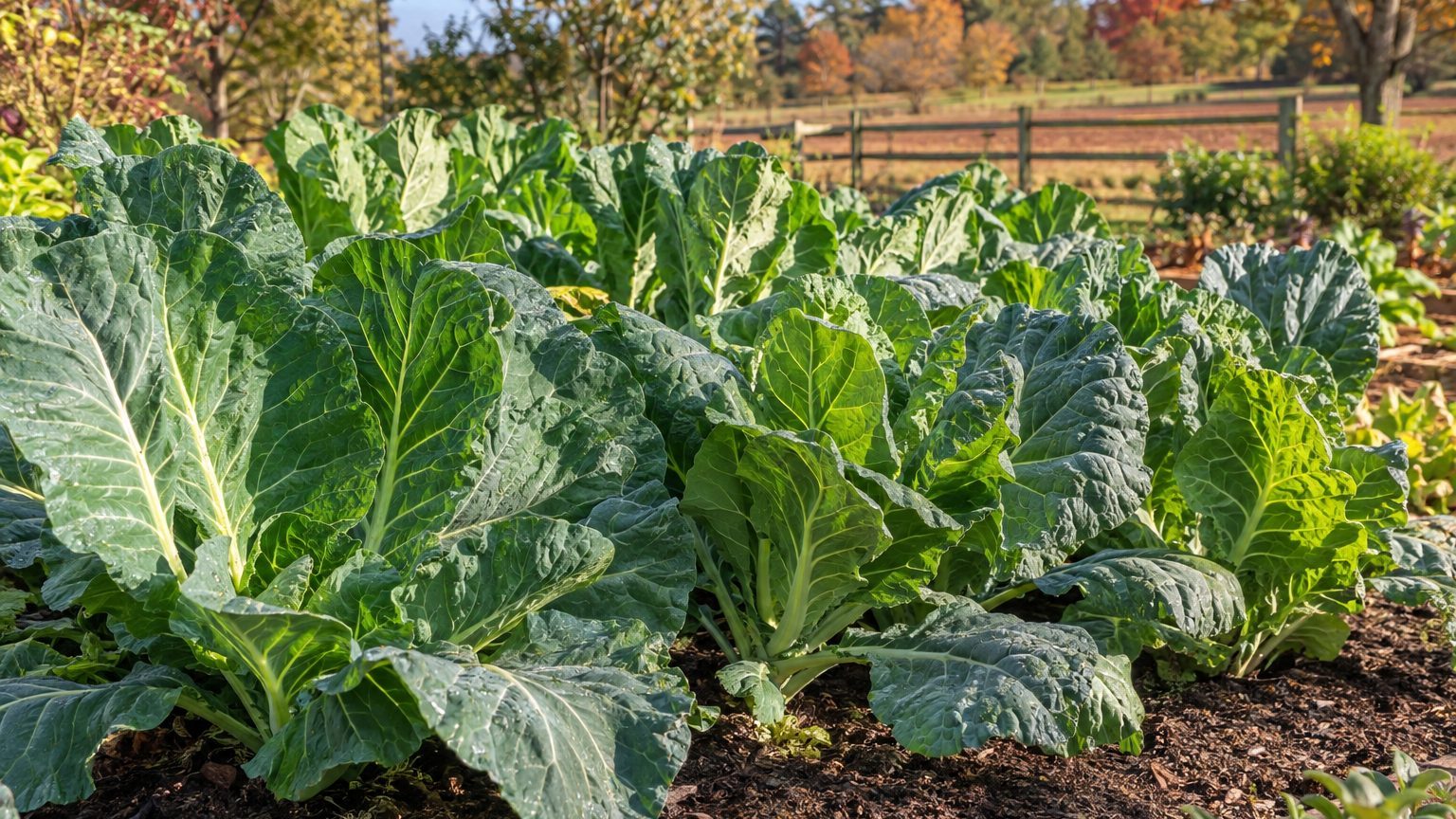

For most West Virginia gardens, the best collards are an open-leaf, non-heading type, grown mainly as a fall crop, with a quick spring planting as a bonus. Charleston’s first fall freeze arrives between October 18 and November 1, which leaves a long runway for late-summer plantings. Kale, mustard and turnip greens fill the gaps around them. Planting time and elevation matter more here than any variety name.
The short answer for West Virginia
Choose a loose-leaf collard, plant it for fall, and treat spring as the second chance. The state’s season is long enough for both, but the fall crop gets cool nights that spring plants never see. If you want the full crop-by-crop picture, the guide to Growing Collards in West Virginia covers the basics.
What the frost dates say
Charleston’s numbers come from NOAA’s 1991-2020 Climate Normals for 32F freezes, using the 30-70% probability band. The last spring freeze falls between April 9 and April 23. The first fall freeze falls between October 18 and November 1. These are probabilities of a 32F freeze, not guarantees, so a freeze can still land after the late end of the spring range.
From the late end of spring to the early end of fall, that is roughly six months. Add the tolerance collards have for a light frost, and the season stretches on both ends. That is why the choice comes down to type, not brand.
Charleston sits in a river valley, and higher ground freezes noticeably earlier in fall. This page has no summer heat figure for the state and no West Virginia variety trial results, so it does not rank named cultivars. Seed packets and catalogs will tell you which are open-leaf, and that is the trait to look for.
Greens compared
| Green | Best planting window | Why it fits |
|---|---|---|
| Loose-leaf collards | Late summer for fall; early spring as a second crop | Handle frost, sweeten in the cold, hold up longer in warm weather |
| Kale | Late summer for fall; early spring | Comparable cold tolerance, milder flavor |
| Mustard greens | Early spring or fall | Fast from seed, but bolts when weather warms |
| Turnip greens | Early spring or fall | Quick, and the roots are a second harvest |
What will not work here
Late starts and slow types
A slow, large-framed collard set out late is the most common failure. Collards don’t die at the first freeze, but growth slows sharply as nights cool. A plant that is still small when the freeze arrives in the October 18 to November 1 band stays small. In higher country, where frost comes earlier, the window closes sooner still.
The fix is to count backward from your fall frost, not forward from the seed packet. Give the plant its growing time before the cold slows it, and favor types that size up quickly.
Trusting one spring date
Treating April 23 as a safe date fails too. That end of the band is a probability, so a 32F freeze can still arrive after it. Hardened-off collard transplants shrug off a light one. Seedlings straight from a warm windowsill do not. Spring mustard is the other casualty: plant it late and it bolts before you get a decent harvest.
The coldest-month figure adds a limit. Charleston’s mean daily minimum in its coldest month is 26.1F, so freezing nights are routine in winter. Established collards often ride that out. But that is an average from one valley station, and the extreme lows in colder counties run well below it. Don’t plan on winter harvests everywhere in the state.
Crowded rows also cause trouble. West Virginia’s narrow valleys and wooded hillsides can hold damp, still air, and tight spacing keeps leaves wet longer, which invites leaf spot and rot. This page has no humidity figure to quote, so take it as a general rule of thumb. Give each plant enough room that air moves between them, even if the bed looks sparse in the first month.
Last, don’t import a neighbor’s schedule. A calendar written for the Deep South, where collards grow through winter, will have you planting at the wrong end of the year. The When to Plant Collards in West Virginia page works from this state’s frost dates instead.
What changes across West Virginia
The USDA Plant Hardiness Zone Map (2023) puts West Virginia across zones 5a to 7a. That is five half-zone steps, built on one variable: the average annual extreme minimum temperature. So there is no single answer for the state. A garden in a warm river valley and one on a high ridge are effectively in different climates.
The zone system says nothing about summer heat or season length directly, but it is a decent proxy for where you sit on that spread. Charleston is the reference point for the dates on this page. Read the zone range as a warning that other parts of the state differ, and by how much.
If you garden in the northern part of the state or at altitude, shift everything in one direction. Start fall plantings earlier in the summer, since your first freeze arrives before Charleston’s. Expect the spring window to open later. Lean toward the faster collard types and toward kale, which shrugs off cold. And treat winter survival as a bonus, not a plan.
If you garden in the warmer southern and western valleys, the fall crop can run later and overwintering is more realistic, though not guaranteed. In either case, look up your own spot on the USDA map with your ZIP code, not a guess from a neighbor or a seed packet. Then check whether it lands closer to 5a to 7a at the cold end or the warm end, and shift your dates accordingly.
Where to check this for your own county
Your state extension service is the best next stop. West Virginia University’s is at https://extension.wvu.edu/, and it connects to a county office staffed by people who know the local frost pockets and soils.
Look for two things there. The first is a local planting calendar for cool-season vegetables, ideally one written for your county or region, not the state as a whole. The second is any record of varieties trialled nearby, whether from an extension demonstration garden, a Master Gardener program or a county agent’s recommendations. This page could not cite a WVU collard-specific calendar, so that gap is yours to fill.
Call the county office if the website is thin. Ask which collard and kale types perform in your area, and when local gardeners usually see the first killing frost. A short conversation often beats an hour of searching.
A county recommendation always outranks a state one, and this page is the state one. It draws on a single Charleston station, so it can tell you the shape of the season, not the exact week for your hillside. For a companion view of timing, the planting calendar sets these frost dates out sowing window by sowing window.
Checking this against your own garden
Your own observations outrank every date on this page. Three things are worth watching, and none needs equipment beyond your hands and a notebook.
- Soil by feel. In spring, squeeze a handful. If it clumps into a wet ball, wait. If it crumbles and feels cool but not cold, the bed is ready. A bed that dries and warms weeks before your neighbor’s is a warm pocket; one that stays soggy is a cold one.
- First true leaves. After the seed leaves, the first true leaves show how fast a seedling is moving. Slow growth on plants sown alongside a friend’s says your site runs cooler.
- The date of the first frost on the grass, or on a car windshield. Write it down each fall and compare it to the Charleston band of October 18 to November 1. Frost weeks earlier means you sit higher or in a cold hollow.
Keep those notes for two or three seasons, and they become your own calendar, more accurate for your yard than any state figure.
Common questions
Can collards survive a West Virginia winter?
Sometimes. Charleston’s coldest-month mean daily minimum is 26.1F, and established collards often tolerate nights like that. But the state runs from zone 5a to 7a, and colder areas can lose plants during deeper dips. Treat winter harvest as a bonus.
Are collards better planted in spring or fall?
Fall is usually the stronger crop, because plants mature into cooling weather and cold sweetens the leaves. Spring works if you plant early and choose a type that tolerates warmth. If you can only do one, make it fall.
What greens can I grow alongside collards?
Kale is the closest match on timing and cold tolerance. Mustard and turnip greens are faster and suit early spring or fall, though mustard bolts once weather warms. Planting a few of each spreads your harvest across the season.
Should I start collards from seed or transplants?
Either works. Transplants save time on a spring crop and help in a late-summer planting when the calendar is tight. Direct seeding is cheaper for fall. Whichever you choose, work backward from your first fall freeze, not from a fixed date.