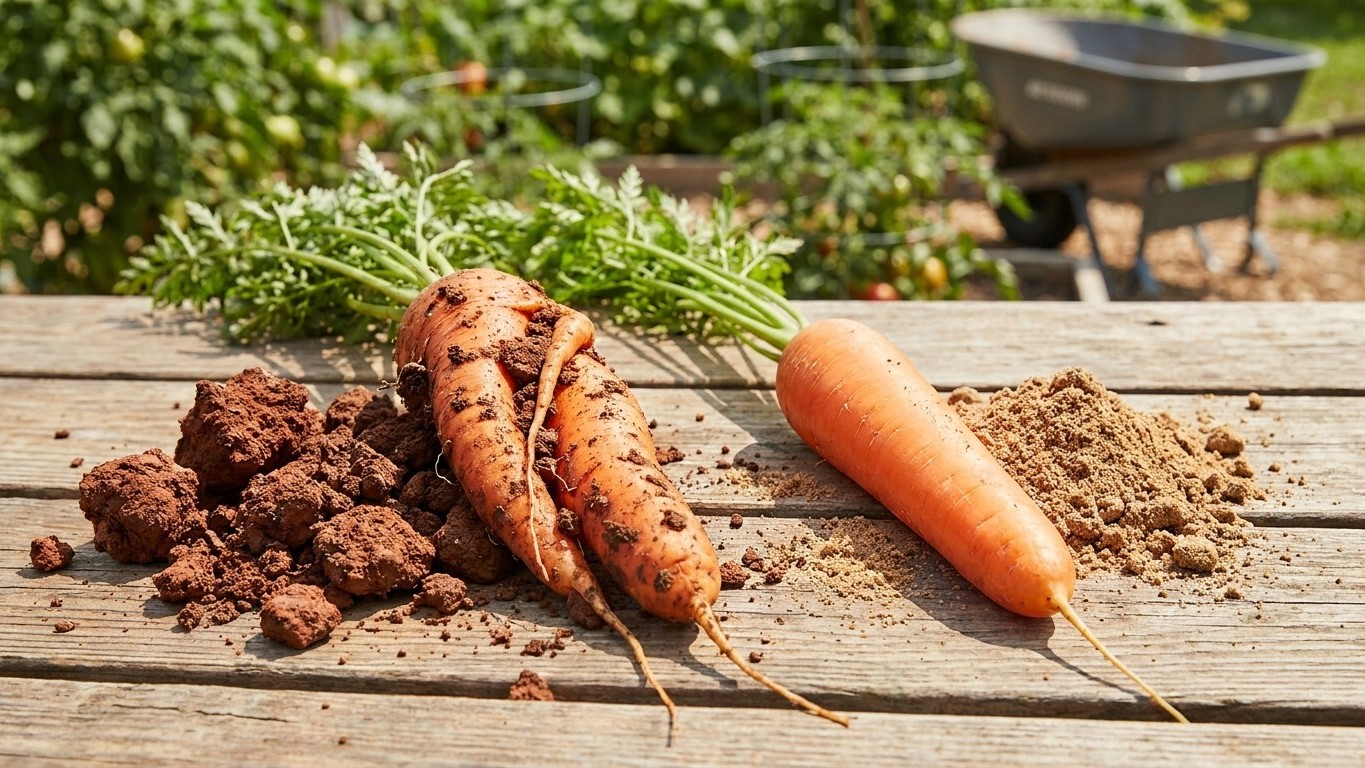

Carrots are ready when the shoulders at the soil line have swelled to the width the seed packet promises. That usually lands somewhere between 70 and 100 days after seeding. Once they are out of the ground, the tops decide how long they last: carrots left bunched with their greens keep about 10 to 14 days, while trimmed carrots kept cold and humid can last far longer. Timing and storage are one decision, not two.
When carrots are ready in Manitoba
Watch the shoulders, not the calendar. The top of each root pushes up and shows at the soil surface, and that width is your first clue. The count that goes with it is 70 to 100 days from seeding. Clemson Cooperative Extension puts the early end lower, at about 65 to 75 days after planting, which is why a fast variety can be ready before a slow one is even close.
Carrots are sown in place. There is no transplant date to count from, so every one of those days starts the morning the seed goes into the row. The frost dates for Manitoba are not published on this page, so the range has to come from your own seeding date. A row seeded on June 1 would reach the 70-to-100-day window between August 10 and September 9. A row seeded three weeks later slides the whole window three weeks later. Do the arithmetic once, write both dates on the seed packet, and you have a harvest window that belongs to your garden.
Check one before you pull the row
Pull a single carrot at the early end of the window. Look at the length and the color, and taste it. Color matters more than people expect: a pale, thin carrot needs more time, while a full-colored one with a broad shoulder is done. The seed packet’s days-to-maturity figure is a better guide than any general number, because the source behind this page names no variety.
Soil changes how the pull goes. The dominant profile in the agricultural parts of the province, according to Agriculture and Agri-Food Canada’s Canadian Soil Information Service, is a Chernozem. That is the deep, dark prairie soil, and it covers 41 percent of the mapped surface. Its median texture is loam to silt (45 percent sand, 24 percent clay, 31 percent silt), and it is imperfectly drained. Loam like that lets a carrot slide out easily when it is moist. When it dries and firms up, roots snap at the neck. Water the row the evening before, then loosen the soil beside the carrot with a garden fork instead of hauling on the greens.
That profile is a starting point, not a diagnosis. Manitoba spans hundreds of soils, and river bottoms, low ground and any yard a builder has scraped or filled can differ completely. For the specifics, see Will Carrots Fork in Manitoba Soil?, and for the full season, Growing Carrots in Manitoba.
Keeping them, and for how long
Clemson Cooperative Extension’s Home & Garden Information Center states it plainly: “Store them at 33 °F and high humidity to prevent wilting. Bunched carrots (plants with tops on) can be stored for about 10 to 14 days.” The source gives no humidity percentage, only “high,” so treat it as a target to reach rather than a number to measure. The temperature it does give: 33 °F.
That figure is one degree above freezing. It is not a cellar temperature in the everyday sense, and the gap matters. A carrot held at 50 °F does not slowly age; it sprouts and goes soft in a fraction of the time. A carrot that dips below freezing has a different problem, because the cells rupture and it turns mushy when it thaws. The window between those two failures is narrow.
The tops are the catch. Leaves keep drawing moisture out of the root long after harvest, which is why bunched carrots last 10 to 14 days and trimmed ones can keep for months. Cut the greens off right after pulling, leaving a small stub of stem so the crown is not damaged. Toss the tops on the compost pile or cook with them.
Read those durations as maximums under ideal conditions. The 10 to 14 days is what a perfectly cold, humid setup can deliver, and a warmer kitchen counter will cut it hard. The same goes for the “months” of a trimmed carrot: that is the ceiling, and a carrot with a nick, a split or an insect tunnel will fail well before it. Sort as you trim. Keep the clean, unblemished roots for storage and eat the imperfect ones first.
Insect damage starts in the ground, so if you are finding tunnels, What Eats Carrot in Manitoba, and When covers the timing.
Where in the house that actually is
The 33 °F target is easy to state and awkward to hit. Most houses have four candidate spots, and each fails differently.
| Spot | Main risk for carrots | Verdict |
|---|---|---|
| Refrigerator crisper drawer | Dries roots out if they are loose in the drawer | Good for a few pounds, in a bag or lidded container |
| Heated room or pantry | Too warm; sprouting and softening | Only for what you will eat this week |
| Attached or detached garage | Swings with the weather, freezing in a hard Manitoba winter | Unreliable without monitoring |
| Unheated basement or cold room | Can freeze near outside walls, or run too warm near the furnace | Closest match for a large harvest |
For a big harvest, the unheated basement or cold room comes closest, provided you find the right corner. Pick a spot away from the furnace and the water heater, ideally on the north side, and keep the carrots off the concrete floor with a shelf or pallet. Damp sand, or a lidded container with a slightly damp cloth over the roots, supplies the humidity that the source calls for.
A fridge is the easiest way to hold a small amount near the target, but open air inside one pulls moisture out of the roots quickly. A sealed bag or a covered container fixes that.
Put a thermometer in the spot for a few days before you commit the crop, and check it at the coldest time of night. If the reading sits near 33 °F, you are in business. If it drops to freezing during a cold snap, or climbs into a range where roots sprout, you have found out for the price of a cheap thermometer instead of a bin of ruined carrots.
What goes wrong here
Freezing is the first failure, and a Manitoba winter makes it likely. A cellar or garage that seemed fine in October can drop below freezing in the first serious cold spell. Frozen carrots look normal in the bin and turn limp and watery when they thaw. Check the thermometer after the first hard cold night, and if the space is getting too cold, move the carrots inside or insulate the container with a blanket or straw.
A damp autumn is the second. The dominant soil here is imperfectly drained, and the next most common soil order in the survey, Gleysolic, is one shaped by poor drainage. In a wet fall, carrots left in saturated ground can split after a heavy rain or start to rot at the crown. Pull the row earlier if the forecast turns wet, and let the roots dry briefly (out of direct sun) before trimming and storing them. Damp carrots stored in a warm spot rot quickly.
The third is a glut nobody can eat. A 20-foot row of carrots is a lot of carrots, and the 10-to-14-day limit on bunched ones makes waiting a bad plan. Cut the tops first, sort the roots, and put the best in cold storage right away. Then deal with the rest: cook them, give them away, or blanch and freeze the surplus. Harvesting in two or three passes, a week or so apart, also spreads the load.
Common questions
How do I know a carrot is ready without pulling it?
Look at the shoulder where the root meets the soil. Once it has swelled to about the width the seed packet describes and enough days have passed since seeding, pull one to check length and color.
How long do carrots keep with the tops on?
Clemson Cooperative Extension says bunched carrots, with their tops still attached, can be stored for about 10 to 14 days. That is a best case, in cold, humid conditions.
Why cut the tops off before storing?
The leaves keep drawing moisture out of the root, so the carrot wilts. Trimmed carrots hold moisture much longer, and can keep for months under the right conditions.
Does my soil affect harvest and storage?
It affects the pull more than the storage. Loam that is slightly moist lets roots slide out whole, and heavy or rocky ground makes them fork and break. Utah State University Extension recommends compost and double digging for heavy soil. A soil test, or a jar test that shows how much sand, silt and clay you have, will tell you what your own garden is really like.