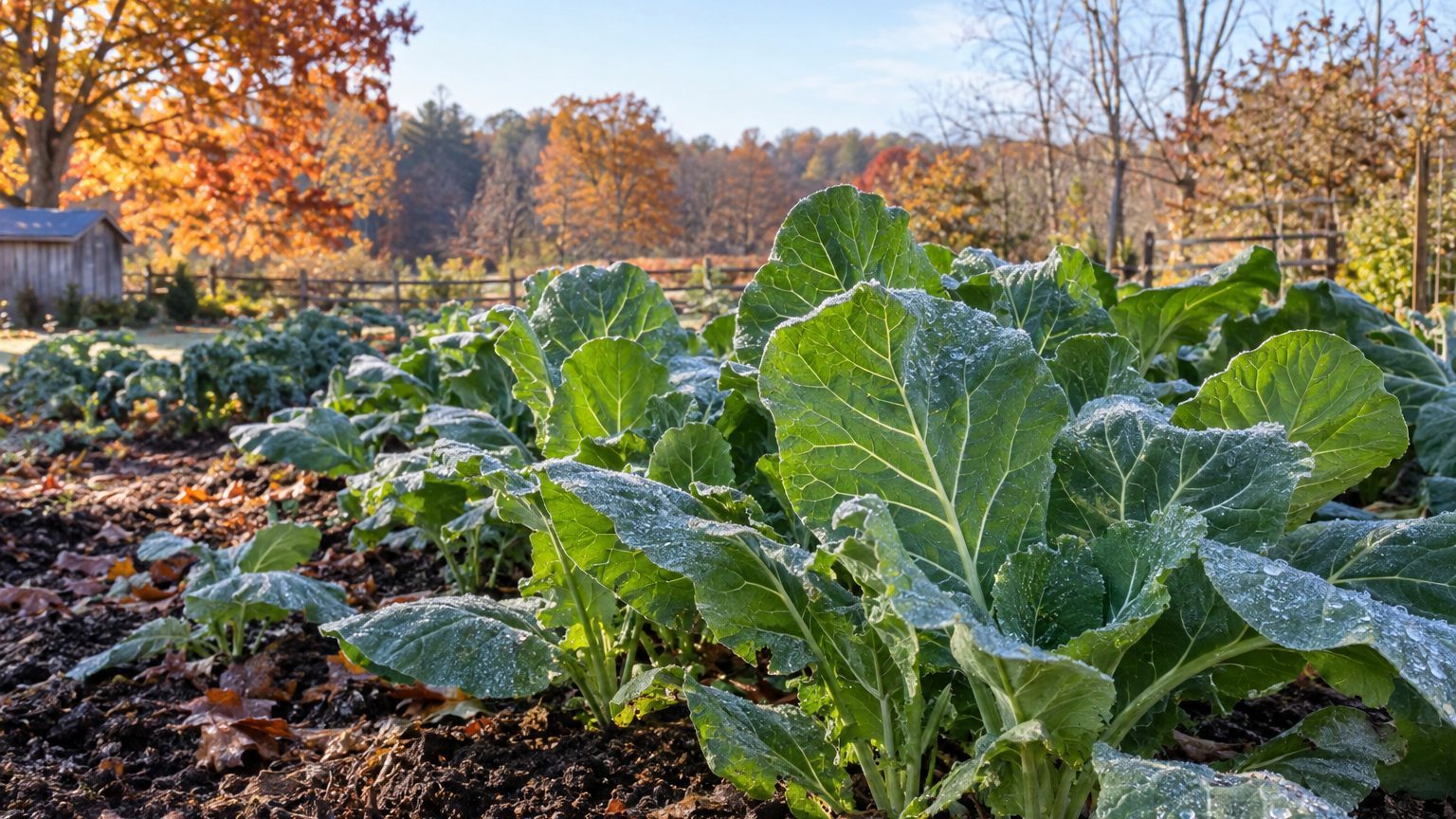

West Virginia gives collards two planting windows: one in spring, built around the April frost dates, and one in late summer for a fall crop that runs into the first hard freezes. Collards are a cool-season green, so the dates below are anchors to plan around rather than deadlines to fear. For the full crop guide, see Growing Collards in West Virginia.
The short answer for West Virginia
Set out spring collards around the last-frost window of April 9 to April 23, and time fall plantings by counting back from the first-frost window of October 18 to November 1. Both windows come from NOAA’s 1991-2020 Climate Normals for the Charleston station (USW00013866).
What are those dates a probability of? They are the band where the chance of a freeze at 32°F or colder runs between 30 and 70 percent. Inside the spring band, a freeze on any given date is roughly a coin flip. Inside the fall band, the first freeze is about as likely to have arrived as not. Neither is a promise. A freeze after April 23 is less likely, but not ruled out.
Why does this matter less for collards than for tomatoes? Because collards shrug off light frost. A tomato gardener treats the last-frost date as a gate. A collard grower treats it as a landmark. Seed started indoors ahead of the spring band gives you transplants ready to go out right around it, and they can handle a few cold nights afterward. Many gardeners find flavor improves too, since cold nights push the plant to turn starch into sugar.
Working the fall window backward
Fall is where most West Virginia gardeners lose time. The seed packet lists days to maturity, and that number should be subtracted from the October 18 end of the fall band. Whatever date you land on is the latest you should sow or transplant. Most people plant later than that and wonder why the plants stay small. Collards grow slowly as days shorten, so a small plant on October 18 stays small. The variety matters here as well, and The Best Collards and Greens for West Virginia covers which ones finish quickly enough.
What the winter number tells you
The coldest month’s mean daily minimum is 26.1°F, the average of the lowest temperature each night. That is a typical night, not the worst one. Individual nights drop well below it, and the USDA hardiness zone is built on that average annual extreme instead. The point is that Charleston’s winter nights are cold enough to end a fall collard crop in a normal year, and mild enough that plants in a sheltered spot sometimes push through. Treat overwintering as a bonus, not a plan.
What will not work here
The most common failure is applying Charleston’s dates to a ridge. The station sits in a river valley, and the data carry a warning: higher elevations across the state freeze noticeably earlier in fall. A fall crop timed to an October 18 to November 1 window can meet its first hard freeze weeks sooner on a hilltop farm. Small plants can survive that. Plants that were supposed to be full size by then are stuck at half height.
Slow varieties are the second casualty. The frost-free stretch here is not long, and it is shared by two crops. A long-maturing collard sown late for fall never catches up, because growth slows with each shortening day. If a packet promises many weeks to harvest and you are already deep into summer, pick a faster type or accept a baby-leaf harvest.
Waiting for warm soil is the third mistake, and it is a habit borrowed from tomatoes and peppers. A spring collard set out in late May meets summer heat before it has grown a real frame. Leaves toughen, cabbage worms build up, and the plant may bolt. The spring crop belongs at the front of the season, near the April band, not after it.
Then there is spacing. West Virginia summers and falls are humid, and crowded leaves stay wet after every rain. Wet leaves invite fungal problems and give pests a sheltered place to work. A tight double row that looks efficient in June is a damp tangle by September. Give each plant room for air to move through, and pull off the lowest leaves that touch the soil.
Finally, don’t count on winter to do the work. In the colder parts of the state, a 26.1°F average minimum at the reference station is a warm number. Anyone north or higher up will see much lower lows, and unprotected plants there won’t come back in spring. If you want to test overwintering anyway, put a row cover over the bed and treat the result as a trial. The one date to write down is this: count backward from October 18 using your seed packet’s days to maturity.
What changes across West Virginia
There is no single answer for the state. The USDA Plant Hardiness Zone Map runs from 5a to 7a across West Virginia, a spread of two full zones plus a half-step. That is a difference of roughly 20°F in the average annual extreme minimum between the coldest and mildest corners. A gardener in a low valley and one in the high Allegheny country are working with different calendars, even if they share a county line.
Charleston dates are the reference here, so treat them as the middle of the map, not the whole of it. Readers in the Northern Panhandle, the higher mountain counties, or any exposed hillside should expect a later spring and an earlier fall than the numbers above. In practice, that means two shifts. Set spring transplants out a little later than the April band and protect them with a cover on cold nights. For fall, subtract a few extra days on top of the packet’s maturity number, so the plants have more time before the first freeze arrives.
Readers in the milder river valleys and the southern lowlands have room to move the other way. A fall planting can run a bit later, and overwintering is more realistic. Even so, cold air drains downhill and collects in the lowest spots, so a hollow can behave like a higher zone than the map suggests.
Which zone are you in? This page cannot tell you. Look up your ZIP code on the USDA Plant Hardiness Zone Map and note the result. Then compare it to the range above and decide whether you sit closer to the mild or the cold end of the state.
Where to check this for your own county
The next stop is West Virginia University Extension at https://extension.wvu.edu/. It is the state’s land-grant extension service, and it has county offices staffed by people who know the local soil, elevation, and frost pockets. This page gives you the state picture, built on one Charleston station. A county recommendation beats a state one every time, and this is the state one.
What should you look for there? Start with a local planting calendar for vegetables, ideally one that lists cool-season greens by planting window. Then look for variety trials: which collards and other brassica greens have actually been grown in or near your county, and how they performed. A variety that did well in a trial two counties over, at a similar elevation, is worth more than any general recommendation.
This page does not have a WVU collard calendar in its verified data, so it cannot quote one. The one calendar it does have on file comes from another state’s extension service and covers lawn care, not vegetables, so it does not apply here. If the extension site has nothing specific for collards, call the county office and ask when they would sow a fall brassica crop. Ask for the county’s average first fall freeze date, then compare it to the October 18 to November 1 band above. If the two differ, trust the county figure.
Checking this against your own garden
Your own observations outrank every date on this page. A calendar built from one river-valley station cannot know about your slope, your windbreak, or the low corner where frost settles first. Three things are worth watching, and none needs equipment.
- Soil warmth by feel. Push your hand into the bed in early spring. Soil that feels cold and clammy and clumps in a wet ball is not ready for seedlings. Soil that crumbles and feels neutral is. A bed that reaches that point weeks before your neighbor’s is a warm microclimate, likely sheltered or south-facing.
- The first true leaves. Collard seedlings first show two rounded seed leaves, then the first true leaves with the familiar shape. Compare the timing across spots in your yard. A tray that reaches true leaves sooner tells you which corner runs warm.
- Where frost shows up first. On the first frosty morning, walk the yard. White grass in one spot and green grass in another maps your cold pockets without a thermometer.
Write it down. Keep a dated note of the first frost in your yard each fall, and check it against the October 18 to November 1 band. After a season or two, your own record replaces the state’s estimate.
Common questions
Can I direct-seed collards in West Virginia, or should I use transplants?
Both work. Direct seeding suits the fall crop, when soil is warm and seed comes up fast. Spring transplants get a head start on the cool weather. Because the spring window is short, most gardeners find transplants more reliable.
Will a frost kill my collards?
A light frost usually does not. The 32°F freeze probabilities on this page mark when frost becomes likely, but collards tolerate it well. Hard freezes at much lower temperatures are what end the crop, and those come later, especially at elevation.
Can collards survive a West Virginia winter?
Sometimes. The coldest month’s mean daily minimum at the Charleston reference station is 26.1°F, and individual nights go lower. Plants in sheltered lowland spots may survive, but in the colder zones it is unlikely. Treat overwintering as a bonus.
Do the Charleston dates apply where I live?
Only roughly. Charleston is a river valley, and higher ground freezes earlier in fall. The state spans USDA zones 5a to 7a, so check the zone map for your ZIP code and confirm timing with your county extension office.