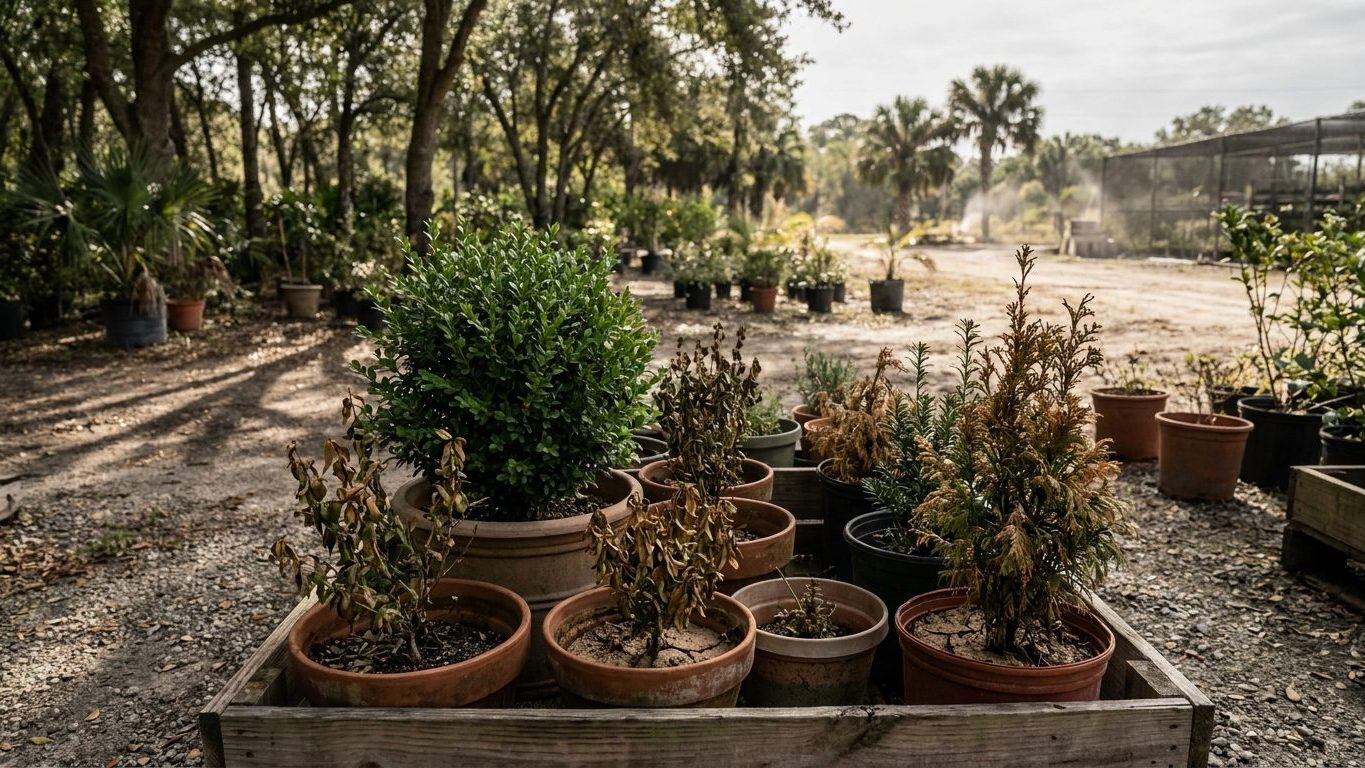

Every hedge species on our Mississippi list survives somewhere in the state, and none fails everywhere. The catch is the middle bucket. Of the 12 species documented on this site, 5 hold across all of Mississippi (USDA zones 7b to 9a), 7 hold in only part of it, and 0 fail outright. Those seven can look hardy on a plant tag and then struggle where it counts. Your zone, not a simple yes or no, decides which ones belong in your yard.
What actually holds in Mississippi
A USDA hardiness zone rests on one number: the average annual extreme minimum temperature. The USDA Plant Hardiness Zone Map 2023 builds it from 1991-2020 normals, and it puts Mississippi at 7b to 9a. That is a range, not a verdict on your property, so check which band your county sits in before you order anything. “Holds” here means survives. It says nothing about how a plant will look in year ten, and where a plant’s range stops on the warm side, heat is often the reason rather than cold.
Seven plants that hold in only part of the state
Boxwood (Buxus sempervirens), cherry laurel (Prunus laurocerasus) and arrowwood viburnum (Viburnum dentatum) hold in zones 7b, 8a and 8b. Zone 9a falls outside their range. Four others hold in 7b only, the coolest zone in Mississippi: privet (Ligustrum vulgare), yew (Taxus x media), arborvitae (Thuja occidentalis) and eastern hemlock (Tsuga canadensis). Plant those four anywhere warmer and you are working outside their documented range, whatever the nursery tag suggests.
Five plants that hold everywhere
American hornbeam, Leyland cypress, inkberry holly, winterberry holly and eastern red cedar survive from 7b through 9a. Inkberry stays evergreen, while winterberry loses its leaves in winter, which matters if you want a January screen. Hardiness ranges come from the NC State Extension Gardener Plant Toolbox, crossed with Mississippi’s own USDA range.
| Plant | Holds in | Regrows from old wood |
|---|---|---|
| Boxwood | 7b, 8a, 8b | Yes |
| Cherry laurel | 7b, 8a, 8b | Yes |
| Arrowwood viburnum | 7b, 8a, 8b | Yes |
| Privet | 7b only | Yes |
| Yew | 7b only | Yes |
| Arborvitae | 7b only | No |
| Eastern hemlock | 7b only | Yes |
| American hornbeam | 7b to 9a | Yes |
| Leyland cypress | 7b to 9a | No |
| Inkberry holly | 7b to 9a | Yes |
| Winterberry holly | 7b to 9a | Yes |
| Eastern red cedar | 7b to 9a | No |
The hedges you can never cut back down
The last column of that table matters more than the zones. Three of the twelve will not sprout from bare, old wood: Leyland cypress, arborvitae and eastern red cedar. Cut into the brown, leafless interior of any of them and the branch stays bare. A hedge of these plants is whatever height you let it reach, and no hard prune can fix an overgrown one later.
Leyland cypress is the trap for most homeowners, because it holds statewide and races upward at 3 to 4 feet a year toward 15 to 25 feet as a screen. Planted as a tidy 6-foot hedge and left alone for a few seasons, it outruns any trimmer. Prune it from late spring to midsummer, and start early, while every cut still lands in green growth. Eastern red cedar grows 12 to 24 inches a year and reaches 8 to 20 feet as a screen. It takes light cuts only, in late winter.
Arborvitae moves slower, at 6 to 9 inches a year, and reaches 4 to 15 feet as a hedge. It is also a 7b-only plant here, so it has both a range problem and a no-regrowth problem. Trim it in late winter before growth starts, or in midsummer.
Everything else on the list regrows from old wood, which makes those plants forgiving of neglect. Boxwood, privet, cherry laurel, yew, hemlock, arrowwood viburnum, hornbeam, inkberry and winterberry can all be cut hard and rebuilt. Regrowth still takes time, though. Boxwood adds only 3 to 6 inches a year, so a boxwood hedge cut back hard may take years to refill. Hemlock recovers, but the note for it says light cuts only.
The practical rule is to decide the finished height before you buy. If the site can only take 6 feet, skip the Leyland and the cedar, however cheap and fast they are. Pick something you can renovate.
Matching the plant to the job
Start with height, since it sorts the field quickly. A low, formal edge points to boxwood (2 to 6 feet as a hedge, zones 7b to 8b) or yew (3 to 8 feet, 7b only). A middle-height hedge of 5 to 15 feet fits inkberry or winterberry holly, both at 6 to 12 inches of growth a year, or American hornbeam at about 12 inches a year and 6 to 15 feet. Arrowwood viburnum reaches 6 to 10 feet, growing 12 to 24 inches a year. For a tall privacy screen, the options are Leyland cypress (15 to 25 feet), eastern red cedar (8 to 20 feet), cherry laurel (6 to 15 feet, 7b to 8b) and hemlock (10 to 20 feet, 7b only).
Speed is the second sorting question. Privet gains 2 to 3 feet a year and reaches 4 to 12 feet as a hedge, which means two trims a season, in spring and midsummer. Cherry laurel adds 1 to 2 feet a year, and its trim comes in late spring, after flowering. Yew and boxwood are the slow end of the list, and slow plants cost more up front but demand less pruning.
Pruning windows differ enough that a mixed planting becomes a calendar exercise:
- Late winter, while dormant: inkberry and winterberry holly.
- Late spring: boxwood (after the last frost), cherry laurel (after flowering), yew (after new growth hardens) and hemlock.
- Right after flowering: arrowwood viburnum.
- Midsummer, after the first flush: American hornbeam.
None of the pruning windows in our notes for these twelve plants names autumn. Late September is a month for planning and ordering, not trimming. For the wider picture on hedge types and care, see Hedges.
The ground you are planting into
Mississippi’s official state soil, named by law in 2003, is the Natchez series, an Inceptisol, which is a young soil without strong horizons yet. USDA NRCS records its surface layer as slightly acid, at a pH of about 6.2, and silt-dominated: 5 percent sand, 13 percent clay and 82 percent silt. Organic matter is about 1.8 percent, and the soil is well drained. Those are representative figures for the mapped surface horizon (31 components, queried 2026-08-29), not a reading from anyone’s garden bed.
Treat them as a tendency. Ground like this sheds water rather than holding it and carries little organic matter, so a new hedge leans on mulch and watering through its first dry spells. Your own yard may differ completely. River bottoms, hill country and any lot a builder scraped or filled can look nothing like the Natchez series. Get a soil test through Mississippi State University Extension and plant against your own number, not the state’s.
Frost dates carry the same warning. NOAA NCEI 1991-2020 Climate Normals for the reference airport station put the last spring freeze (32°F, 30-70% probability band) between March 6 and March 22, and the first fall freeze between November 7 and November 22. Suburban and rural gardens usually freeze later in spring and earlier in fall, often by one to two weeks, and more at elevation. For boxwood, whose trim is timed to the last frost, add that margin before you cut. Neighboring-state lists sort the same kind of plants against different zones, as the pages for Hedge Plants for South Carolina: What Holds, and What Only Looks Hardy and Hedge Plants for Wisconsin: What Holds, and What Only Looks Hardy show.
Common questions
Which hedge plants hold across all of Mississippi?
Five of the twelve species documented here: American hornbeam, Leyland cypress, inkberry holly, winterberry holly and eastern red cedar. They survive in zones 7b through 9a. Leyland cypress and eastern red cedar cannot be cut back to size once they outgrow the space.
Can I grow boxwood or cherry laurel in the warmest part of the state?
Both are documented for zones 7b, 8a and 8b only. Zone 9a falls outside that range, and the warm limit is often about heat rather than cold. If your county is in 9a, choose from the five statewide plants instead.
Which hedges can never be cut back hard?
Leyland cypress, arborvitae and eastern red cedar. They do not regrow from old wood, so cuts into bare interior growth stay bare. Every other plant on the list can be cut back and rebuilt, though slow growers like boxwood take years to recover.
Where do I confirm my own zone and frost dates?
Start with the Mississippi State University Extension office for your county. The frost dates here come from one reference airport station, and this page does not publish county-by-county figures.