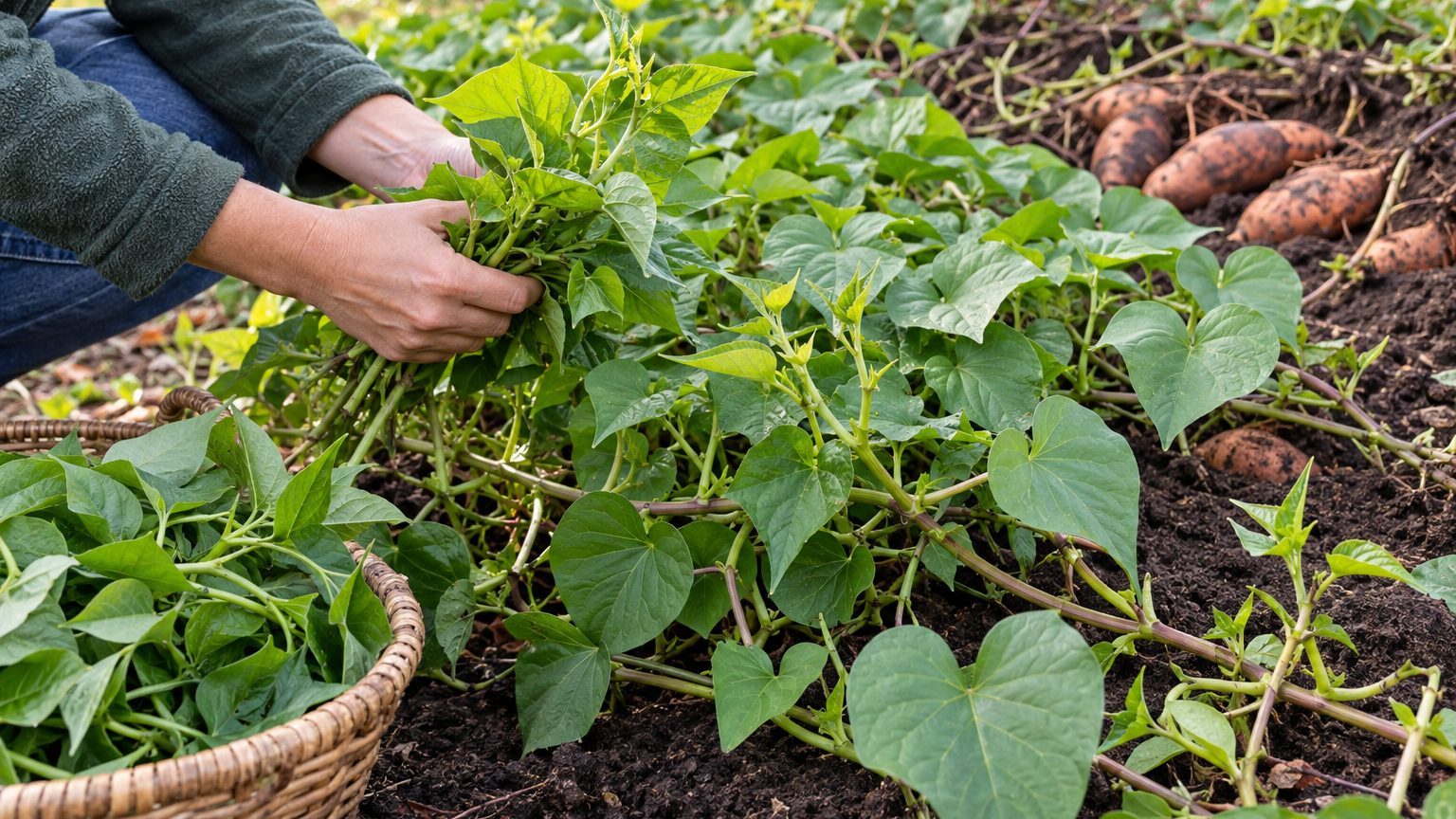

Yes, the leaves are edible, and a moderate harvest barely dents the roots. Sweet potato vines regrow from the tips, so pinching a few handfuls of young growth each week is closer to pruning than to raiding the crop. Most of the world already treats the foliage as a vegetable. American gardeners mostly cut it back and toss it on the compost pile.
What is actually going on
The thing to understand is that a sweet potato plant makes far more leaf than it needs. Leaves are the solar panels. The storage roots are the battery, and they fill with sugars the foliage produces. A healthy vine in a warm season sprawls in every direction, sets roots at its nodes and keeps pushing new growth from the tip. Take off the tip, and the buds just behind it wake up and send out side shoots. The plant bounces back because it was built to keep growing.
That is why a moderate leaf harvest costs the roots little. The plant has surplus canopy, and the canopy is renewable. What matters is how much leaf area stays behind to keep feeding the roots. Strip a vine to bare stems and you have unplugged the battery charger. Take the top several inches from a range of vines and the plant hardly registers the loss.
Why it is eaten elsewhere and ignored here
Across parts of Africa, Asia and the Pacific, sweet potato greens are a routine market vegetable, cooked the way Americans cook spinach or collards. The flavor is mild and a little earthy, and the texture is sturdier than spinach once cooked. In the US the plant has been bred and marketed almost entirely for its roots, so the foliage never became part of the food culture. Nothing about the plant forbids it. It is a habit gap.
Not a potato, not a yam
One clarification matters here more than usual. Sweet potato is not a potato and it is not a yam, whatever the supermarket label says. It belongs to the morning glory family, not the nightshades. That is relevant because the foliage of true potatoes is toxic and should never be eaten. Sweet potato leaves are a different plant with a different chemistry, and the two must not be mixed up in a garden bed or in a kitchen. True yams, a separate group of tropical tubers, are also not what you are growing in a US backyard.
Keep the caution in proportion. Sweet potato leaves contain oxalates, as spinach and beet greens do, so anyone on an oxalate-restricted diet for kidney stones should ask a doctor before making them a habit. For most people, cooked greens in normal amounts are ordinary food.
If you are still planning the bed, the full Growing Sweet Potatoes: Slips, Heat, and a Careful Cure guide covers the roots. This page covers the crop growing above them. Plants on a well-built ridge, as explained in Why Sweet Potatoes Are Grown on Ridges, tend to have plenty of vine to spare in a decent season, which is exactly what makes a leaf harvest possible.
In the garden
The practical question is how much you can take before the roots notice. No single number applies everywhere. A conservative habit works nearly anywhere: cut from many vines rather than a lot from one, and always leave most of the canopy in place. The table below sets out common situations, and what goes wrong in each.
| Situation | What to do | What happens when it goes wrong |
|---|---|---|
| Regular pinching for the kitchen | Take the top several inches of tip and young leaves from a few vines, rotating among plants | Cutting the same vine every time leaves it stunted and thin, while never pinching lets vines run long and leggy with few side shoots |
| A bigger harvest for a large pot of greens | Spread the cuts thinly across many vines | Stripping one plant bare stalls it, and its roots lag behind its neighbors |
| Early in the season, just after planting | Wait until vines are established and running | Cutting small plants delays canopy closure and slows the roots that are just starting to bulk |
| Late in the season while roots are filling | Keep the picking light | Heavy cuts leave the roots short of sugars during the stretch when they need them most |
| Before digging | Vines cut back ahead of the fork are fair game if the leaves are healthy | Leaves blackened or slimy from cold damage are not worth eating |
| In the kitchen | Use tender tips and young leaves, cooked briefly | Old leaves and thick stems turn tough and stringy no matter how long you cook them |
Cooking is simple. Wash the greens well, since the sprawling vines pick up soil splash. Sauté them in a skillet with oil and garlic, stir them into soups near the end of cooking, or blanch and dress them like any other leafy green. Tips and young leaves cook fast, in a few minutes. Discard the tough lower stems.
Two cautions on sourcing. First, ornamental sweet potato vines sold in nursery flower baskets are the same species, bred for colorful foliage rather than for roots, and they may have been treated with products never meant for food. Unless you know how a plant was grown, do not eat it. Second, the same goes for your own beds. Only harvest greens from plants that have not been sprayed with anything not labeled for edible crops, and if you use any pest control on the bed, follow the label’s rules for food plants and its waiting period before harvest.
Leaf-harvest habits do not fix root problems. If you dig up roots with holes or tunnels, the causes are animal or insect, and the diagnosis is in Holes and Tunnels in Sweet Potato Roots.
What it depends on where you are
Part of this page is national. The biology holds from Georgia to Oregon: the plant regrows from its tips, leaves feed roots, and taking a little from many vines is safer than taking a lot from a few. Part of it is local, and this page cannot see your yard.
Season length is the biggest local variable. Where summers are long, vines have time to recover from every cut and still fill the roots. Where the season is short, every leaf counts more, because there are fewer weeks left for regrowth, and you should be more cautious about how much you take and how late you take it. Summer heat matters too. Sweet potatoes love warmth, and in hot weather vines regrow quickly. In a cool summer growth crawls, and a cut that a vine would shrug off elsewhere can set it back for weeks.
Summer rainfall changes the picture in a third way. Steady moisture gives lush, tender foliage, but wet soil brings its own risks to the roots underground. Dry summers make leaves tougher and the plant more dependent on your watering. None of these factors gives a universal schedule, and anyone who hands you one for the whole country is guessing.
The right move is to check two sources. The state pages on this site cover local conditions, and your state’s cooperative extension service, run through the land-grant university, knows which types have been trialled where you live and how the growing season behaves in your county. Search for your state name plus “extension sweet potato.” That is also where to ask which types of sweet potato suit your climate, including whether any are grown specifically for foliage. This page will not name a variety it cannot source.
The mistake that costs the most
The costly mistake is treating the vines like a lettuce bed and stripping a plant of most of its leaves in one go, especially once the roots have started to fill. It happens because the vine looks enormous and unstoppable. It seems obvious that a plant that size can spare an armful. But the canopy you see is doing the work that is filling the roots below, and a plant cut back hard has to spend its reserves rebuilding leaves instead of building roots.
The damage is quiet. Nothing dies, and there is no visible warning. The vine sprouts new growth within days, which looks like recovery. The loss shows up in the fall, when you dig and find fewer or smaller roots than the vines promised. By then the season has ended and nothing can be corrected.
The alternative is a rotating, light harvest. Pick tips from many vines, a little at a time, and leave the bulk of the leaf area untouched. Ease off as the season winds down and the roots are working hardest. If you want a lot of greens, plant a few extra vines for that job so the ones you count on for roots stay intact. And when in doubt, take less than seems reasonable. The greens will still be there next week.
Common questions
Are sweet potato leaves safe to eat?
Yes, for most people, when cooked and grown without chemicals not meant for food. The leaves contain oxalates, so anyone advised to limit oxalates because of kidney stones should check with a doctor first. Never confuse them with true potato foliage, which is toxic.
Can I eat the leaves of ornamental sweet potato vines?
Same species, but the answer is usually no, or at least not unless you know how the plant was grown. Nursery baskets may have been treated with products not intended for edible crops. Grow your own from food-grade slips if you want greens.
Will picking leaves ruin my harvest of roots?
Not if you stay moderate. Take tips from many vines, leave most of the canopy, and go lighter late in the season. A short season or a cool summer calls for extra caution, and your state extension service can tell you how much slack your area gives you.
Can I cut the vines before I dig?
Many gardeners do, since it clears the way for the fork, and healthy vines make good eating. What happens after digging matters more. Freshly dug roots need to cure somewhere warm, and they should never go in a refrigerator or a cold cellar. Cold injury is permanent and is one of the most common ways a good crop gets ruined. Before you store any root, inspect it. A soft patch or a weeping spot ends the question for that root, and a firm, sound-looking skin is not a guarantee that it is safe.