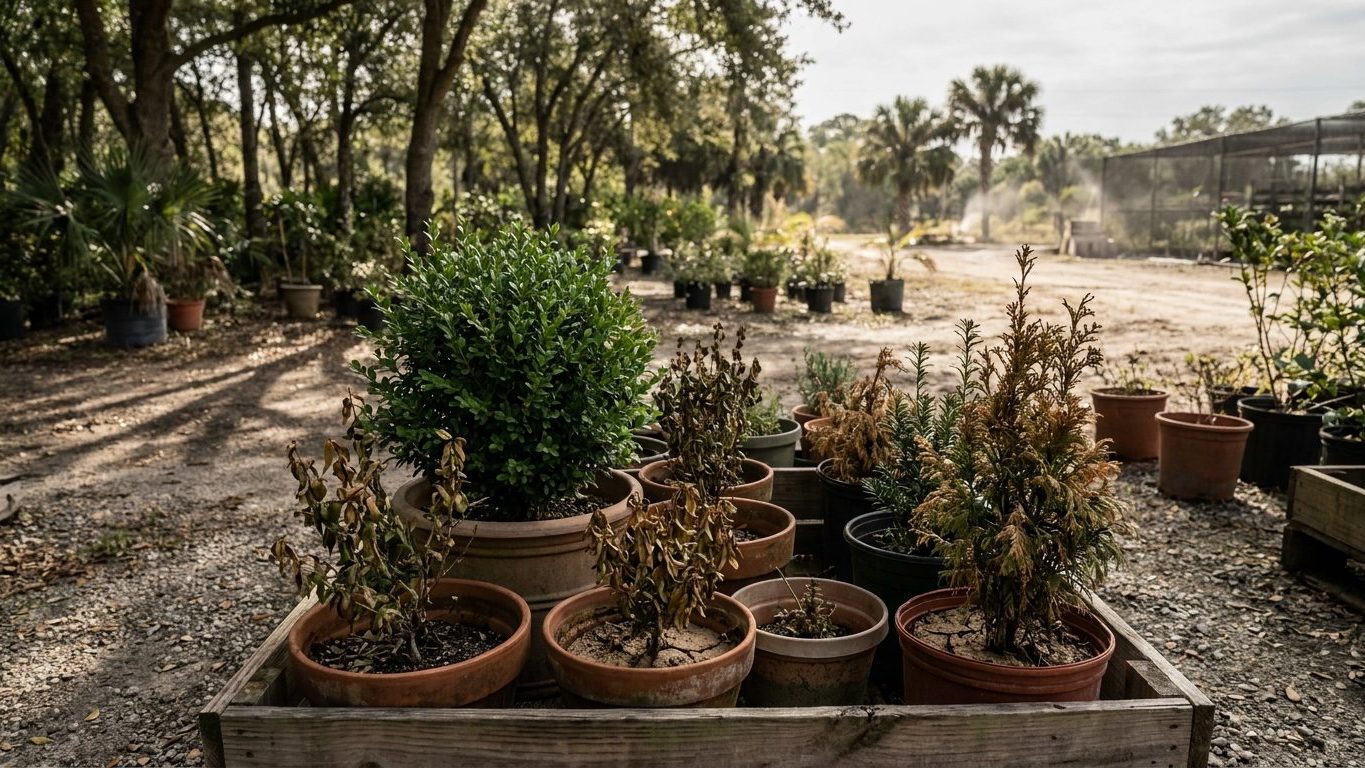

New Mexico runs from USDA zone 4b to 9a, and that spread decides which hedge you can plant. Of the 12 hedge species, 4 hold across the whole state, 8 hold in only part of it, and none fail everywhere. The risk sits in that middle group. Leyland cypress and cherry laurel fall outside the range in the coldest zones, and privet, yew, arborvitae and hemlock give out before the warmest ones.
What actually holds in New Mexico
The 4b-to-9a range comes from the USDA Plant Hardiness Zone Map (2023 edition, built on 1991-2020 normals). That system uses one variable: the average annual extreme minimum temperature. It says nothing about summer heat, dry air or alkaline dirt. “Holds” means survives a typical winter low. It does not promise a handsome hedge. The upper end of a range is often a heat limit, and a plant sitting at that edge can stay alive and sulk for years.
The hardiness ranges come from the NC State Extension Gardener Plant Toolbox, crossed with New Mexico’s own span of zones. That span covers the whole state, but your yard sits in one zone, and elevation can change it within a short drive. Look up your address before you buy anything.
The four that clear the whole range
American hornbeam grows 6 to 15 feet as a hedge, adds about 12 inches a year and gets pruned in midsummer after the first flush. Inkberry holly is evergreen, reaches 5 to 15 feet and takes its cuts in late winter while dormant. Winterberry holly matches it in size and schedule but loses its leaves in winter. Eastern red cedar builds an 8-to-20-foot screen at 12 to 24 inches a year, with light cuts in late winter. Three of the four regrow from old wood. The cedar does not.
The eight that depend on your zone
| Plant | Holds in zones | Growth a year | Height as hedge | Regrows from old wood |
|---|---|---|---|---|
| Boxwood | 5a to 8b | 3 to 6 inches | 2 to 6 feet | Yes |
| Leyland cypress | 6a to 9a | 3 to 4 feet | 15 to 25 feet | No |
| Privet | 4b to 7b | 2 to 3 feet | 4 to 12 feet | Yes |
| Cherry laurel | 6a to 8b | 1 to 2 feet | 6 to 15 feet | Yes |
| Yew | 4b to 7b | 6 to 12 inches | 3 to 8 feet | Yes |
| Arborvitae | 4b to 7b | 6 to 9 inches | 4 to 15 feet | No |
| Eastern hemlock | 4b to 7b | 12 to 24 inches | 10 to 20 feet | Yes |
| Arrowwood viburnum | 4b to 8b | 12 to 24 inches | 6 to 10 feet | Yes |
Read the table from both ends. At the cold end (4b), boxwood, Leyland cypress and cherry laurel are out. At the warm end, privet, yew, arborvitae and hemlock stop at 7b, so a garden in 8a or 9a loses all four. In 9a, Leyland is the only one of the eight left. Other states sort the same twelve species differently; Hedge Plants for North Carolina: What Holds, and What Only Looks Hardy shows how.
The hedges you can never cut back down
Three of the twelve species will not sprout from old wood: Leyland cypress, arborvitae and eastern red cedar. Cut into the bare, leafless interior and the branch stays bare. There is no second chance, so the hedge has to be held at its target size from the first year.
Leyland is the dangerous one, because it holds only in zones 6a to 9a and grows 3 to 4 feet a year. Skip two summers of pruning and you have added 6 to 8 feet. Pruning it back to size afterward is not possible. As a screen it wants 15 to 25 feet of room, and it gets cut between late spring and midsummer. If the space is a narrow side yard, this is the wrong plant, however fast it fills in.
Arborvitae (zones 4b to 7b) is the gentler case. It adds only 6 to 9 inches a year and stays at 4 to 15 feet as a hedge. Trim it in late winter before growth starts, or in midsummer. Slow growth makes mistakes easy to avoid, but one hard cut into brown wood leaves a permanent hole. Eastern red cedar, the statewide option, grows 12 to 24 inches a year toward 8 to 20 feet. It takes light cuts in late winter and nothing more.
Compare that with the plants that forgive you. Privet is the classic hard-prune hedge: 2 to 3 feet of growth a year, cut twice a season (spring and midsummer), and it rebuilds from old wood. Yew, boxwood, cherry laurel, arrowwood viburnum, hornbeam and both hollies also regrow. Hemlock regrows too, though its schedule calls for light cuts in late spring.
The practical rule: pick the plant whose mature height matches the height you want to keep. A 6-foot hedge from a species listed at 15 to 25 feet is a maintenance problem, and with a no-regrow plant it becomes an unfixable one. Late September is also the wrong month to cut any of the three. Leyland’s window closed at midsummer, and arborvitae and red cedar wait for late winter.
Matching the plant to the job
Start with what the hedge is for, then check the zone. A few pairings:
- Tall screen: eastern red cedar statewide, Leyland in 6a to 9a, hemlock in 4b to 7b (10 to 20 feet, regrows, light cuts only).
- Formal, low, clipped: boxwood (2 to 6 feet, 3 to 6 inches a year) in 5a to 8b, or yew (3 to 8 feet) in 4b to 7b.
- Quick fill on a budget of patience: privet at 2 to 3 feet a year in 4b to 7b.
- Informal and wildlife-friendly: hornbeam, inkberry, winterberry or arrowwood viburnum (6 to 10 feet, pruned right after flowering).
Timing depends on frost, and the only dates come from one airport weather station. NOAA NCEI’s 1991-2020 normals (30-to-70-percent probability band for a 32°F freeze) put the last spring frost at March 31 to April 12 and the first fall frost at October 29 to November 9 for that station. Suburban and rural gardens usually see the last spring frost one to two weeks later and the first fall frost one to two weeks earlier, and elevation stretches both further. Check your county before you set a date.
With today at September 29, that first-frost window is about a month out at the reference station and possibly sooner at your place. Boxwood, which is pruned in late spring after the last frost, waits until well after mid-April there. Gardeners near the Colorado line at higher elevation can compare notes with Hedge Plants for Colorado: What Holds, and What Only Looks Hardy. For the wider picture, see Hedges.
The ground you are planting into
Hardiness zones ignore soil, and New Mexico’s soil is not forgiving. USDA lists the Penistaja series, an Aridisol (a dry-climate soil, usually alkaline and often carrying salts), as the state’s representative soil. Its surface horizon averages a pH of about 7.5, which is alkaline. It is sandy, with 69 percent sand, 15 percent clay and 16 percent silt, and holds about 1.4 percent organic matter. It drains well. Those figures come from USDA NRCS Soil Data Access (47 mapped components, queried August 29, 2026).
These are representative values for the mapped surface, not a measurement of your bed. River bottoms, hill country and any lot a builder has scraped or filled can differ completely. Use them as a tendency: ground in this state often sheds water fast, holds few nutrients and leans alkaline. For a hedge, that means new roots dry out quickly, and plants that prefer acid soil may struggle even when the zone says yes. The two hollies are the ones I would test for first, since they are usually associated with acidic ground.
A soil test gives you your own pH and salt reading for the price of a few dollars and a mailed sample. The New Mexico State University extension service at aces.nmsu.edu can point you to your county office and to testing options. Do it before you buy 40 feet of hedge plants, not after.
Common questions
What is the safest evergreen hedge for all of New Mexico?
Two evergreens hold across the full 4b-to-9a range: inkberry holly and eastern red cedar. Holding means surviving winter lows, not thriving in every soil or heat level. Red cedar cannot be cut back to size once it outgrows its space, and inkberry can.
Can I grow boxwood in New Mexico?
Only in zones 5a to 8b. It grows 3 to 6 inches a year, reaches 2 to 6 feet as a hedge and regrows from old wood. Prune it in late spring after the last frost. In 4b and 9a it falls outside its documented range.
Which hedge grows fastest?
Leyland cypress adds 3 to 4 feet a year in zones 6a to 9a, but it cannot be cut back once it gets too big. Privet grows 2 to 3 feet a year in 4b to 7b and recovers from hard pruning. Hemlock and hornbeam are steadier, at 12 to 24 inches and about 12 inches a year respectively.
Should I test my soil before planting a hedge?
Yes. The state’s representative soil is alkaline, sandy and low in organic matter, but your yard may not match it. A test tells you your own pH, and your county extension office can help you interpret it.