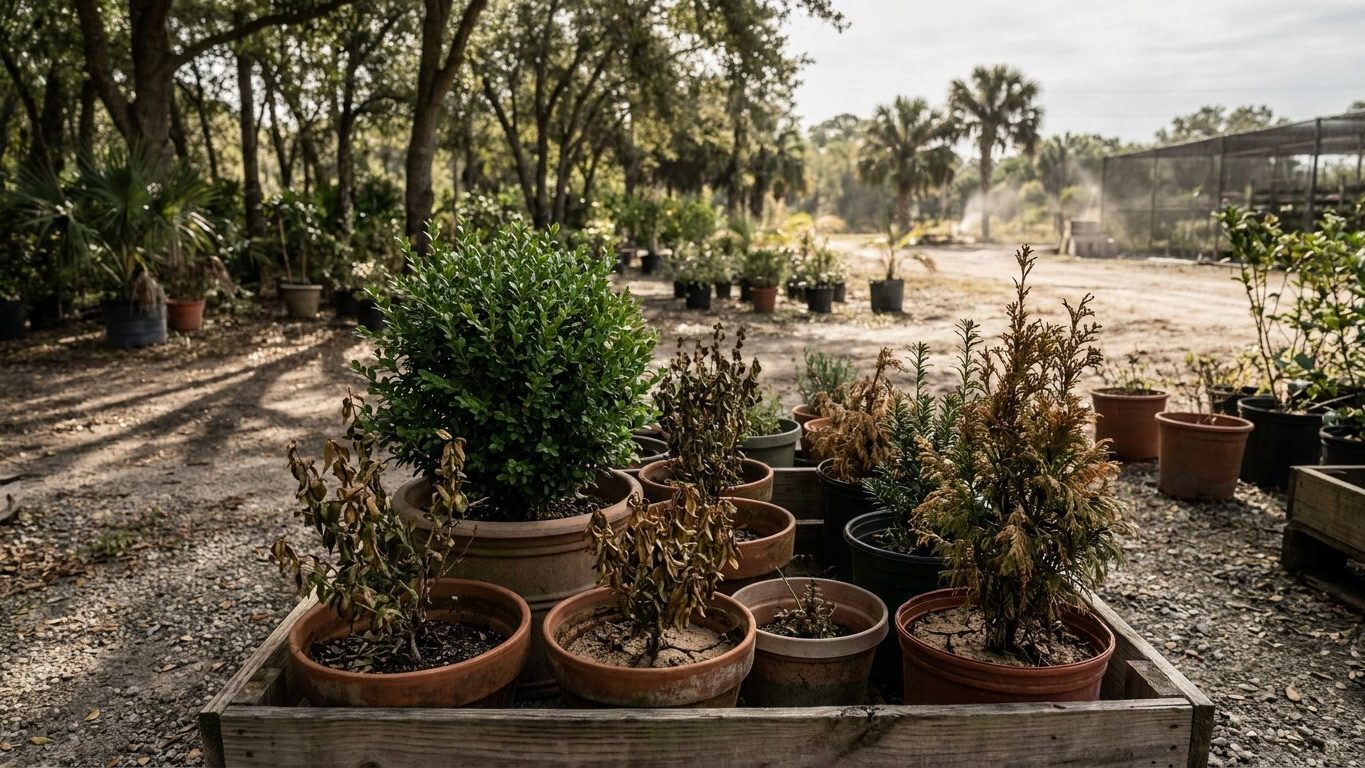

Ask which hedge plants work in Arizona and the honest answer is: it depends on which Arizona you mean. The state’s USDA hardiness range runs from 4b to 10b, one of the widest spans of any state in the country, stretching from the pine country around Flagstaff to the cactus flats around Yuma. None of the twelve hedge species tracked across this site survive that entire range. Every one of them fits only part of it, and matching your ground to the right plant matters more than chasing any single “best hedge” list.
What actually holds in Arizona
Start with what will die on you, not what will thrive. Every hedge species carries an upper zone limit as well as a lower one, and in Arizona the upper limit is usually the one that matters. USDA hardiness zones are built on a single measurement, the average annual extreme minimum temperature, tracked over the 1991-2020 period and released as the USDA Plant Hardiness Zone Map in 2023. That number tells you how cold a place gets in a rough winter. It says nothing about how hot it gets in July, and that is exactly the variable that kills a boxwood or a yew in the low desert even when the zone map technically calls that ground warm enough for it.
Arizona spans zones 4b through 10b. Of the twelve hedge species documented on this site, none survive across that whole range. Twelve survive in part of it. None survive nowhere. That third bucket is the one worth sitting with: every classic hedge plant on this list has a home somewhere in Arizona, but almost none of them have a home everywhere in it.
| Plant | Hardy USDA zones | Regrows from old wood |
|---|---|---|
| Boxwood | 5a-8b | Yes |
| American hornbeam | 4b-9b | Yes |
| Leyland cypress | 6a-10b | No |
| Inkberry holly | 4b-9b | Yes |
| Winterberry holly | 4b-9b | Yes |
| Eastern red cedar | 4b-9b | No |
| Privet | 4b-7b | Yes |
| Cherry laurel | 6a-8b | Yes |
| Yew | 4b-7b | Yes |
| Arborvitae | 4b-7b | No |
| Eastern hemlock | 4b-7b | Yes |
| Arrowwood viburnum | 4b-8b | Yes |
Read that table by geography, not by name recognition. Species that top out at 7b or 8b belong to Arizona’s higher, cooler ground, the country around Flagstaff, Prescott and the White Mountains, where real winter freezes happen and summer heat stays comparatively mild. Species that reach into 9a, 9b or 10b are the only ones with a real shot in the low desert around Phoenix, Tucson and Yuma, and even there, the top of the listed range is a heat survival ceiling, not a promise of a lush, dense hedge. A plant rated to 9b can still limp through a desert summer looking thin and stressed.
The hedges you can never cut back down
Three of the twelve species share a trait that matters more than growth rate or leaf color: cut past the green growth into bare wood, and that wood never sprouts again. Get the size wrong on one of these and there is no rescue pruning, only a permanent bare patch. Leyland cypress, Eastern red cedar and Arborvitae all carry this limitation, and each fits a different slice of Arizona.
Leyland cypress (x Hesperotropsis leylandii) is the only one of the three rated into Arizona’s hottest zones, hardy from 6a to 10b. It grows fast, 3 to 4 feet a year, and builds into a 15 to 25 foot screen, pruned in late spring to midsummer. Because it grows that quickly and can never regenerate from old wood, it needs shaping while it is still young. Wait a few seasons and let it get away from you, and the fix is not a hard cutback, it is starting over with a new plant.
Eastern red cedar (Juniperus virginiana) covers a wider slice of the state, 4b to 9b, growing 12 to 24 inches a year into an 8 to 20 foot screen. Its own pruning note is blunt: late winter, light cuts only. That instruction exists because of the same old-wood limit. It is a native option for the state’s middle elevations, not a plant to reach for if you plan on heavy annual shaping.
Arborvitae (Thuja occidentalis) is confined to zones 4b through 7b, which puts it in Arizona’s cooler high country and takes it off the table entirely for the low desert. It grows more slowly than the other two, 6 to 9 inches a year, reaching 4 to 15 feet as a hedge, pruned in late winter before growth starts or again in midsummer.
The working rule for all three is the same. Always leave a layer of live green foliage on every cut, and decide the mature width you want in the first year of shaping, because there is no hard-cutback option later the way there is with a privet or a boxwood.
Matching the plant to the job
The other nine species split naturally by what job they are doing in the landscape, and Arizona’s zone map decides which of them are even in play. For a tight, formal, hand-clippable hedge, boxwood (5a-8b, growing 3 to 6 inches a year into a 2 to 6 foot hedge, pruned in late spring after the last frost) and yew (4b-7b, 6 to 12 inches a year, 3 to 8 feet, pruned in late spring after new growth hardens) both regrow from old wood, meaning they forgive a hard pruning mistake. Neither one, though, reaches past zone 8b, so both are out of reach for the low desert regardless of how well they are cared for. Privet (4b-7b only) fills the same formal role faster, 2 to 3 feet a year into a 4 to 12 foot hedge, but it demands pruning twice a season, spring and midsummer, to hold a clean line.
For screening and wildlife value, American hornbeam carries the widest range among the deciduous options, 4b to 9b, growing 12 inches a year into a 6 to 15 foot hedge, pruned midsummer after the first flush of growth. Arrowwood viburnum (4b-8b, 12 to 24 inches a year, 6 to 10 feet, pruned right after flowering) adds flowers and berries to the same rough elevation band. Inkberry holly stays evergreen and winterberry holly drops its leaves, but both share the same 4b to 9b range and the same 6 to 12 inch growth rate, both pruned in late winter while dormant. Cherry laurel builds a larger evergreen screen, 6 to 15 feet, but its range is narrower, 6a to 8b only, and it grows more slowly, 1 to 2 feet a year.
Eastern hemlock is worth a separate note. Its documented range, 4b to 7b, overlaps Arizona’s cooler zones on paper, but hemlock evolved in moist, shaded northern woodland, conditions the state’s dry, high-sun climate rarely offers even at elevation. Fitting the zone map is not the same as fitting the site.
Growth rate also decides how long a bare fence line stays bare. Privet and Leyland cypress deliver a filled-in screen fastest; boxwood and yew ask for patience, sometimes years of it, in exchange for a tighter, more formal shape.
The ground you are planting into
The soil USDA records as representative of Arizona is the Casa Grande series, an Aridisol, the classic dry-climate soil profile. Its surface horizon runs about pH 8.5, alkaline, and is mostly sand, 64 percent, with only 14 percent clay and 22 percent silt, organic matter around 0.8 percent, and it drains well.
That alkalinity has a direct effect on several plants from the list above. A pH near 8.5 locks up iron and manganese, showing up as yellowing leaves with darker green veins, a problem for yew, hemlock, and the hollies even in the zones where their hardiness would otherwise allow them. This is not a universal truth for every yard in the state. A river-bottom lot or a bed built on hauled-in topsoil can run very differently from the mapped series, and the only way to know for certain is a soil test rather than an assumption drawn from a statewide average.
Organic matter at 0.8 percent is thin. Most of the species on this list, hornbeam and viburnum especially, developed in richer eastern woodland soils and establish faster when compost is worked into the planting row, even though that amendment does little to shift the underlying pH.
The sandy, well-drained texture cuts both ways. It keeps roots from sitting in water, which lowers rot risk, but it also sheds moisture fast, meaning these hedges need deeper, less frequent watering that reaches the root zone rather than a daily shallow soak that never gets past the top few inches. Before amending blind, a soil test through the University of Arizona Cooperative Extension will tell you whether your own ground matches the state’s representative profile or departs from it.
Common questions
Can I grow a boxwood hedge in Phoenix?
Boxwood’s documented hardiness runs only from zone 5a to 8b. The low desert around Phoenix runs hotter than that upper limit, which is why established boxwood hedges there tend to struggle regardless of watering. It is a plant suited to Arizona’s higher, cooler ground, not the flatland desert.
What’s the fastest-growing hedge for Arizona’s cooler zones?
Among species that fit zones 4b through 7b, privet grows fastest, at 2 to 3 feet a year, though it needs pruning twice a season to stay tidy. Leyland cypress grows faster still, 3 to 4 feet a year, but it only fits zone 6a and warmer.
When should I prune my hedge in Arizona?
Timing follows the species, not a statewide frost calendar. The low desert has no reliable fall freeze; NOAA’s 1991-2020 climate normals for that station show Phoenix reaching 32°F in only 6 of 30 spring seasons. A pruning rule written as “after the last frost” means little there. Follow the timing listed for each plant instead, such as arrowwood viburnum right after flowering or boxwood after the last frost where frost actually happens.
Does frost matter when planting a hedge in low-desert Arizona?
Barely. NOAA station data for the low desert shows a frost-free season in most years, with any freeze arriving as a rare cold snap between late December and mid-January. Arizona’s high country is a different climate entirely, with genuine hard freezes every winter, so a planting calendar written for one part of the state can be flatly wrong for the other.