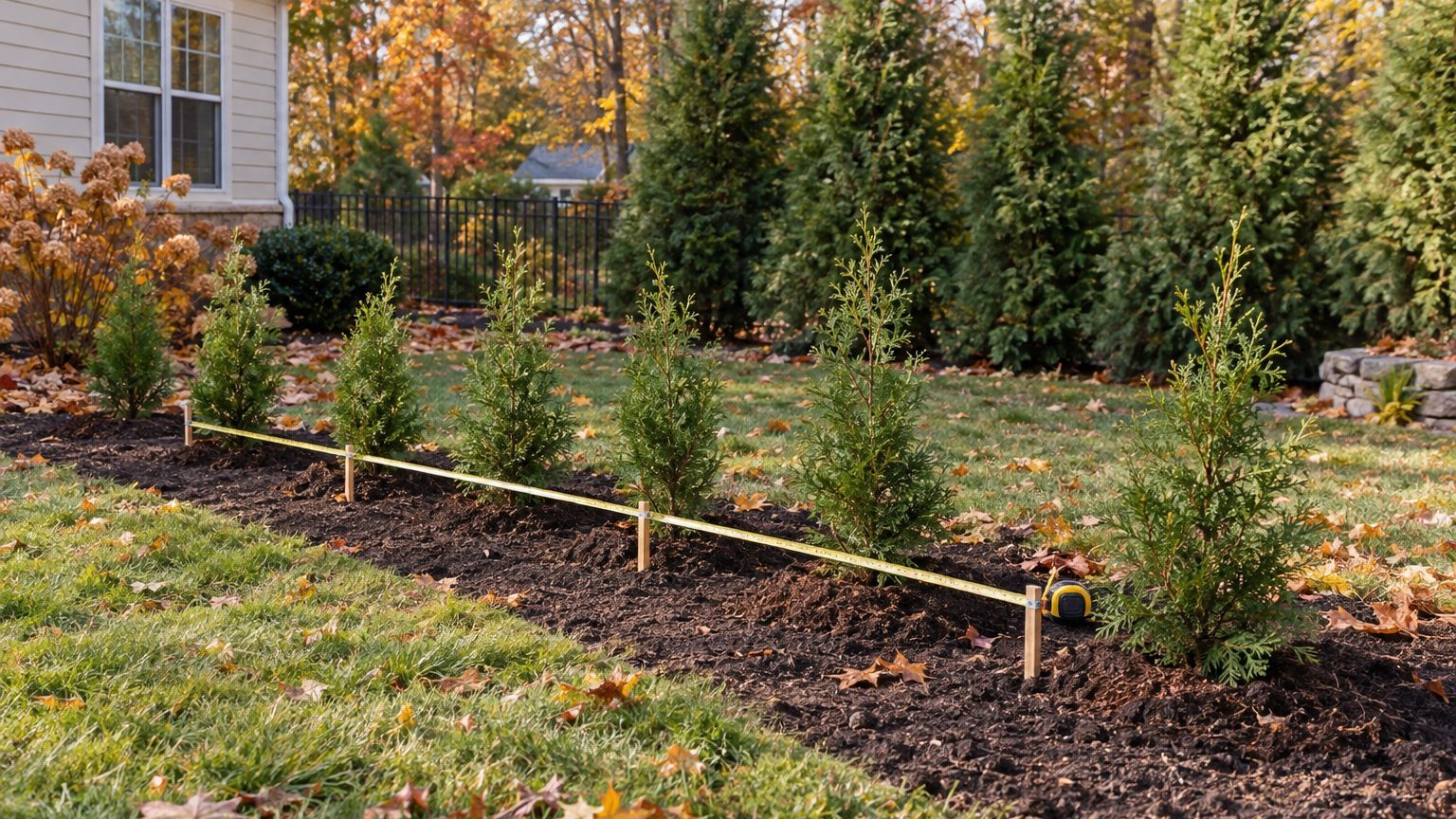

Divide the mature width on the plant tag by two for a screen that closes fast, or multiply it by two-thirds for a hedge that stays healthy longest. Eastern red cedar (Juniperus virginiana) hedges are built from narrow cultivars, so the tag figure counts, not the 10 to 20 feet an untrimmed tree can reach. Get the number right at planting, because this tree can’t be rebuilt later. This guide is part of the wider Hedges series.
How far apart to plant eastern red cedar
The method is arithmetic on a single number: the mature width stated for the cultivar you are buying. Half of it gives the fastest screen. Two-thirds gives plants with more room to stay sound for decades. Measure from the center of one trunk to the center of the next.
One worked example
Say the tag reads 6 feet wide at maturity (a made-up figure, so swap in your own). Half is 3 feet and two-thirds is 4 feet. Your shopping-list number becomes 3 to 4 feet apart, center to center. Pick 3 if speed matters most and 4 if you would rather have a hedge that lasts.
| Width on the tag (example) | Half (fast screen) | Two-thirds (longest-lived) |
|---|---|---|
| 6 feet | 3 feet | 4 feet |
| 9 feet | 4.5 feet | 6 feet |
| 12 feet | 6 feet | 8 feet |
The species width is a ceiling
Reference sources list the untrimmed type species at 10 to 20 feet wide. That is the upper limit of what an unclipped plant does, not a spacing to copy. Planting a hedge 10 to 20 feet apart would leave gaps for years. Hedge cultivars are selected to be far narrower, and you will be clipping them anyway.
If a plant has no stated width, ask the seller for the cultivar’s mature width before you buy. Without it you are guessing, and a wrong guess is expensive to fix.
Two more numbers on the tag or in the description should fit the site. Eastern red cedar is hardy in USDA zones 3 to 9, and as a screen it runs 8 to 20 feet tall. It adds 12 to 24 inches a year, so the gap between plants and the height you want both tell you how long the wait will be.
What planting them closer really buys you
About one season. Shrinking the spacing from 4 feet to 3 removes a foot of gap, and at 12 to 24 inches of growth a year that foot fills in roughly a year sooner. After that, the plants spend the next twenty years competing with each other.
Thin bases and damp air
Crowded cedars fight over the same soil. Their lower branches lose light first, the needles drop, and the base thins. Air stops moving through the middle of the row, and the foliage stays damp longer after rain. Damp, still air is how canker and blight get in.
Eastern red cedar makes this mistake permanent. It does not regrow from old wood. There are no dormant buds under the bark of bare brown branches, so anything cut back past the green growth leaves a hole. A gap in a cedar hedge never refills, and a base that has gone bare stays bare. Cut into the green, never through it.
Trim in late winter, with light cuts only. The exact window follows your local frost dates, so check the timing with your state’s cooperative extension service.
Rust and orchards
Cedar-apple rust needs two hosts to complete its cycle: this tree and an apple tree. If you live near an orchard or have apples in the yard, it matters more. Spacing can’t stop the disease, but open rows dry faster than packed ones, and that is one of the few things you control.
One row or two
A single row is what most gardens need. Most suburban yards have a strip of ground beside a fence or driveway, and one line of cultivars planted at the tag spacing fills it neatly. It is also the easiest arrangement to clip and to keep airy.
A staggered double row zigzags the plants, so each one sits in the gap of the row beside it. It closes faster and screens better at the base and in the middle. The cost is roughly twice the plants and twice the width. With the 6-foot example, a single row needs a strip about 6 feet wide once mature. A double row needs about 12.
Choose the double row when you have open acreage and want a dense screen against wind, a road, or a neighbor. It suits rural lots where the hedge will run 8 to 20 feet tall and no one will squeeze past it. Stay with one row on a narrow lot, where the double row’s extra width would crowd a fence line or walkway.
Whichever you pick, don’t tighten the in-row spacing to compensate. The double row is the way to get more screen, not a license to plant the pair closer than the tag suggests. Other species follow different arithmetic, so see How Far Apart to Plant American hornbeam for a Hedge or How Far Apart to Plant Yew for a Hedge if you are comparing options.
Working out how many plants you need
The formula is short. Divide the length of the run by the spacing, then add one, because a row needs a plant at each end. Follow these steps in order:
- Measure the run in feet along the line the trunks will follow.
- Choose the spacing from your tag (half to two-thirds of the mature width).
- Divide the run by the spacing.
- Add one, and round up if the answer isn’t a whole number.
For a 60-foot run at 4-foot spacing, that is 15 plus 1, so 16 plants. Price them locally, since cost varies by region and by size.
Corners and the boundary
A corner changes the count. One plant sits at the turn, shared by both legs. If you calculate each leg separately with the plus-one step, you count that plant twice, so subtract one from the total.
The setback from the boundary matters just as much. The cedar will reach its full width whatever the plan says, so the trunk needs at least half the tag width between it and the property line. For the 6-foot example, that is 3 feet of clear ground, plus a little more if you want room to trim from your own side. Check local ordinances and any utility easements before you mark the row.
Common questions
Can I plant eastern red cedar 10 feet apart?
Only if the tag says the cultivar is around 20 feet wide, which is rare for hedges. The 10 to 20 feet figure describes the untrimmed type species, and it works as a ceiling. For a hedge, use half to two-thirds of the width on your plant’s label.
Can I cut a cedar hedge back hard if it gets too big?
No. It does not regrow from old wood, so cutting into bare brown branches leaves a permanent hole. Keep trims light and stay within the green growth.
When is the best time to prune?
Late winter, with light cuts only. The exact window moves with your local frost dates, so confirm it with your state’s cooperative extension service instead of relying on a fixed date.
Does it matter if I have apple trees nearby?
Yes. Cedar-apple rust needs both this tree and an apple tree to complete its cycle, so it matters most where orchards are close. Your extension service can tell you how common it is in your area.