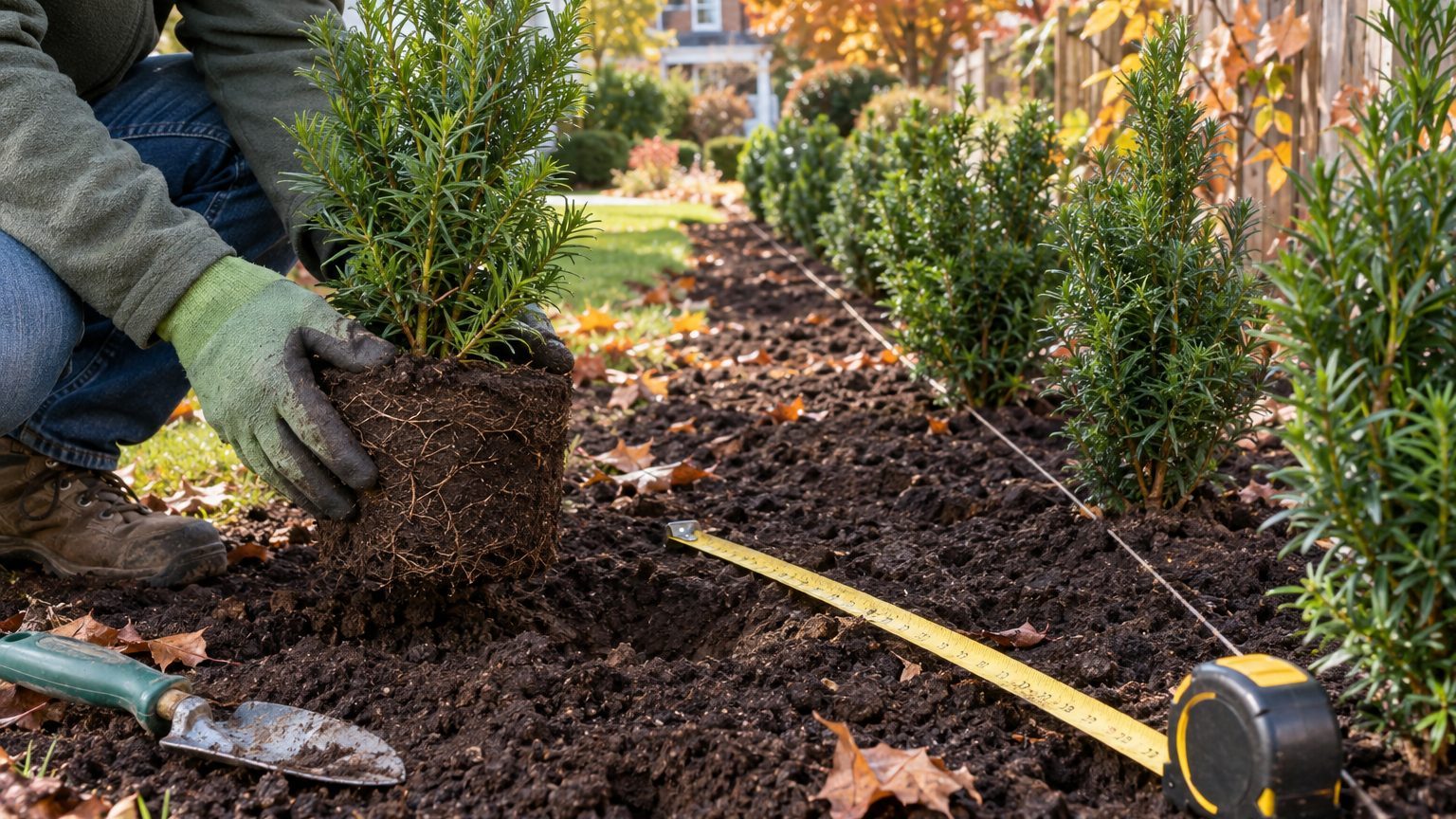

Plant yew at half to two-thirds of the mature width printed on the tag of the cultivar you are buying. The tag decides, not the species figure quoted online. That number describes an unclipped plant and runs far wider than any hedge cultivar. Yew (Taxus x media) is rated for USDA zones 4-7, and the spacing below assumes you are planting inside that range.
How far apart to plant yew
One number from the plant tag does the work: the mature width of that specific cultivar. Multiply it by one-half for a screen that closes fast. Multiply it by two-thirds for plants that stay healthy longest. Trunk center to trunk center is how you measure it.
The species width is a ceiling, not a spacing. Untrimmed, the type species can reach 2 to 12 feet wide, and that is the upper bound of what an unclipped plant does. Hedge cultivars are selected to be far narrower, and they get clipped every year. Space a hedge from the 12-foot figure and you would set plants so far apart they would never meet.
Here is the arithmetic with a made-up but ordinary tag. Say the cultivar lists a mature width of 4 feet:
- Half of 4 feet is 2 feet, or 24 inches, for the fastest screen.
- Two-thirds of 4 feet is 2 feet 8 inches, or 32 inches, for the longest-lived planting.
- Anything between those two is a legitimate choice, and you can nudge it to make your row divide evenly (more on that below).
The number for the shopping list, then, is 24 to 32 inches apart for a 4-foot cultivar. Swap in the width from your own tag and repeat the same two multiplications.
Height does not enter into it. Yew grows 6 to 12 inches a year and is kept as a hedge anywhere from 3 to 8 feet tall, but a 3-foot hedge and an 8-foot hedge of the same cultivar use the same spacing. Width sets the distance between plants. How tall you let the hedge get is a pruning decision.
If the tag gives no mature width, ask the seller for the cultivar’s width as a clipped plant. Do not guess from the species range. A tag that lists only the species is a sign you may not be getting a hedge cultivar at all.
For a different shrub, the same method applies with a different tag. The boxwood version of this math lives at How Far Apart to Plant Boxwood for a Hedge.
What planting them closer really buys you
About one growing season. The gap between 24 and 32 inches is 8 inches, and at 6 to 12 inches of growth a year, that is roughly what one summer adds. A tighter row closes maybe a year sooner. Then the plants spend the next twenty years competing with each other.
The competition starts underground. Roots fight for the same narrow strip of soil, and the shade from neighbors kills the lowest branches, so the base of the hedge thins out. The middle of a packed row also stays damp and still, since air barely moves through it. That is the environment where canker and blight get a foothold.
Yew has its own weakness that makes crowding riskier. Root rot in wet ground is the single most common cause of death for this plant. A tight row planted in heavy soil or a low spot that holds water stacks two problems: roots that cannot spread out and roots that sit wet. If water lingers anywhere along your line, go to the wide end of the range and fix the drainage before you plant. Raising the planting area slightly helps more than any spacing tweak.
Yew does forgive one mistake that other hedge plants do not. It regrows from bare brown wood because it carries dormant buds under the bark. A row that has gone leggy or too thick can take hard renovation and come back, which is exactly why yew is the usual answer for an overgrown hedge. A conifer without that safety net does not get a second chance, and the spacing advice in How Far Apart to Plant Eastern red cedar for a Hedge reflects that.
Renovation timing follows the season, not the calendar. The window is late spring, after the new growth hardens. Your last frost date shifts that by weeks, so ask your state’s cooperative extension service for the local timing.
Regrowth is a rescue, not a plan. A year of patience buys you a base that stays full, air that moves through the hedge, and fewer replacements down the row.
One row or two
A single row is what most gardens need. At 3 to 8 feet tall, one line of yew makes a solid hedge, whether it sits along a driveway, a foundation, or the edge of a garden room.
A staggered double row is a different build. The second row sits opposite the gaps in the first, so the two rows interlock. It closes faster and screens better, but it costs roughly twice the plants and twice the width of a single row. With the 4-foot cultivar from the earlier example, plan on about twice that footprint at maturity, and count each row separately when you order.
| Single row | Staggered double row | |
|---|---|---|
| Plants needed | Run length divided by spacing, plus one | About twice that |
| Width taken | The cultivar’s mature width | Roughly twice as much |
| Closing speed | Slower | Faster |
| Best for | Most yards, narrow strips, property lines | Wide boundaries where you want a dense screen sooner |
Choose the double row when you own the depth for it and want privacy at the taller end of the range without waiting long. A road edge or a neighbor’s windows are common reasons. Choose the single row nearly everywhere else, particularly on narrow lots, where a double row would eat the lawn or crowd a fence.
Keep the drainage warning in mind before you double up. Two dense rows hold more moisture between them than one, and yew does poorly in wet ground. A double row belongs on well-drained soil.
Working out how many plants you need
The formula is short: run length divided by spacing, plus one. The extra plant is the one that finishes the end of the row. Convert everything to inches first so the math stays clean.
Take a 40-foot straight run at 32 inches. That is 480 inches divided by 32, which gives 15, plus 1. The shopping-list figure is 16 plants. If your run does not divide evenly, adjust the spacing a little inside the half-to-two-thirds range until it does. That beats ending the row with an awkward gap.
Corners change the count. Plant one shrub at the corner and let both legs share it, or you will double-count. An L-shaped hedge with legs of 32 feet and 16 feet at 32 inches works out to 13 plants on the long leg and 7 on the short one. That is 20, minus the shared corner, for 19 total.
The boundary setback matters just as much, because the plant will reach its full width whatever the plan says. Measure from the boundary to the center of the row, and leave at least half the mature width plus room to work with shears. For the 4-foot cultivar, that means the row’s center sits more than 2 feet from the line. Check local ordinances or HOA rules for required distances, since those vary by town.
Where a row runs beside a pasture, all parts of yew are toxic to livestock and horses. Set the line so branches and clippings cannot reach over a fence to animals.
Common questions
Can I plant yew closer than half the mature width?
Half is the floor of the method, and going under it gets you the crowding problems described above. If you want speed, start at half and buy a size that fills in sooner, rather than shrinking the spacing.
How far from a fence or property line should the row go?
At least half the mature width on the tag, measured to the center of the row, plus clipping room. A cultivar tagged at 4 feet needs more than 2 feet of clearance. Local rules may ask for more.
Does yew grow in my zone?
Taxus x media is rated for USDA zones 4-7 in the NC State Extension Gardener Plant Toolbox. Confirm your zone before you order anything.
Can I fix a hedge that has grown too thick or bare?
Yes, because yew regrows from old wood. Cut hard in late spring after the new growth hardens. Your state’s cooperative extension service can give the local timing for your frost dates. The wider hedge overview at Hedges covers how other plants handle the same job.