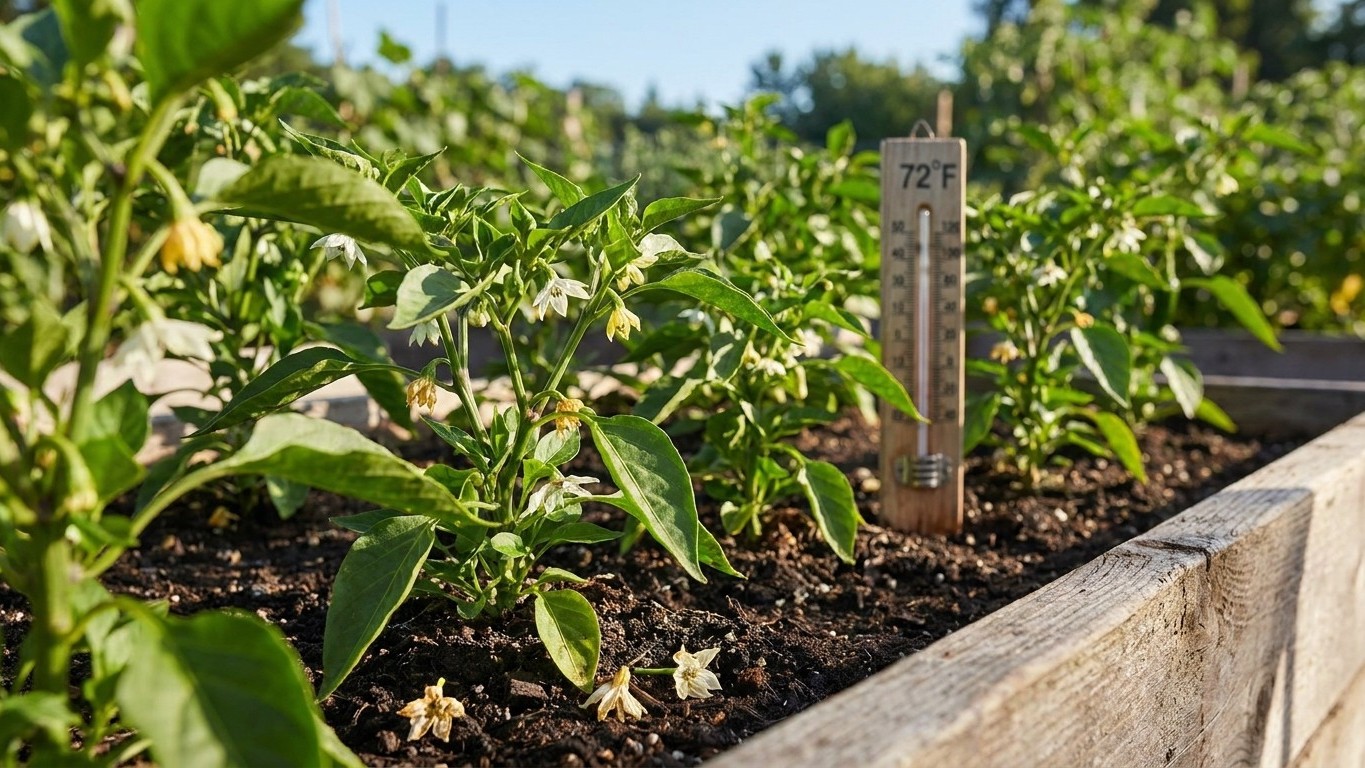

In most of Utah, pepper seed goes into trays somewhere between early February and early March indoors, timed backward from the average last spring frost and a 60°F soil reading. Exactly when depends on your county’s frost date and elevation, but the arithmetic is the same everywhere: count 8 to 10 weeks back from transplant day. Get that timing wrong and Utah’s climate punishes both ends of the growing season, not just the cold one.
The short answer
Start with the number that actually drives most pepper failures in this state: 52.1 days a year at or above 90°F, measured at the Salt Lake City reference station over the 1991-2020 period (NOAA NCEI Climate Normals). That’s not an average summer temperature. It’s a count of heat-load days, the days when soil moisture disappears fast, plants pull water harder than their roots can supply, and flowers abort before they ever become peppers. Fifty-two days is a lot of chances for a hot afternoon to hit right when your plants are blooming, and pepper flowers are unforgiving about it.
Pepper fruit set fails above roughly 90°F daytime heat, according to Utah State University Extension. A single heat spell during flowering can knock blossoms off the plant before pollination ever happens, which is why gardeners in Washington County or the lower Wasatch benches sometimes see plenty of foliage and almost no fruit through the hottest stretch of July and August.
But heat is only one half of the failure. Fruit set also fails when nights drop below 55°F, and that’s the threshold Utah gardeners get wrong most often, because they assume a warm valley day means a warm night. It doesn’t always. This site carries daytime heat-load data for Utah, but it does not carry summer night minimum temperatures, and there’s a good reason to be careful here: night temperatures do not track cleanly with latitude, elevation, or even the coldest month of the year. A bench above a valley can run 10 degrees cooler at night than the valley floor a few miles away. A canyon-mouth garden can trap cold air that a flat suburban lot never sees.
That means the only reliable way to know if your nights threaten fruit set is to watch your own thermometer during bloom, not to guess from where you sit on a map. If you’re gardening in Cache Valley, the Uinta Basin, or anywhere with a reputation for cool nights, track your actual overnight lows once flowering starts. If you’re in a warmer pocket, the daytime heat-load count above matters more. Either way, the fix isn’t a fixed date on a calendar; it’s watching the two thresholds and adjusting shade, watering, or row cover accordingly.
When to start seed here
The scheduling math is simple once you have your own frost date, but it’s worth walking through step by step because Utah’s frost dates swing widely by elevation and region.
- Find your average last spring frost. At the Salt Lake City reference station, the 32°F freeze probability window (the 30 to 70 percent band) runs from April 12 to April 29, according to NOAA NCEI 1991-2020 Climate Normals for station USW00024127. Salt Lake sits in a comparatively mild valley; most of the rest of Utah is higher and colder, so a mountain valley or high bench should expect frost later into May, while southern Utah’s lower elevations often clear frost earlier than this window.
- Confirm soil temperature, not just the calendar. Utah State University Extension recommends transplanting only after frost has passed and the soil has reached 60°F. A calendar date without a soil thermometer reading can still burn a batch of transplants if a cold snap lingers.
- Count backward 8 to 10 weeks from that transplant date. If your local last-frost window sits near the Salt Lake reference dates, an 8-week count lands seeds indoors in mid-February; a 10-week count pushes that back to early February. Gardeners at higher elevation, working from a later frost date, shift their whole schedule later by the same number of weeks.
- Build in slack for a slow soil warm-up. Soil temperature often lags air temperature by one to two weeks in spring, especially in shaded or north-facing beds, so treat the 60°F soil mark as the real trigger, not the frost date alone.
- Recheck before you harden off. Since flowering itself takes another 35 to 45 days after the plant starts blooming, not from the sowing date, an early or late start compounds through the season. A seed start pushed two weeks late can mean flowering lands squarely inside the hottest heat-load stretch instead of just ahead of it.
What goes wrong here
- Blossom drop during a heat spell. When daytime temperatures climb into the 90s during flowering, a pepper plant sheds flowers rather than setting fruit. With 52.1 days a year averaging 90°F or higher at the Salt Lake reference station, this isn’t a rare event in much of the state. The remedy is timing bloom to miss the worst of that stretch where possible, and using shade cloth or afternoon shade during an active heat wave so flowers aren’t hit at their most vulnerable stage.
- Blossom drop from a cool night. The opposite failure shows up when overnight temperatures fall below 55°F during flowering, something that can happen even in a warm valley if a cold air pocket settles in. Since this site doesn’t track summer night minimums, the only remedy is watching your own overnight lows through bloom and using row cover or a warmer microclimate (a south-facing wall, a raised bed) if cool nights are a known pattern in your yard.
- Sunscald on exposed fruit. Utah’s sun is strong at elevation and in the drier southern half of the state, and pepper fruit left without leaf cover can develop pale, papery patches on the side facing direct sun. Keeping the plant’s natural foliage canopy intact, rather than heavily pruning leaves for looks, is the simplest fix, since the leaves are doing real work shading the fruit underneath.
- Blossom-end rot. This shows up as a sunken, dark patch on the bottom of the fruit and is usually a watering-consistency problem rather than a soil-nutrient one; uneven watering interrupts calcium uptake even when calcium is present in the soil. Even, regular watering through fruit development, especially during the hottest weeks when soil dries fastest, is the practical remedy.
Common questions
Can I direct-sow pepper seed outdoors in Utah?
Utah’s frost-free window, combined with the 8 to 10 week germination-to-transplant timeline Utah State University Extension recommends, generally makes direct-sowing impractical here. Peppers need warm soil to germinate reliably, and by the time outdoor soil is consistently warm enough, a direct-sown plant would flower too late to beat the hottest stretch of summer in most of the state.
What if my county’s frost date is different from Salt Lake’s?
Use your own last-frost date as the anchor point and run the same 8 to 10 week backward count from there. The April 12 to April 29 window applies specifically to the Salt Lake City reference station; higher, colder parts of Utah should expect a later frost-free date, and lower desert valleys in the south often clear frost earlier.
Does soil temperature matter more than air temperature for transplanting?
Utah State University Extension ties the transplant trigger to both: frost must have passed and soil must reach 60°F. Air temperature can feel warm on a sunny spring day while soil several inches down is still cold, so a soil thermometer is a better transplant guide than a calendar date or an afternoon air reading.
How do I know if my nights are too cool for fruit set?
There’s no substitute for tracking your own overnight low temperatures during the flowering stage, since night minimums vary by microclimate in ways that elevation or latitude alone don’t predict. If overnight readings during bloom regularly dip below 55°F, expect reduced fruit set and consider row cover or a warmer garden location for the next season.