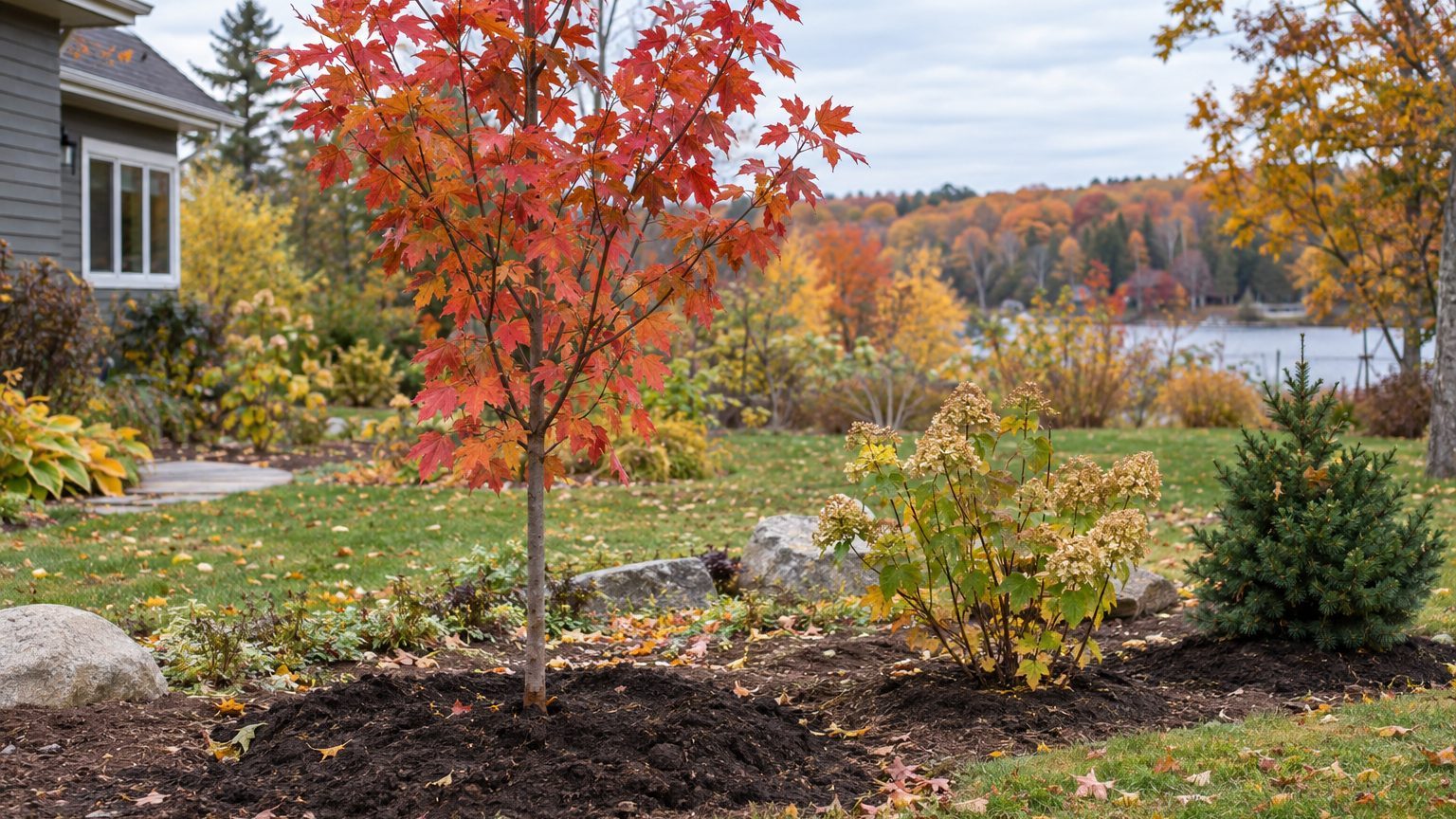

In Arkansas, the safe fall planting target for trees and shrubs is September 26 to October 9, which is six weeks before the first fall frost (November 7 to November 20 at the Little Rock station). Later planting can still work for hardy container plants, because roots keep growing in cool, workable soil. But every week past that window leaves a young tree less time to anchor itself before winter. Here is how the dates are built and what to plant.
The deadline in Arkansas
Roots don’t follow the calendar the way leaves do. Once the air turns cold, top growth quits, but roots keep pushing outward as long as the soil is workable and above freezing. That’s why the real deadline is measured back from the day the ground freezes, not from the first frost on the windshield.
Cornell Cooperative Extension in Orleans County, New York, states the rule this way: “Fall is an excellent time for transplanting, provided you get them to their new home at least 6 weeks before the ground freezes, allowing them time to establish roots before winter dormancy.” Nobody publishes a statewide ground-freeze date for Arkansas, so the practical move is to count back from something that is measured: the first fall frost.
NOAA’s NCEI 1991-2020 Climate Normals for the Little Rock station (USW00013963) put the first 32°F freeze, in the 30-70% probability band, between November 7 and November 20. Count six weeks back from that range and you get the conservative target: plant between September 26 and October 9.
Why that date has a cushion built in
Air cools faster than soil. The ground freezes later than the first frost, so the true limit usually falls well after the dates above. Think of September 26 to October 9 as the safe target, the window where a tree gets its full six weeks with room to spare, rather than a wall. Plant after it and you’re spending that cushion, not breaking a law of nature.
Direction matters inside the state. In the colder part of Arkansas, meaning farther north and at higher elevation, the first fall frost arrives earlier, so the planting deadline moves earlier too. In the warmer southern part, frost holds off longer and the window stretches later. Shift your own target accordingly.
The dates side by side
| Milestone | Date range | Source |
|---|---|---|
| Safe planting target | September 26 to October 9 | Cornell rule applied to NOAA frost range |
| First fall frost (32°F) | November 7 to November 20 | NOAA NCEI 1991-2020 Normals, Little Rock station |
| Light-frost season (36°F) | April 3 to October 31 | NWS Little Rock |
| Ground freezes | Later than the first frost | No single date; varies by year and location |
Arkansas is not a place where the ground never freezes. The mean daily minimum of the coldest month at Little Rock is 30.9°F (NOAA NCEI Climate Normals 1991-2020), which sits below 32°F, so the six-week rule applies here. Local frost timing shifts by county, and the first and last frost dates in Arkansas give a fuller picture of how much.
What to plant late, and what to wait on
Plants sold in containers or as balled-and-burlapped stock carry an intact root system into the ground. They lose less to transplant shock than a bare, freshly dug plant would, and that head start is what makes October planting workable when September slipped by. The catch is that the plant has to be fully hardy where you live.
Good candidates for the tail end of the window
Hardy deciduous trees and shrubs are the safest late bets. They drop their leaves within weeks of going in, so there’s little foliage to lose water while the roots settle. Shade trees, flowering shrubs and fruiting shrubs that are comfortably rated for your zone fit this description.
Check the tag against the USDA Plant Hardiness Zone Map 2023, which places Arkansas in zones 6b to 8a. That range covers the whole state, so look up your own county rather than assuming the middle. The zone rests on one number, the average annual extreme minimum temperature. A separate figure, the 30.9°F mean daily minimum of the coldest month at Little Rock, shows how routine sub-freezing nights are during winter.
Plants that should wait for spring
Borderline plants top the wait list. If a shrub is rated at the very edge of your zone, it can shrug off a cold snap when established and struggle badly when it has been in the ground a few weeks. Spring planting gives it a whole growing season to build reserves before its first winter. Put fully hardy container and balled plants in during the September 26 to October 9 window, and hold borderline plants until spring.
Evergreens sit in between. Needled and broadleaf evergreens keep their foliage all winter and keep losing moisture through it, while roots in cold soil can’t pull much water back up. Plant them at the early end of the window, or wait for spring if the window has already passed.
Tender plants follow a tighter clock. The caution here is that they respond to light frost, not hard freeze, and NWS Little Rock puts the 36°F dates at April 3 and October 31. That is the window that counts for anything frost-sensitive, so the 32°F dates above don’t apply to it. Gardeners farther east who want to compare a neighboring state’s timing can read How Late Can You Plant Trees and Shrubs in Fall in Alabama?
General planting technique (hole width, root-flare height, staking) doesn’t change with the season, and it’s covered in Planting and Caring for Trees, Shrubs and Perennials.
Watering and mulch until the ground freezes
A tree planted in fall has one job before winter: grow roots. Leaves are finished for the year, and buds won’t wake up until spring. Whatever energy the plant has goes underground, out of the container-shaped root ball and into the surrounding soil. That’s the reason the first winter is about roots, not growth, and why a tree that looks like it did nothing all autumn may be doing exactly what it should.
Water deeply, and keep at it until freeze-up
Rain in an Arkansas fall is unreliable, and a new root ball dries out differently from the native soil around it. Water slowly enough that it soaks down instead of running off, and keep the soil evenly moist, not soggy. Check by pushing a finger or a trowel a few inches into the soil at the edge of the root ball. If it’s dry there, water. If it’s wet, skip a round.
Keep going after the leaves drop. Roots stay active in cool soil, and a dry November can undo an October planting. The job ends when the ground freezes, and in an Arkansas winter that can mean stopping and restarting around freeze-thaw swings.
Mulch in a ring, never a volcano
Mulch buffers soil temperature and holds moisture, which is what a fall planting needs. NC State Extension’s Gardener Handbook (chapter 11, Woody Ornamentals) says: “Provide a 3-inch layer of mulch to reduce water loss and maintain uniform soil moisture and temperature around roots.” Elsewhere the same handbook says: “A 2-inch to 3-inch layer of mulch suppresses most annual weed seeds and makes it easy to hand-pull any that do germinate.”
Both sentences point to the same depth, and more is not better. Keep the mulch to a 2-inch to 3-inch layer, spread in a wide ring around the tree, and pull it back so the trunk flare stays visible. Mulch heaped against the bark in a cone holds moisture against the trunk, invites rot and gives rodents cover. The mulching guide covers how to keep the ring clean.
What goes wrong
Planting too late for the climate is the simplest mistake. A tree that goes in after the safe window has less time for roots to establish before cold sets in. In the colder part of Arkansas, that window closes sooner than at Little Rock, so gardeners there who follow the reference-station dates end up planting late without realizing it. If a tree goes in after October 9, plan on extra watering and a proper mulch ring for the whole first winter.
Winter burn hits evergreens. Foliage keeps losing water on dry, windy, sunny winter days while the roots, sitting in cold soil, can’t keep up. The result is brown, crisp needles or leaf edges by late winter. A well-watered plant going into the freeze and mulch over the roots both lower the risk, and planting early in the window gives roots more time to help.
Heaving is what shallow, poorly settled root balls suffer when soil freezes and thaws repeatedly. The soil expands and contracts, and it can push a new plant partly out of the ground, exposing roots to air. Firm the soil at planting, keep mulch in place and check after hard freezes. Press any lifted plant back down and cover the roots.
Drying out is the quiet one. A dry fall can leave a young tree short of water while the surface looks fine, and roots in a dry root ball stop growing. Watering deeply through autumn, even after the leaves are gone, prevents most of it.
Common questions
Can I still plant trees in Arkansas in November?
You can, but the margin is thin. November 7 to November 20 is when the first fall frost typically arrives at the Little Rock station, which is well past the safe window of September 26 to October 9. The ground freezes later than the first frost, so a hardy container-grown deciduous tree may still get some root time, but you’re spending your cushion. Water and mulch carefully, and consider waiting for spring with anything evergreen or borderline.
Does the six-week rule count from the first frost or from frozen ground?
Cornell’s rule counts from when the ground freezes. Because that date isn’t published for Arkansas, the dates here count six weeks before the first fall frost instead, which lands earlier and errs on the safe side. Treat September 26 to October 9 as a cautious target. The true limit usually falls later.
Does the deadline change across Arkansas?
Yes. The colder part of the state, farther north and at higher elevation, sees its first fall frost sooner, so the deadline moves earlier. The warmer part gets a longer window. The USDA Plant Hardiness Zone Map 2023 runs from zone 6b to 8a across the state, which is one reason a statewide date can only be a starting point. Other seasonal timing is collected in the Arkansas guides.
Is spring planting better than fall?
Neither is automatically better. Fall gives roots a head start and spares the plant a summer of heat right after planting, but only if it goes in on time. Spring suits borderline plants and evergreens, and it suits frost-tender ones, which have to wait until after the last light frost near April 3 (NWS Little Rock, 36°F). Either season works when the plant is matched to the timing.