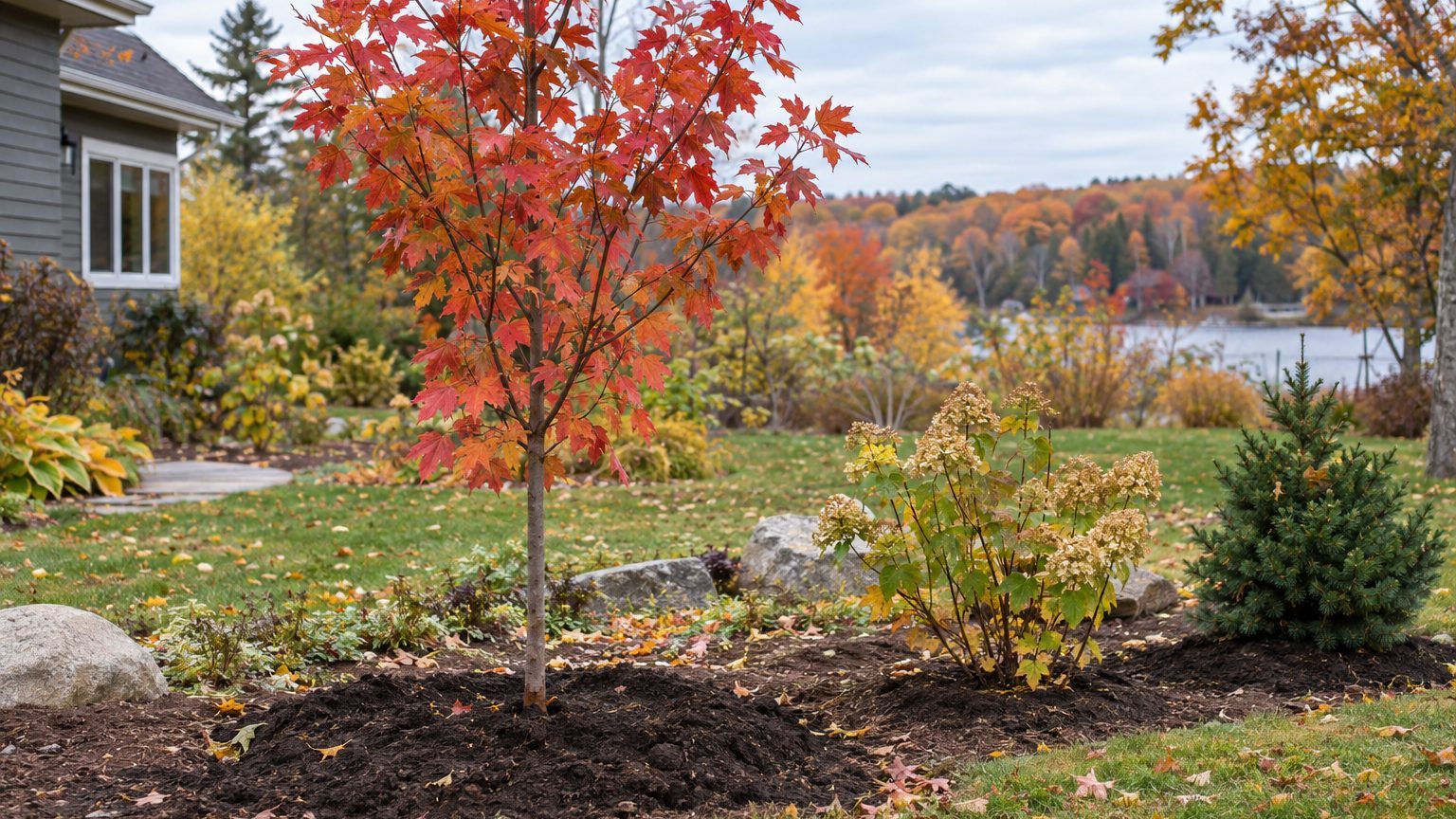

In Kansas, the conservative deadline for planting trees and shrubs in fall is September 11 to September 21, which is six weeks before the first fall frost. That frost typically arrives between October 23 and November 2 at the Wichita reference station. Planting after that window isn’t a lost cause for hardy container and balled stock, but every week of delay shortens the time roots have before winter.
The deadline in Kansas
Roots don’t follow the thermometer the way leaves do. They keep growing as long as the soil is workable and above freezing, which in Kansas can mean weeks after the first frost has blackened the tomato vines. A tree planted in fall is really getting a head start on spring: the top sits dormant while the roots knit into the surrounding soil. So the air turning cold doesn’t set the deadline. Frozen ground does.
Cornell Cooperative Extension states the rule this way: “Fall is an excellent time for transplanting, provided you get them to their new home at least 6 weeks before the ground freezes, allowing them time to establish roots before winter dormancy.” The catch is that nobody publishes a single ground-freeze date for the state. It shifts with snow cover, soil type, wind exposure and how the winter unfolds. The first fall frost, on the other hand, is measured and tabulated, so it makes a sturdy anchor for counting backward.
Working back from the first frost
NOAA’s 1991-2020 Climate Normals for the Wichita airport station put the first 32°F freeze between October 23 and November 2, the range where the odds of that first freeze run between 30 and 70 percent. Count six weeks back from those dates and you get the safe target: September 11 to September 21. Write that down if you plan next year’s planting calendar now.
Treat it as the safe date, not the hard stop. The ground freezes after the air does, so the true limit falls later than the first frost, sometimes well later. A hardy tree planted in early October is getting fewer weeks than Cornell would like, but not zero. Since it’s September 30 as of this writing, the conservative window has just closed for this year, and the decision now is about how much risk a particular plant can take (more on that below).
Your yard is not the airport
Those dates come from a station at an airport, and airports run warm. Suburban and rural gardens typically see the first fall frost earlier than the reference figure, often by one to two weeks, and more at elevation. Farther north in Kansas, and on higher ground toward the western part of the state, the first frost comes earlier, so the planting deadline moves earlier too. Pull your own county’s numbers from First and Last Frost Dates in Kansas and count back from those rather than from Wichita.
Kansas is not a place where winter planting works year-round. The mean daily minimum of the coldest month at Wichita is 22.5°F (NOAA 1991-2020 normals), well under freezing, so the ground does freeze and the six-week logic applies across the state. The USDA Plant Hardiness Zone Map (2023 edition) lists Kansas at 5b to 7a, which tells you how much your county may differ from the reference city.
What to plant late, and what to wait on
Container-grown and balled-and-burlapped trees and shrubs that are fully hardy in your zone are the best candidates for a late fall planting. A container plant arrives with its whole root system intact, so there is little disturbance for the plant to recover from. A balled tree has lost part of its roots in the digging, which makes consistent watering after planting even more important, but it’s still a good bet if the species is well within its hardiness range.
Hardiness is where Kansas gets specific. The coldest-month mean daily minimum of 22.5°F at Wichita describes a typical winter night, not the worst one. A plant rated right at the edge of your USDA zone can make it through most winters and still get hammered by one bad cold snap, and a newly planted specimen has less reserve than an established one. So choose plants rated comfortably for your zone, not just barely.
Evergreens are the other group that needs caution. Pines, spruces, arborvitae and broadleaf evergreens like boxwood and holly keep their foliage all winter, and that foliage keeps losing water to sun and wind while cold soil limits how much the roots can take up. A young evergreen with a shallow, unfinished root system is the classic setup for winter burn. Evergreens planted earlier in fall handle this far better than ones planted right before freeze-up.
| Plant type | Late fall outlook in Kansas | What to do |
|---|---|---|
| Hardy deciduous trees and shrubs, container-grown | Good | Plant while soil is workable, then water until the ground freezes |
| Hardy deciduous trees, balled and burlapped | Good, with attention | Plant promptly, water steadily, mulch |
| Evergreens, needled or broadleaf | Risky if planted late | Plant early in fall, or wait for spring |
| Plants rated near the edge of your zone | Poor | Hold until spring |
The decision to write down
If a plant is borderline for your zone or is an evergreen you’re only now getting to, wait until spring for anything rated borderline for your zone, and keep it in its container in the meantime, out of the harshest wind. The nursery bench is a poor place for a plant to spend winter, but the bare ground is worse for a plant that hasn’t rooted in. For the mechanics of setting a plant at the right depth, see Planting and Caring for Trees, Shrubs and Perennials.
Watering and mulch until the ground freezes
A fall-planted tree looks like it’s doing nothing, and that is exactly the point. Above ground, it’s dormant. Below ground, the roots are the only part working, spreading from the root ball into native soil. That is why the first winter is about roots, not growth. Anything that pushes the plant to grow tops in fall, such as pruning or a dose of fertilizer, works against the job at hand. Skip both, and put your effort into keeping the root zone evenly moist.
Kansas falls can turn dry and windy, and a dormant plant in dry soil is a plant that can’t build roots. Water slowly and deeply after planting, then keep checking. Push a trowel in near the edge of the root ball and see how the soil feels: if it’s crumbly and dry, water. Continue until the ground freezes, and give a final thorough soak before that happens. Keep watering until the ground freezes, not until the leaves drop or the first frost shows up, because the roots are still drinking after both.
Mulch in a ring, not a volcano
Mulch does two jobs for a new planting: it holds moisture, and it keeps soil temperature from swinging as much. NC State Extension’s Extension Gardener Handbook gives the depth for both purposes. On weeds: “A 2-inch to 3-inch layer of mulch suppresses most annual weed seeds and makes it easy to hand-pull any that do germinate.” And on trees: “Provide a 3-inch layer of mulch to reduce water loss and maintain uniform soil moisture and temperature around roots.” North Carolina is a different climate, but the depth logic is the same in Kansas. More isn’t better.
Spread the mulch in a wide, flat ring across the planting area, and pull it back so it doesn’t touch the trunk. Mulch piled against bark holds moisture where the tree doesn’t want it and gives rodents cover. A neat doughnut with the root flare visible in the center is the goal, not a cone. If you’re unsure about materials or how far to spread it, Mulching Without Killing the Plant covers the common mistakes.
What goes wrong
The most common failure is simply planting too late for this climate. A tree that goes in after the soil has started to stiffen has almost no time to anchor before dormancy, and it enters winter with the roots still confined to the ball it came in. Hardy species often survive this anyway, but the ones that don’t tend to die in spring or early summer, after the gardener has stopped worrying. Count back six weeks from your own county’s first-frost date and treat what falls before that as the comfortable zone, and what falls after as increasingly a gamble.
Winter burn, heaving and drying out
Winter burn shows up in late winter as brown needle tips or scorched leaf edges on evergreens. It happens when sun and wind pull water out of foliage faster than cold roots can replace it, and a newly planted evergreen is the most exposed. A watered-in, mulched plant sited out of the sharpest wind has a much better chance. A burlap screen on the windward side helps on exposed sites.
Heaving is the other winter problem, and it hits shallow root balls hardest. Kansas ground freezes and thaws repeatedly through winter, and each cycle can nudge a poorly anchored plant upward until roots are exposed to air. Even mulch depth, which helps hold soil temperature more uniform, is the main defense. After a thaw, look at the base of new plantings. If one has lifted, firm the soil back gently and water it.
Drying out is the quietest failure of the three. A dry fall followed by a dry, windy winter can leave roots parched without a single visible sign until spring. That is why the watering habit above matters as much as the planting date. For a broader view of the state’s timing, the Kansas guides collect the seasonal calendars in one place.
Common questions
Is it too late to plant a tree in Kansas at the end of September?
The conservative window of September 11 to September 21 has passed, but the first frost at the Wichita reference station is still weeks away, October 23 to November 2. Hardy container and balled trees planted promptly and watered well still have a fair chance. Evergreens and anything borderline for your zone are better held until spring.
Does the six-week rule count from the first frost or from frozen ground?
Cornell Cooperative Extension counts from when the ground freezes. Using the first fall frost as the starting point is the safer approximation, because the ground freezes later than the air does. The real limit is therefore somewhat later than September 11 to September 21, but it depends on the year and your site, and no one can name it in advance.
Can I plant in winter if the soil isn’t frozen?
Kansas ground does freeze, with the coldest month at Wichita averaging a daily minimum of 22.5°F. A warm afternoon or a thaw doesn’t reset the clock for roots that need weeks to establish before hard cold. Hold the plant in its container, watered and sheltered, and set it out in spring.
How do I compare Kansas timing with other states?
The logic is the same everywhere, but the dates shift with the first frost. If you garden or have family across state lines, the numbers for Kentucky are laid out in How Late Can You Plant Trees and Shrubs in Fall in Kentucky?. Within Kansas, remember that the north and the higher ground in the west reach their deadline earlier than Wichita does.