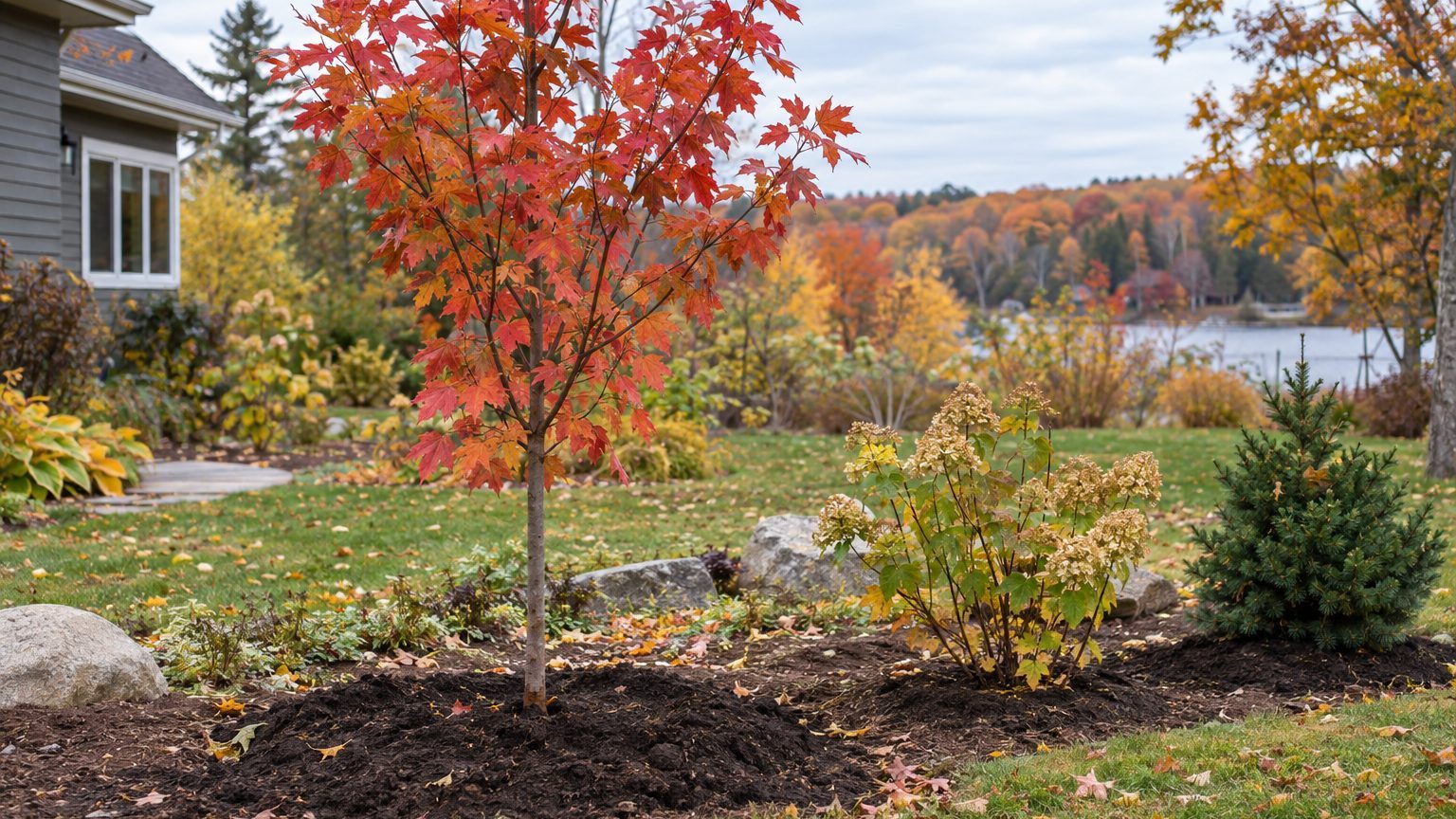

In Kentucky, the safe deadline for fall-planting trees and shrubs runs from September 21 to October 1, which is six weeks before the first fall frost (November 2 to November 12 by NOAA’s normals). Planting later isn’t doomed. Roots keep growing in cool, workable soil long after the leaves drop, so hardy container and balled plants can go in through much of November. You just lose your margin for error.
The deadline in Kentucky
Cold air and cold soil are two different things. A frost can flatten your tomatoes overnight while the ground four inches down stays warm enough for roots to keep pushing. Woody plants take advantage of that gap. Once the top growth shuts down for the year, a newly planted tree or shrub sends its energy underground, and it keeps doing so until the soil itself gets close to freezing.
Working back from the first frost
For Louisville, NOAA’s NCEI 1991-2020 Climate Normals put the first fall 32°F freeze in a window from November 2 to November 12 (that’s the 30-70% probability band, so some years come earlier and some later). Count six weeks back from that range and you get a conservative planting deadline of September 21 to October 1. That’s the date to write on the calendar. As of the last day of September 2026, the window is closing, not closed.
The six-week figure comes from Cornell Cooperative Extension, which puts it this way: “Fall is an excellent time for transplanting, provided you get them to their new home at least 6 weeks before the ground freezes, allowing them time to establish roots before winter dormancy.” Notice what the rule counts from. It counts from frozen ground, not from the first frost.
Why the real limit falls later
Ground freezes after the air does. Cornell’s benchmark is the freezing of the soil, and in Kentucky that usually arrives well after the first frost. So the September 21 to October 1 range is the safe target, not the last possible day. A hardy shrub planted in mid-October has usually not missed its chance. It has just spent some of its cushion.
Two things shift the dates. First, the Louisville figures come from an urban weather station, and the National Weather Service in Louisville has cautioned that it doesn’t match the surrounding rural parts of Jefferson County. Gardens out in the country should expect a tighter window and count back from the earlier end of the range. Second, the colder parts of the state, meaning farther north and higher in elevation, get their first frost earlier, so their deadline moves earlier too. If you garden in one of those pockets, aim for the start of September’s end-of-month range or ahead of it. Our guide to first and last frost dates in Kentucky helps you pin down your own spot.
Kentucky isn’t a place where you can ignore the freeze question. The mean daily minimum of the coldest month at Louisville is 27.8°F (NOAA NCEI Climate Normals, 1991-2020), which sits below freezing. The ground does freeze here, so the deadline logic applies in full. That number also matters for hardiness, which is where the next section picks up. The USDA Plant Hardiness Zone Map (2023 edition) puts Kentucky between zones 6a and 7a, and different parts of the state sit in different zones, so check your own address rather than trusting a statewide number.
What to plant late, and what to wait on
Not every plant needs the same head start. The ones that establish well in a late fall are fully hardy for your area, arrive in a container or a balled-and-burlapped root ball, and drop their leaves for winter. The ones that struggle are borderline plants and evergreens that keep losing water through the cold months.
Safe bets after the deadline
Deciduous trees and shrubs are the easiest late-fall planting. With no leaves to feed, they lose very little water, and the roots get on with settling in. Container-grown plants have an intact root system that isn’t disturbed much at planting. Balled-and-burlapped trees have lost part of their roots in digging, but they carry a chunk of soil with them, and that helps. Perennials that are hardy in your zone go in well too, provided they’re in the ground while the soil is still workable.
Hardy means hardy for where you live, not for the zone printed on the plant tag alone. The figure that decides whether a plant makes it through the winter is the average annual extreme minimum temperature, which is what the USDA hardiness system measures. Louisville’s coldest-month minimum of 27.8°F is a mean daily low (not a record low), so plants still need to handle colder snaps than that. When the tag says zone 6 or colder, you’re comfortably covered across most of Kentucky. Our overview of planting and caring for trees, shrubs and perennials covers the basic technique that goes with every one of these.
Better to wait for spring
Borderline plants are the ones to hold back. Anything sold at the edge of its range in Kentucky, such as crape myrtle or certain camellias, needs a full season of root growth before it faces a hard winter. Plant it in spring and it gets that season. Plant it in November and it gets a few weeks. Anything borderline hardy waits for spring. Same goes for the broadleaf and needled evergreens (hollies, boxwood, rhododendron, arborvitae, pines and spruces). They hold onto their foliage all winter, and on sunny or windy days that foliage keeps losing water that a young root system can’t replace, especially if the soil is frozen.
Some deciduous trees have a reputation for sulking when planted late, and dogwood, magnolia and birch are the names that come up most. If one of those is on your list, a spring planting is the lower-risk call. The plant will still be there in April, and the nursery will usually have a better selection anyway.
Watering and mulch until the ground freezes
The first winter is about roots, not growth. Above ground, a newly planted tree looks like it’s doing nothing, and that’s normal. The plant has gone dormant up top and is pouring its resources into the roots, which keep expanding into the surrounding soil as long as it stays workable and above freezing. Everything you do in the weeks after planting should protect that quiet process. That means steady moisture and a modest layer of mulch, and not much else. Skip fertilizer, which pushes tender top growth the plant doesn’t need, and hold off on any pruning beyond removing broken branches.
Water deeply, right up to freeze-up
Fall rain in Kentucky is often generous, but not always. Some autumns run dry, and a new plant can’t reach far for moisture. Water slowly and deeply so that the whole root ball and the soil just beyond it get soaked, rather than sprinkling the surface. Check by feeling the soil a little below the surface. When it’s barely damp, water again. Keep this up until the ground freezes, including through dry stretches in November and on the mild days that show up in winter. Evergreens matter most here because they keep losing water all winter.
Mulch in a ring, not a volcano
Mulch does two jobs for a new planting. It holds moisture, and it evens out the swings in soil temperature. NC State Extension’s Gardener Handbook (chapter 11, Woody Ornamentals) gives the depth for both. On weeds: “A 2-inch to 3-inch layer of mulch suppresses most annual weed seeds and makes it easy to hand-pull any that do germinate.” On trees: “Provide a 3-inch layer of mulch to reduce water loss and maintain uniform soil moisture and temperature around roots.” A 2-inch to 3-inch layer is the range to use, and more isn’t better.
Shape matters as much as depth. Spread the mulch in a wide, flat ring around the plant and keep it pulled back from the trunk or stems, so the base of the trunk where it flares out stays visible. A mound piled against the bark holds moisture against it, invites rot and gives voles a cozy place to nest and chew through winter. Piling it high is the most common mistake in residential landscapes, and it’s how a ring becomes a volcano. The full method is in mulching without killing the plant.
What goes wrong
Most fall-planting failures trace back to one of four things. The plant went in too late, the evergreen dried out, the root ball worked its way out of the ground, or nobody watered during a dry spell. All four are avoidable, and none of them requires special equipment.
Too late, and winter burn
Planting after the ground has started to freeze leaves roots no time to grow. The plant then meets the coldest weeks with only the root system it arrived with, which might be a fraction of what the plant needs. In colder parts of the state, the ground reaches that point earlier. Treat any planting after October 1 as a calculated risk and protect it with water and mulch. For the neighboring state’s dates, see How Late Can You Plant Trees and Shrubs in Fall in West Virginia?
Winter burn shows up in late winter as brown, scorched needles or leaf edges on evergreens. The cause is water loss. Sun and wind pull moisture out of the foliage while the roots, stuck in cold or frozen soil, can’t replace it. A late-planted evergreen has the smallest root reach to make up the difference, which is why the previous section put them on the wait list.
Heaving and dry falls
Kentucky winters swing back and forth across freezing. When the soil freezes, thaws and freezes again, shallow, loosely settled root balls can be pushed upward and left exposed to cold and drying air. Firm planting at the correct depth, a ring of mulch and a check after each hard freeze help. If a plant has lifted, press the soil back down around it once the ground thaws.
Dry autumns are the quieter problem. A tree can go into winter thirsty without looking any different, and the damage only appears in spring as weak leaf-out or dieback. Watering through a dry fall is cheap insurance against it.
Common questions
Is October too late to plant trees in Kentucky?
October is past the conservative September 21 to October 1 target, but it isn’t too late for hardy container and balled trees, since the ground doesn’t usually freeze until well after the first frost (November 2 to November 12 at Louisville). The risk goes up the later you go, and up faster in rural areas and the colder north and higher elevations. Water well and mulch.
Does the six-week rule count from the first frost or from frozen ground?
Cornell Cooperative Extension counts from when the ground freezes. Because that comes later than the first frost, counting six weeks back from the first frost gives you a conservative, safe date. That’s how the September 21 to October 1 range was worked out from NOAA’s frost range.
Should I plant evergreens in the fall?
Early in the window, hardy ones can work, but evergreens are the riskier group because they lose water all winter. If you miss the deadline, wait for spring. Evergreens planted before the deadline still need deep watering until the ground freezes.
Do these dates apply to my county?
Only roughly. The frost range comes from a Louisville station, which the National Weather Service in Louisville says differs from rural Jefferson County. Colder parts of Kentucky have earlier first frosts, so move your deadline earlier there. Browse more Kentucky guides for local timing, and remember that even within one county, a low-lying frost pocket can freeze weeks before a hilltop.