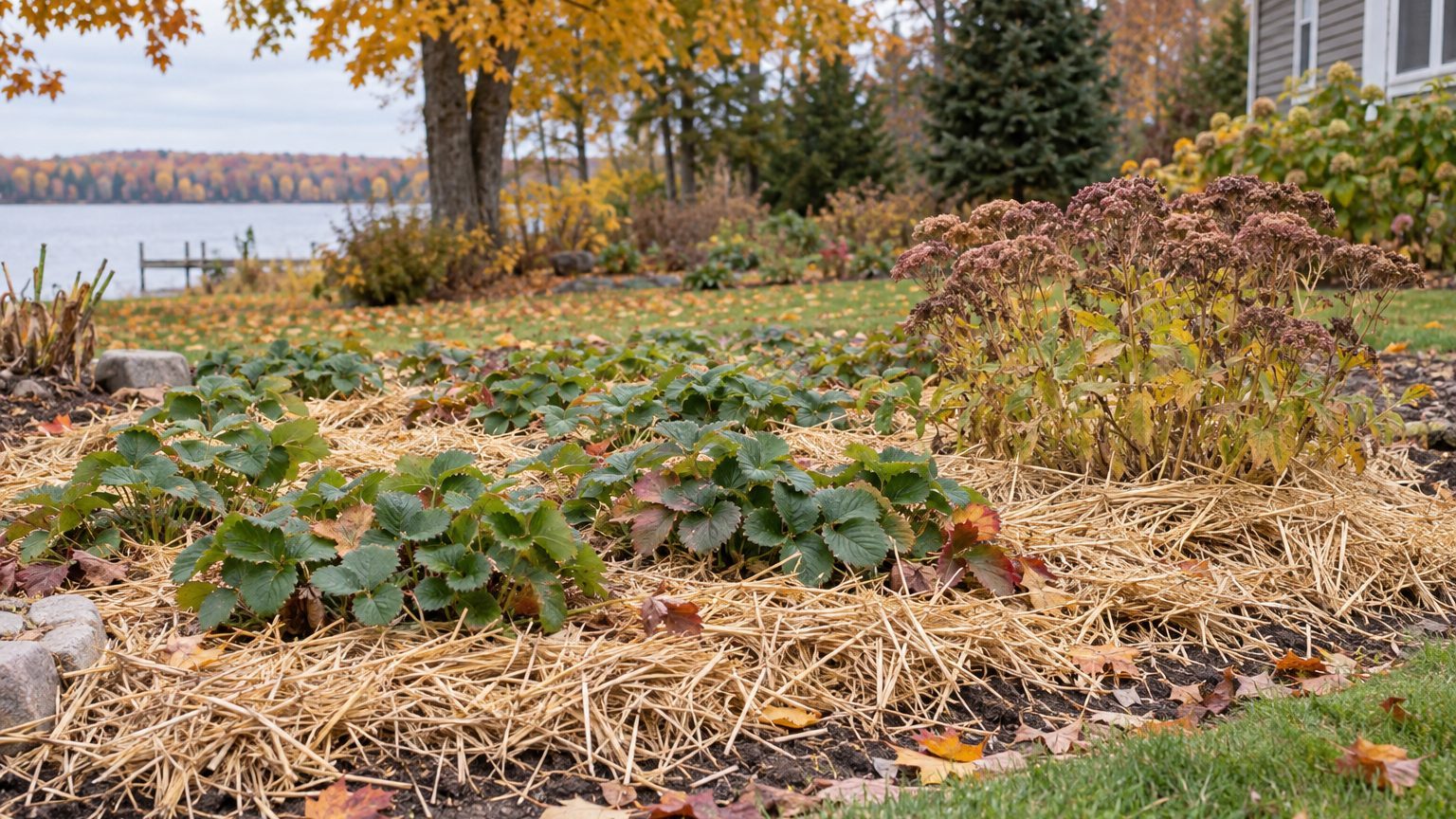

Wait for the ground to start freezing, then mulch. For Michigan strawberries and borderline perennials, that means late fall, well after the first frost, which the MSU Extension Michigan Garden Calendar puts between October 6 and October 21 for zone 6a. Mulch spread too early holds warmth and moisture against the crowns and gives mice and voles a cozy place to settle in. Mulch spread once the soil stiffens does its real job: keeping the freeze steady until spring.
When to put winter mulch down in Michigan
Why the order feels backward
Most of us think of mulch as a blanket that keeps plants warm. Winter mulch behaves more like the lid on a cooler. A cooler doesn’t make ice, it keeps ice from melting. Straw laid over frozen soil keeps that soil frozen, and that is the whole point. What hurts plants in a Michigan winter is often not the deep cold but the cycle: soil freezes, thaws during a warm spell, then freezes again. Each round swells and shrinks the soil, and shallow-rooted plants get pushed upward like a cork working out of a bottle.
The cold itself is not in doubt. NOAA NCEI Climate Normals for 1991-2020 put the mean daily minimum of the coldest month at 19.2°F at the Detroit reference station. That is an average of nightly lows, so plenty of nights run colder, and other parts of the state differ. The USDA Plant Hardiness Zone Map (2023 edition, built on the average annual extreme minimum) covers Michigan with zones 4a-6b. Frozen soil is a given here. The real questions are when it starts and whether it stays put.
Finding your window
First fall frost and frozen ground are two different events. The MSU Extension Michigan Garden Calendar lists the first fall frost for zone 6a as October 6 to October 21. A frost is a surface event. It blackens basil and squash and tells perennials to shut down, but the soil underneath is still warm and damp. Mulch on top of that and you insulate exactly the conditions that rot crowns and attract rodents.
Put winter mulch down after the ground starts to freeze, which comes well after the October 6 to October 21 first-frost range, not inside it. A simple test works better than a calendar. Push a trowel into the bed. When the top layer of soil is stiff in the morning and still firm by late afternoon, and the plants have gone dormant (strawberry leaves flattened and dull, perennial tops browned), the window is open. Several hard freezes in a row usually get you there.
Where you live moves the window. Farther north and at higher elevations, the first fall frost arrives earlier than that range, the ground freezes earlier, and mulching shifts earlier with it. Yards in the southern part of the state run later. Look up your own local numbers in First and Last Frost Dates in Michigan, then use the trowel test to settle the exact week.
Not everything in the yard needs this. Established perennials that are comfortably hardy for your location sit through the winter fine without help. The mulch goes on strawberries, on plants at the edge of their hardiness, and on anything planted this year. Seasonal timing differs so much across the state that the other Michigan guides follow the same logic of adjusting to your own spot.
Strawberries
Why the crowns need protection
A strawberry plant is a crown, a short, stubby stem at soil level, with leaves above and roots below. Everything for next season’s crop comes out of that crown, and in fall the plant is already setting the buds that become June berries. Bare cold and wind can damage the crown directly. Freeze-thaw cycles do a different kind of harm: they lift the plant out of the ground, snapping roots and leaving the crown sitting on top of the soil, exposed to drying air. A plant that heaved in February often looks fine until it fails to grow in May.
That is why timing matters more than thickness. Straw laid over warm soil in October does nothing useful for heaving, because the soil has not frozen yet. Straw laid after the ground has started to freeze holds the soil at a steady temperature, so a January thaw doesn’t translate into a heave. Use the same trowel test described above, and expect to mulch strawberries around the same time as the borderline perennials, after several hard freezes and not on the first frosty morning.
Straw, depth, and uncovering in spring
The standard material is clean straw, meaning the stalks left after grain is harvested, not hay. Hay is full of seed heads, and you will be pulling oat and grass seedlings out of your berry rows all summer. Shredded leaves work in a pinch, but whole leaves, especially broad ones like maple, mat down into a wet sheet that smothers the crowns.
As for depth, the only figures I can point to come from NC State Extension. The NC State Extension Gardener Handbook (chapter 11, Woody Ornamentals, available here) says: “A 2-inch to 3-inch layer of mulch suppresses most annual weed seeds and makes it easy to hand-pull any that do germinate.” That passage is about weeds, not strawberry crowns, but it sets the order of magnitude for a mulch layer generally. Straw fluffs up when dry and sags when wet, so spread it loose and even over the whole row, covering the crowns, and resist the urge to pile more on. More is not better.
Spring is where people slip. Pull the straw back when new growth starts to show at the crowns, not on a fixed date, and keep it close by for frost nights. New leaves under straw come up pale yellow, a sign they are reaching for light. Rake the straw off the crowns and into the aisles between rows. It keeps weeds down there and keeps the berries clean when they ripen. If a hard frost is forecast after the plants start blooming, pull the straw back over them for the night. The last frost date for your area, found in First and Last Frost Dates in Michigan, tells you how long to stay alert. For the broader picture on varieties, planting, and care through the season, see Growing Strawberries.
Perennials and borderline plants
Who actually benefits
A tag that says “hardy to zone 5” means the plant should survive the average coldest winter of that zone, in the ground, for years. It says nothing about a plant in its first winter, when roots are still shallow. So the plants that benefit from winter mulch in Michigan fall into a few groups: anything planted this season, anything whose zone rating sits right at or near your own zone on the USDA Plant Hardiness Zone Map, and shallow-rooted plants that heave easily. Garden mums, coral bells, and other plants with a shallow, fibrous root system are common heave victims. Roses, lavender, and some hydrangeas that bloom on old wood sit at the edge of their comfort in many parts of the state.
Your zone decides a lot. The USDA map runs from 4a to 6b across Michigan, and a plant that is truly borderline in one part of the state may be completely secure in another. At the Detroit reference station, NOAA puts the coldest month’s mean daily minimum at 19.2°F, which is cold enough to justify mulching marginal plants there, and colder parts of the state have a stronger case still. Check the plant’s rating against your own zone before deciding it needs a blanket.
Perennial herbs fit this group too, since sage, thyme, and lavender often sit at the edge of their range. The specifics for each are in Getting Perennial Herbs Through the Winter.
A ring around the crown, not a pile on it
The shape of the mulch matters as much as the timing. Think of a donut, not a volcano. Spread the material in a ring around the plant and leave a gap right at the crown (or trunk, or stem base) so the center can breathe. Piling mulch directly on top keeps the crown wet, invites rot, and gives rodents shelter right where the tender tissue is.
On depth, stay in the range the NC State Extension Gardener Handbook gives: “A 2-inch to 3-inch layer of mulch suppresses most annual weed seeds and makes it easy to hand-pull any that do germinate.” For trees, the same source says: “Provide a 3-inch layer of mulch to reduce water loss and maintain uniform soil moisture and temperature around roots.” Notice that neither goes higher. Keep winter mulch in that 2-inch to 3-inch range, applied after the ground starts to freeze, and pull it back from every crown. Shredded leaves, straw, and evergreen boughs all work well on perennials. For the general rules on getting the ring shape right, Mulching Without Killing the Plant covers the mistakes in detail.
What goes wrong
Winter mulch fails in predictable ways. Each one has a look, and each one is preventable with a small change in timing or shape.
| Problem | What it looks like | What prevents it |
|---|---|---|
| Mulching too early | Soft, dark crowns; plants that never fully go dormant; mice moving in | Wait until the soil surface is stiff and stays stiff |
| Matted mulch | A wet, slimy layer of whole leaves; moldy smell at the surface | Use clean straw or shredded leaves, spread loose |
| Mulch piled on crowns | Rot at the base of the plant in spring | Leave a gap around the crown |
| Forgetting to uncover | Pale, stretched, yellowed new growth under the straw | Pull it back as soon as growth shows |
Rot and rodents
Early mulch and rodent trouble go hand in hand. Laid over unfrozen ground, a thick layer of straw or leaves makes a dry, insulated nest right at the soil surface. Voles and mice will take it, and in the process they chew crowns, bark, and roots you will not discover until spring. Mulch that goes on after the soil has started to freeze is less attractive, because the warmth that makes the nest appealing is gone. For shrubs and young trees, keep mulch away from the trunk itself, and a cylinder of hardware cloth around the base gives extra protection against gnawing.
The spring mistake
Forgetting to uncover is the quiet one. Straw left in place through April smothers strawberry crowns and holds cold, wet conditions against perennials just as they wake up. Check the crowns each week once the soil thaws, and pull mulch back as soon as new growth shows. You are not removing protection permanently. Keep the straw nearby and ready to throw back over the plants if a hard frost threatens after they have started to grow.
Common questions
Can I mulch right after the first frost?
Not if you want the mulch to do its job. The first fall frost in zone 6a, October 6 to October 21 according to the MSU Extension Michigan Garden Calendar, only marks the start of dormancy. The soil is still warm and won’t be frozen yet. Waiting until the ground begins to freeze is what keeps crowns from rotting and keeps freeze-thaw cycles from lifting them.
Do hardy perennials need winter mulch?
Usually not, once they are established and rated comfortably for your location. The plants that gain from it are this year’s new plantings, shallow-rooted perennials prone to heaving, and anything rated close to your own zone on the USDA Plant Hardiness Zone Map. When in doubt, mulch the new and marginal ones and leave the established ones alone.
What is the best material, and how deep?
Clean straw suits strawberries, and straw, shredded leaves, or evergreen boughs work on perennials. Stay with the NC State Extension range of a 2-inch to 3-inch layer, and never mound it against stems or crowns. Whole leaves that mat down and hay full of seed are the two materials most likely to cause trouble.
What if winter brings little snow?
Snow is nature’s own mulch, and a winter without much of it leaves the soil more exposed to freeze-thaw swings. That makes a properly timed layer of mulch more valuable, not less. Check beds after windstorms and thaws, and re-spread anything that blew off. Remember too that the 19.2°F figure is an average of nightly lows, and the USDA zone is built on an average of extremes, so some winters will run colder than either number suggests.