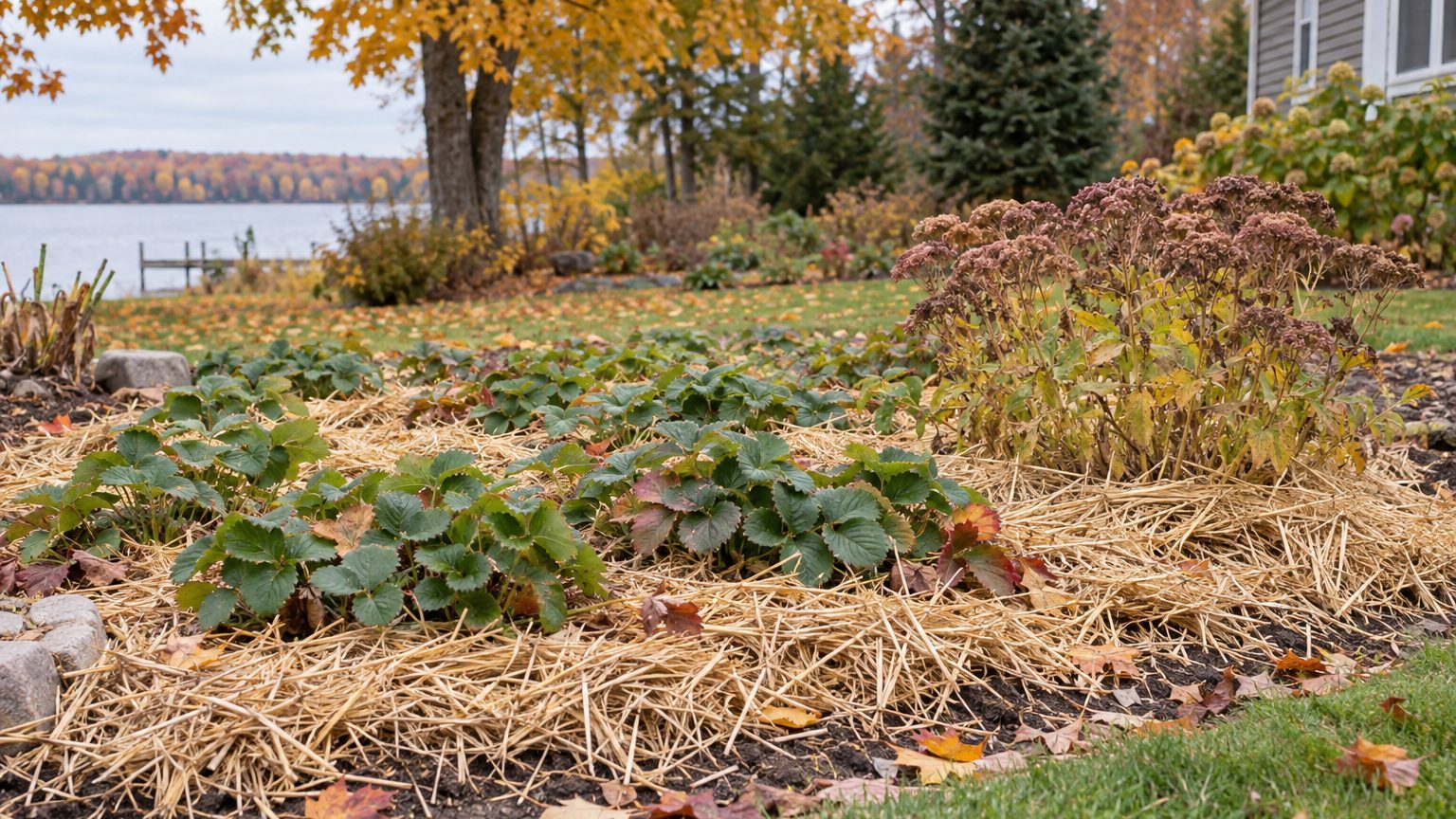

Wait for the ground to freeze. In Ohio, that means putting winter mulch on strawberries and perennials in late fall, after the first frost (October 5 to October 15 in zone 6a, according to Ohio State University Extension’s Ohio Gardening Calendar) and after nights turn hard enough to start freezing the soil surface. Mulching on the first frosty morning is the classic mistake. Winter mulch is there to hold the cold in, not to tuck plants in warm.
When to put winter mulch down in Ohio
Why the ground has to freeze first
Columbus, the reference station here, averages a daily minimum of 22.0°F in its coldest month, according to NOAA NCEI Climate Normals 1991-2020. That is well below freezing on a typical midwinter night, so Ohio soil really does freeze, and the repeated freezing and thawing that follows is what hurts plants. Mulch doesn’t generate heat. It slows how fast soil temperature changes, in both directions.
That is why timing matters more than the material. Lay mulch over soil in October and you trap the warmth it soaked up all summer. The plants keep ticking along instead of going dormant. Crowns stay damp and mild, which is how rot gets started, and a blanket of dry straw or leaves looks like a five-star hotel to mice and voles.
The window, and how to read it
The first frost range, October 5 to October 15 in zone 6a per OSU Extension, is the starting gun for dormancy, not for mulching. The real window opens after that and runs through late fall, closing when the ground has frozen solid. Mulch after the October 5 to October 15 first frost has passed and the soil surface has begun to freeze, which in Ohio means late fall.
The ground gives you the cue if you pay attention. Push a trowel into bare soil in the morning. If the top layer is stiff or crusty and still hasn’t softened by afternoon, you’re there. A forecast with nights staying below freezing and days barely climbing above it points the same way. A single frosty morning followed by a mild week does not count.
Ohio is a big state, and Columbus is only one reference point. The USDA Plant Hardiness Zone Map (2023, built on 1991-2020 normals) puts the state at 5b to 6b, so the colder northern counties and higher ground see frost earlier and freeze earlier, and mulching moves earlier with them. Southern Ohio runs a bit later. Follow your own soil, and check the First and Last Frost Dates in Ohio to see where your county sits. More seasonal timing for the state is collected in the Ohio guides.
Strawberries
What bare cold does to the crowns
A strawberry plant is a low rosette. Its crown, the short woody stem at soil level where every leaf and flower cluster originates, sits right at the surface with almost no protection. Two things hurt it over winter. One is raw cold on exposed tissue. The other, usually worse in Ohio, is heaving: soil freezes, expands, thaws, then freezes again, and each cycle can lift shallow roots and push crowns up out of the ground. By March the plants can look like they’ve been halfway pulled from the bed, roots drying in the wind.
Mulch works here by keeping the soil steadily frozen after it freezes, so the seesaw never starts. That is why the same plant under a proper covering often comes through fine while its bare neighbor in the next row doesn’t. The full picture of bed setup, spacing and renovation is in Growing Strawberries.
Straw, depth and uncovering in spring
Clean straw is the standard material. “Clean” means cut grain stalks, mostly free of seed. Hay is a poor substitute because it is full of weed and grass seed, and you’ll be pulling the results out of your berry bed all summer. Shredded or whole leaves can work in a pinch but tend to mat into a wet sheet over the crowns.
For depth, the only figure I’ll rely on comes from the NC State Extension Gardener Handbook (chapter 11, Woody Ornamentals): “A 2-inch to 3-inch layer of mulch suppresses most annual weed seeds and makes it easy to hand-pull any that do germinate.” That sentence is about weeds, not winter protection, but it shows the order of depth that holds up across many mulch jobs. Fluffy straw settles after it gets wet, so spread it loosely and don’t pack it down. More is not better. Deep, soggy mulch invites rot.
The other half of the job is getting it off. Pull the straw back as soon as new growth starts to show in spring, sliding it into the aisles rather than hauling it away. Pale yellow-green leaves pushing up through the straw are the signal. Keep the straw close by, because open strawberry blossoms are tender, and on a frost night you can pull it back over the plants for cover and move it off again in the morning.
Perennials and borderline plants
Most established perennials sold for Ohio gardens are bred for the cold and don’t need a winter blanket. By the USDA system, the state runs from 5b to 6b, which covers the great majority of garden perennials. The ones that earn mulch are the borderline cases: plants whose hardiness is marginal for the zone, anything planted late in the season, and shallow-rooted types that heave easily. Garden mums are a notorious example, and so are first-year perennials that haven’t built a deep root system. Woody herbs like lavender sit in the same category, and the notes in Getting Perennial Herbs Through the Winter cover them in more detail.
A new planting is the easiest call. A perennial set out in fall has had little time to anchor, and one hard freeze-thaw cycle can lever it right out of the soil. If you planted this season, mulch it. If a plant has stood in the same spot for several winters without trouble, it probably doesn’t need you.
Shape matters as much as depth. Spread mulch in a ring around the plant, not a pile on top of it. Leave bare soil, or at most a thin layer, right at the crown, where trapped moisture rots stems and gives rodents shelter. Stay within the NC State range, and remember the same handbook’s line on woody plants: “Provide a 3-inch layer of mulch to reduce water loss and maintain uniform soil moisture and temperature around roots.” That is the ceiling, not a target to exceed. Piled higher, a ring turns into a volcano, which is exactly what you’re trying to avoid. For more on getting that shape right, read Mulching Without Killing the Plant.
For borderline perennials, wait until the ground has begun to freeze, then lay a loose ring of shredded leaves, bark or straw around, not over, the crown. Shredded leaves are free and work well. Whole maple or oak leaves are fine if they are chopped first, because whole ones mat down and hold water against the plant.
What goes wrong
Too early, too wet, too thick
Mulching too early is the root of most winter-mulch failures. The sign shows up in spring: crowns that are dark, soft or mushy at the base, or plants that simply never wake up. Warm soil under a thick layer stays wet, and rot does the rest. The fix costs nothing. Hold off until the soil surface has started to freeze, and the cure for nearly everything below is just that wait.
Matting is a cousin of the same problem. Whole leaves, wet grass clippings and fine compacted material form a slick sheet that sheds air and holds water. You’ll smell it before you see it. Lift a corner in a thaw and find slimy, gray-matted layers against the crowns, and you’ve got the wrong material or too much of it. Use loose straw, shredded leaves or coarse bark, and fluff matted spots with a fork on a mild day.
Voles, and the spring you forget
Voles and mice nest where it’s dry, sheltered and close to food. Heavy mulch laid too early, and mulch piled against stems, gives them exactly that. The telltale signs are small runways in the mulch, chewed bark at the base of woody plants, and shallow tunnels when you rake it back. Waiting for frozen ground helps, since the cold has already pushed rodents toward other cover. Keeping mulch off stems and crowns helps more.
The last failure is quieter: leaving mulch on too long. Plants buried under straw in April grow pale and leggy, bloom late, and give slugs a damp refuge. Check beds as growth starts and uncover early rather than late, since you can always put the straw back on a cold night.
Common questions
Can I mulch right after the first frost?
Not yet. A first frost, October 5 to October 15 in zone 6a according to OSU Extension, tells you plants are slowing down, but the soil is still warm. Wait until the surface begins to freeze and stays that way, which is later in the fall. Mulch applied right after that first frost mostly insulates warmth into the ground.
Is leaf mulch okay for strawberries?
Shredded leaves can work, but clean straw is the safer choice for strawberries because it stays loose. Whole leaves pack down into a wet mat directly over the crown, which is where rot starts. If leaves are what you have, chop them first and keep the layer light enough that you can still see the plants through it.
How deep should winter mulch be?
Stay inside the NC State Extension range of a 2-inch to 3-inch layer, quoted from the Extension Gardener Handbook. That sentence is written about weed suppression, and a separate line for trees recommends a 3-inch layer for moisture and temperature. Neither calls for going deeper, and a thicker layer mainly adds the risk of rot and rodent nesting.
Do established perennials need winter mulch at all?
Most don’t. A perennial that has survived several Ohio winters in the same spot is usually fine bare, since the USDA lists the state at zones 5b to 6b and most garden perennials are bred for that. Mulch earns its place on first-winter plants, fall plantings and borderline types. Even then, snow cover is a natural insulator, so mulch matters most in stretches of cold without snow.