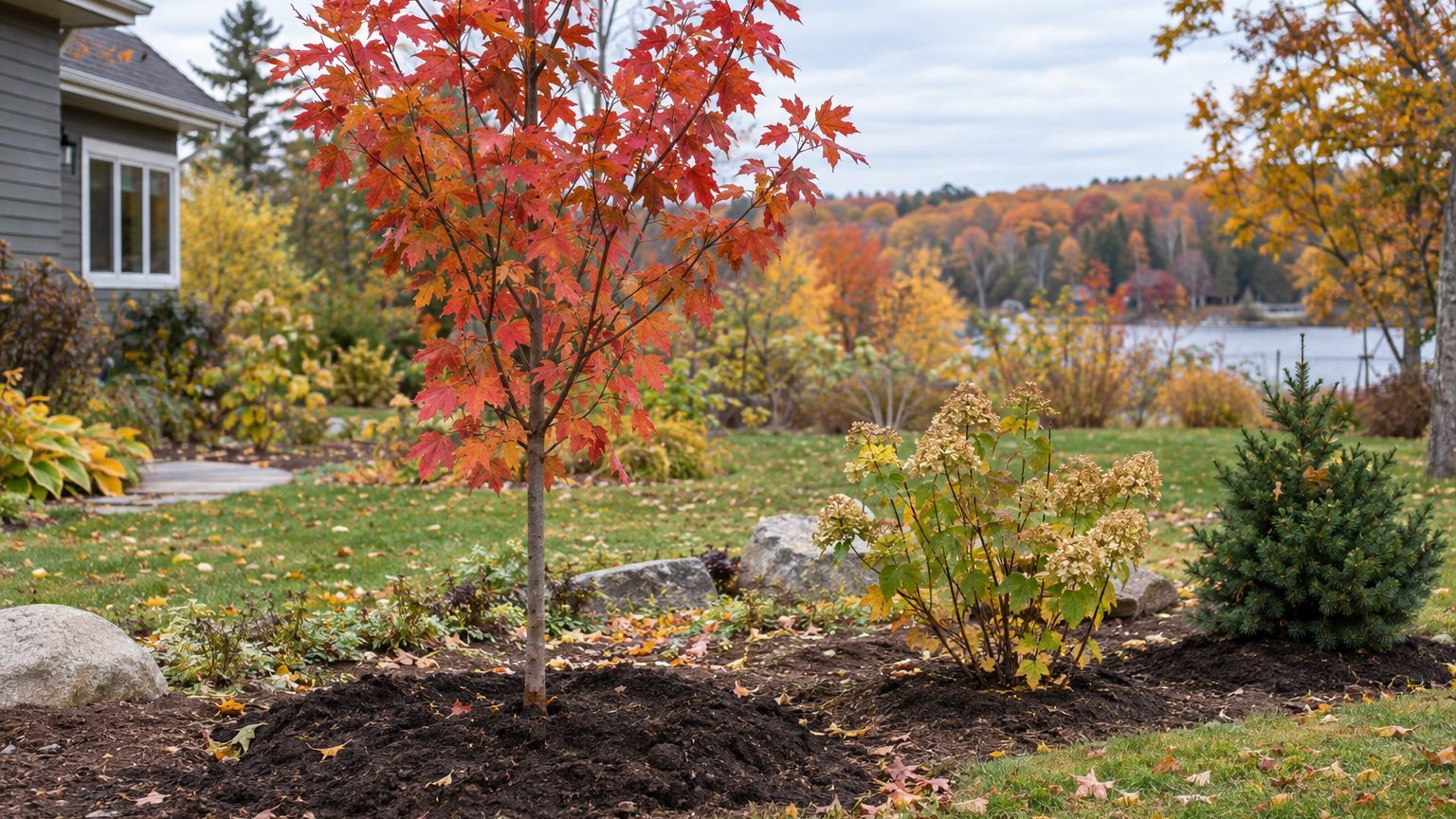

In Michigan, the safe window to plant trees and shrubs in fall closes between August 25 and September 9, which is six weeks before the first fall frost (October 6 to October 21 in zone 6a, per MSU Extension). Plants that go in later often still root in, because the ground freezes weeks after that first frost. The margin shrinks every week you wait, though, and it shrinks faster the farther north you garden.
The deadline in Michigan
Air and soil run on different clocks. A frosty morning kills tomato vines and blackens hosta leaves, but a few inches down the soil is still holding summer’s heat and still open to roots. Root systems of woody plants keep growing as long as the soil is workable and above freezing, long after the air has turned cold. The practical deadline is therefore several weeks before the ground freezes, not the date of the first frost itself.
The rule most extension programs lean on comes from Cornell Cooperative Extension (Orleans County, in its Fall Gardening page): “Fall is an excellent time for transplanting, provided you get them to their new home at least 6 weeks before the ground freezes, allowing them time to establish roots before winter dormancy.” The catch is that nobody publishes a reliable ground-freeze date for a whole state, so a conservative shortcut is to count back from the first fall frost, which is a date you can look up.
Working the dates backward
MSU Extension’s Michigan Garden Calendar puts the first fall frost for zone 6a at October 6 to October 21. Count six weeks back from that range and you get a conservative fall planting deadline of August 25 to September 9. Treat that as the safe target, the range where a tree or shrub gets a full runway before winter. It is not the hard limit. The true limit is the ground freezing, and that usually falls later than the frost, so a hardy container-grown shrub planted in early or mid October, well after the safe range, still has a fair chance. Just know you are spending margin, not following the rule.
| Milestone | Figure | Source |
|---|---|---|
| First fall frost, zone 6a | October 6 to October 21 | MSU Extension, Michigan Garden Calendar |
| Conservative planting deadline (six weeks before that frost) | August 25 to September 9 | Cornell Cooperative Extension rule applied to the MSU frost range |
| Mean daily minimum, coldest month (Detroit) | 19.2°F | NOAA NCEI Climate Normals 1991-2020 |
Why Michigan’s deadline is real
That last row matters. The mean daily minimum of the coldest month at the Detroit reference station is 19.2°F, per NOAA’s 1991-2020 normals. That is an average night low, not a record, and it sits well below 32°F. The ground here freezes solid every winter, so the deadline applies to Michigan gardeners; there is no mild-winter loophole where you can plant in January and forget about it.
One more caution. The USDA Plant Hardiness Zone Map 2023 lists Michigan as 4a-6b, and the frost dates above belong to zone 6a. Yards farther north or at higher elevation have an earlier first frost and an earlier ground freeze, so their deadline moves earlier too, sometimes by a lot. Look up your own county in First and Last Frost Dates in Michigan, then do the six-week subtraction yourself. More local timing is collected in the Michigan guides.
What to plant late, and what to wait on
Not every plant handles a late start equally. The safest candidates are container-grown and balled-and-burlapped trees and shrubs that are fully hardy for your zone. Their roots are already in a mass of soil or potting mix, so they lose less in the move, and a deciduous plant that has dropped its leaves is asking almost nothing of its roots. Maples, lindens, serviceberries, most viburnums and similar workhorses adapt well to this kind of fall planting, provided the ground is still workable.
The risky group is smaller but real. Broadleaf evergreens such as rhododendron, holly and boxwood, and needled evergreens such as arborvitae and pine, keep their foliage and keep losing water all winter through the leaves or needles. If the roots have not had time to settle in, they cannot keep up while the soil is cold or frozen. The foliage browns, and by spring you are looking at a plant that may or may not recover. Wait until spring for borderline-hardy plants and for evergreens that arrive after the safe deadline range of August 25 to September 9.
| Plant type | Late-fall verdict | Why |
|---|---|---|
| Hardy deciduous trees and shrubs, container-grown | Good candidates | Intact root mass; no leaves to feed over winter |
| Hardy deciduous trees, balled and burlapped | Good, if the ground is workable | Roots come with soil, but the ball must be kept moist |
| Needled and broadleaf evergreens | Risky after the deadline | Foliage loses water all winter while roots are still young |
| Plants only marginally hardy for your area | Wait for spring | A cold first winter tests them before roots are established |
Hardiness deserves a closer look than most people give it. The USDA zone system is built on one variable, the average annual extreme minimum temperature, and a plant tagged as hardy for your zone has survived that number in trials. A first winter is harder on a transplant than on an established plant of the same species, so a tag that says “zone 6” on a plant heading into a zone 6a winter is a lot less comfortable than it looks. Detroit’s coldest-month mean daily minimum of 19.2°F (NOAA, 1991-2020) is only the average night; some nights run colder, and those are the ones that punish weak roots.
Perennials are more forgiving than woody plants, but the same logic holds. They also need time to root before freeze-up, so the general advice in Planting and Caring for Trees, Shrubs and Perennials applies: sturdy, hardy plants in the ground with room to grow, nothing that needs coddling.
Watering and mulch until the ground freezes
A late-planted tree has one job before winter: grow roots. It is not adding branches or leaves, and it should not be. Everything happening above ground in the first winter is essentially on hold, while the roots keep exploring the surrounding soil as long as it is workable. Your job is to keep that soil from drying out.
Water deeply until the ground freezes. A slow soak that reaches the full depth of the root ball and the soil just outside it beats frequent light sprinkling, which wets only the top inch or two and trains roots upward. Check by pushing a trowel or long screwdriver into the soil beside the root ball; if it slides in easily and comes out damp, wait. If it is dry and stiff, water. Fall in Michigan can turn dry for weeks at a stretch, and evergreens especially want moisture in the soil going into winter. Once the surface freezes hard, stop; water sitting on frozen ground does nothing for the plant.
Mulch does two jobs here: it slows moisture loss and it evens out soil temperature around the roots. NC State Extension’s Gardener Handbook (chapter 11, Woody Ornamentals) says: “A 2-inch to 3-inch layer of mulch suppresses most annual weed seeds and makes it easy to hand-pull any that do germinate.” On trees specifically it adds: “Provide a 3-inch layer of mulch to reduce water loss and maintain uniform soil moisture and temperature around roots.” Note that two purposes land on the same order of depth. More is not better.
The shape matters as much as the depth. Spread the mulch in a wide ring around the plant, thin near the trunk or stem and never piled against it. A mounded “volcano” holds moisture against bark, invites rot and gives voles a warm winter nest right at the base of the tree. Pull the mulch back from the trunk so the flare of the base stays visible. For more on getting the ring right, see Mulching Without Killing the Plant.
Wait until the soil has cooled before adding mulch on a late planting, but do not wait so long that you are chipping through frozen ground. A ring in place ahead of freeze-up holds soil moisture where the roots can use it.
What goes wrong
Planting too late for the climate is the obvious failure, and it looks different in Michigan than in milder states. If the roots have barely left the root ball when the ground freezes, the plant enters winter with almost no anchor and very little ability to take up water. Aim for the August 25 to September 9 window for evergreens, and treat everything after it as a bonus, not a plan. The colder your part of the state, the earlier that window closes, because the first frost and the ground freeze both come sooner in the north and at higher elevation.
Winter burn is the classic evergreen problem. Wind and winter sun pull moisture out of needles and broadleaf foliage while frozen or cold soil keeps the roots from replacing it. Brown tips, brown edges and bare patches show up in late winter or early spring. Deep watering before freeze-up helps, and so does planting where the plant is sheltered from open wind. It is much easier to prevent than to fix.
Heaving is what shallow root balls do in freeze-thaw cycles. Michigan’s winters alternate between frozen and thawed ground, and a young plant sitting too high can be pushed up a little at a time until roots are exposed. Check after thaws. If you see a plant lifting, press the soil back around the ball, firm it gently and top up the mulch ring. A plant set at the proper depth in the first place, with the root flare at or just above the soil line, resists this much better.
A dry fall quietly undermines everything else. Rain can vanish for weeks, and a newly planted tree with a small root mass is the first thing to suffer. Keep checking soil moisture until the ground is frozen, not just until the leaves fall. Gardeners with a second property in New England will find the same logic with different dates in How Late Can You Plant Trees and Shrubs in Fall in Massachusetts?
Common questions
Is it too late to plant a tree in Michigan in October?
It is past the conservative August 25 to September 9 deadline, but it is not automatically too late. The first fall frost in zone 6a comes October 6 to October 21, and the ground usually freezes later than that. A hardy, container-grown deciduous tree planted early in October and watered until freeze-up has a decent chance. Evergreens and borderline plants are better held until spring.
Can I plant after the first frost?
Yes. A frost is an air temperature, and it hits leaves, not roots. What ends the planting season is the ground freezing, which arrives later. Soil that you can still dig, that is not frozen, is soil where roots can still grow, so a hardy plant put in after the first frost can still make some root progress.
What if the ground is already frozen?
Wait. Trying to chip a hole into frozen ground damages the site and leaves the plant sitting in a hole that will not drain or warm. Keep the plant in its container in a sheltered spot, watered occasionally so the root ball does not dry out, and plant when the soil thaws and is workable in spring.
Does the deadline change in northern Michigan?
Yes, it moves earlier. The colder part of the state, farther north and at higher elevation, gets its first fall frost sooner and its ground freeze sooner. The October 6 to October 21 range is for zone 6a, and Detroit’s 19.2°F coldest-month mean daily minimum comes from NOAA’s 1991-2020 normals. The USDA Plant Hardiness Zone Map 2023 lists 4a-6b for Michigan as a whole, so pull your own local frost range and count six weeks back from it.