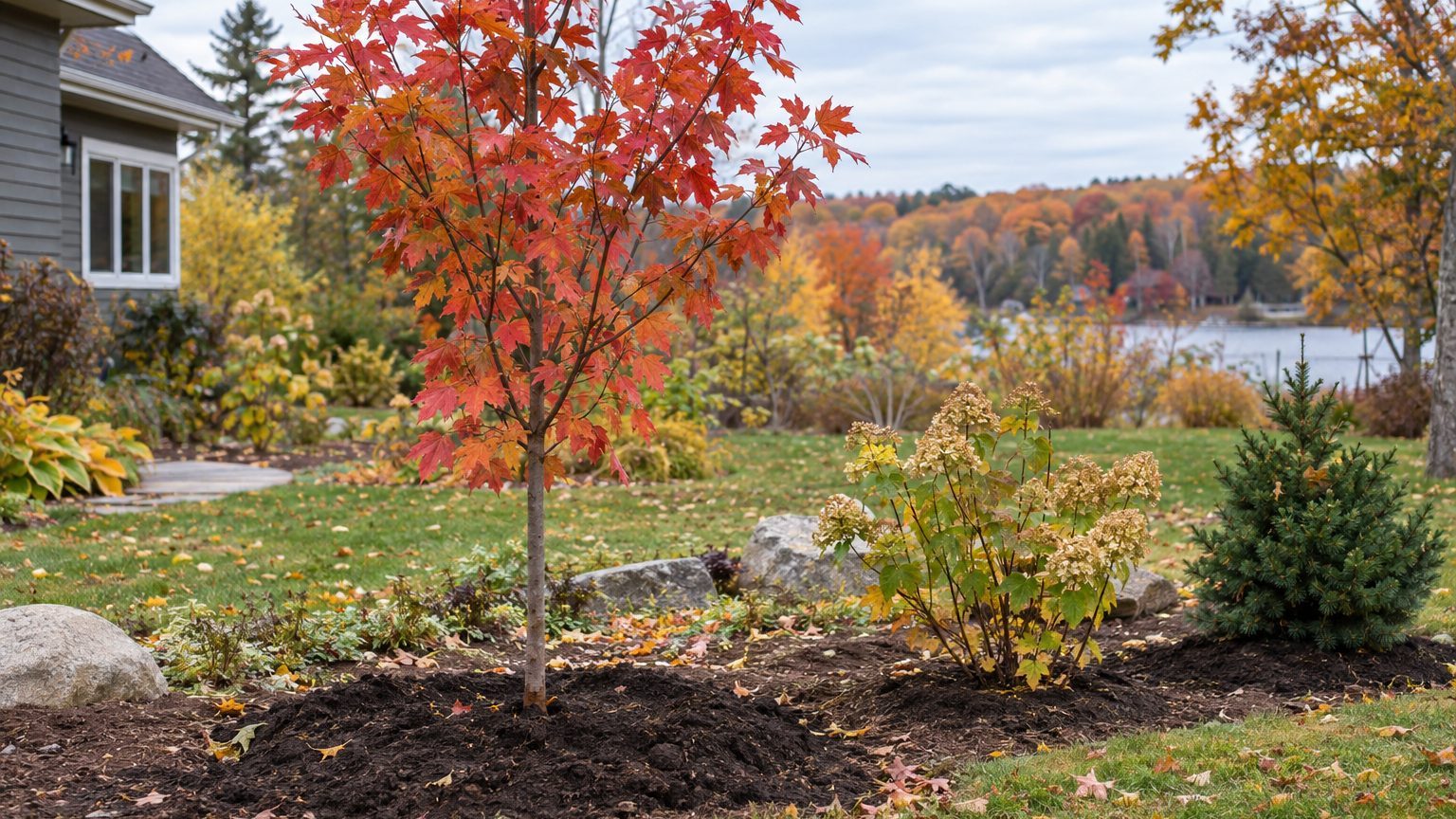

The safe target in Mississippi is to get trees and shrubs in the ground six weeks before the first fall frost. At the Jackson reference station, that puts the deadline between September 26 and October 11. Treat it as a conservative cutoff, not a wall. Jackson’s ground doesn’t freeze, so roots keep working all winter, and fall and winter are the best planting seasons for hardy stock. Rural gardens and colder northern counties should count back from an earlier frost.
The deadline in Mississippi
Roots don’t follow the air thermometer. Top growth slows when days shorten and leaves drop, but roots keep pushing outward as long as the soil is workable and above freezing. In much of Mississippi, that means all winter. The northern advice to plant a set number of weeks before the ground freezes has a different meaning here, because for a large part of the state the ground never gets there.
The numbers behind the date
The frost side of the math comes from NOAA. Its 1991-2020 Climate Normals for the Jackson airport station put the first fall freeze (32°F) somewhere between November 7 and November 22, based on the 30-70% probability band. That is a range because frost is a matter of odds, not a date on the calendar. Some years it arrives early in the window, some years it holds off.
The planting rule comes from Cornell Cooperative Extension, Orleans County, which puts it this way: “Fall is an excellent time for transplanting, provided you get them to their new home at least 6 weeks before the ground freezes, allowing them time to establish roots before winter dormancy.” Cornell counts back from frozen ground, not from the first frost of the air. Ground freezes later than the air does, so counting six weeks back from the first frost builds in extra cushion. Run that arithmetic on Jackson’s frost range and you get September 26 to October 11 as the conservative planting target. Anything planted before then has had a full six weeks of root growth before the first frost even arrives.
Read that as the safe date, not the last date. The true limit, the ground freezing, usually falls later. It also moves with geography. The reference figures come from an airport weather station, and suburban and rural gardens typically see their first fall frost one to two weeks earlier than that, more at higher elevation. The colder part of the state, farther north, reaches frost sooner, so its safe planting window closes sooner too. Check your own county’s dates before you mark a calendar, and see the First and Last Frost Dates in Mississippi for the frost side of the picture. For the same six-week arithmetic run on a neighboring state’s frost dates, there is How Late Can You Plant Trees and Shrubs in Fall in South Carolina?
Where the deadline stops applying
At Jackson, the mean daily minimum of the coldest month is 36.6°F (NOAA NCEI Climate Normals 1991-2020). That is above freezing, and it tells you the ground there does not freeze in the way a Minnesota or New York yard does. So the six-week rule has nothing to count back from. In that part of Mississippi, the deadline simply does not apply as a cutoff, and fall and even winter are the best time to plant.
The logic is straightforward. Cool, moist soil lets a transplant rebuild roots while the top of the plant demands almost no water. Winter rains do much of the watering. By the time spring heat arrives, a shrub set out in November or January has had months of root growth that a May planting never gets. One caution: 36.6°F is an average of nightly lows, and individual nights still dip below 32°F, which is exactly what the frost dates measure. A cold night is not the same as frozen ground.
Hardiness zones add one more layer. The USDA Plant Hardiness Zone Map (2023 edition, built on 1991-2020 normals) places Mississippi across zones 7b to 9a. Zones rest on a single variable, the average annual extreme minimum temperature, so they tell you whether a plant survives your coldest nights over the years, not when to plant it. Other parts of the state differ from Jackson, so check the zone for your own address.
What to plant late, and what to wait on
Container-grown and balled-and-burlapped plants that are fully hardy in your zone take late planting well. So do dormant, bare-root trees and shrubs that go straight into the ground. Their tops are asleep or close to it, their roots are intact or protected, and the cool, moist Mississippi winter gives them months of low-stress growing underground. For those, the September 26 to October 11 target is a comfortable margin, and planting well past it is fine as long as you keep the soil moist.
Borderline plants and evergreens are where the calendar matters. Buy plants rated for your zone with room to spare, and hold anything at the edge of its range until spring. Here is how the main groups stack up.
| Plant type | Late fall or winter planting | What to watch |
|---|---|---|
| Hardy deciduous trees and shrubs | Good, even well past the safe date | Water during dry spells |
| Hardy container perennials | Good if roots have time to knit in | Keep soil evenly moist |
| Fully hardy evergreens | Good, earlier in the window is better | They lose water through leaves all winter |
| Borderline or tender plants | Risky | One hard freeze can kill a young plant |
Evergreens and the water problem
Deciduous plants drop their leaves and nearly stop losing water. Evergreens don’t. Pines, hollies and other broadleaf evergreens keep their foliage all winter, and that foliage keeps giving up moisture to wind and sun. A newly planted evergreen has a small root system and has to replace that water while it is still getting established. The earlier in the fall window you plant it, the more roots it has to work with. Late winter planting works too, but only if you water.
Why borderline plants wait
Zone ratings are built on the average annual extreme minimum, so a plant at the cold edge of its range can lose a mild winter’s worth of good weather to one hard night. A mature shrub often shrugs that off. A plant installed a few weeks earlier has less root, less stored energy, and less stem tissue to spare. Citrus, palms and other subtropical stock fit this category in much of the state. Waiting until spring gives them a full season of growth before their first winter. If you do plant them in fall, choose a sheltered spot and be ready to cover them on the coldest nights.
Whatever you buy, check the tag against your own zone and your own microclimate. The general principles for placing and settling new plants are covered in Planting and Caring for Trees, Shrubs and Perennials.
Watering and mulch until the ground freezes
The first winter is about roots, not growth. A tree or shrub planted in fall has no leaves working, or very few, so it isn’t making food to spend. What it can do is push roots into surrounding soil, using energy stored the previous season. Whatever you do in the first months should serve that job. Skip heavy fertilizer, which pushes tender new top growth that can be caught by frost, and put your effort into keeping the root zone evenly moist.
Water deeply, then wait
Water deeply and slowly, so moisture reaches the whole root ball and the soil just outside it. A quick sprinkle wets the surface and evaporates. The standard advice is to keep watering until the ground freezes. In Mississippi, at Jackson’s numbers, that may never happen, so let the soil decide instead of the calendar. Dig down beside the root ball with a trowel. If the soil is dry a few inches down, water. If it is damp, wait. Winter rain does a lot of the work in most years, but a dry stretch can leave a new planting thirsty while the top looks fine.
Mulch in a ring, not a volcano
Mulch does two jobs, and NC State Extension names both in its Extension Gardener Handbook (chapter 11, Woody Ornamentals). On weeds: “A 2-inch to 3-inch layer of mulch suppresses most annual weed seeds and makes it easy to hand-pull any that do germinate.” On trees: “Provide a 3-inch layer of mulch to reduce water loss and maintain uniform soil moisture and temperature around roots.” The two sentences point to the same range. Spread a 2-inch to 3-inch layer in a wide ring around the planting hole, not deeper.
More is not better. Pile mulch against the trunk in a cone, the so-called volcano, and you hold moisture against bark, invite rot, and give pests a sheltered place to work. Keep a few inches of open ground around the trunk so the base of the tree, the root flare, stays visible and dry. For the finer points, from material to spacing, see Mulching Without Killing the Plant.
Mulch matters even where the ground never freezes. It slows evaporation, evens out soil temperature, and suppresses the weeds that would otherwise compete with new roots for water. That is exactly the protection a fall planting needs while it establishes.
What goes wrong
Planting on the wrong side of the calendar
The mistake in Mississippi is rarely planting too late for the cold. It is planting too late for the warm season that follows. A tree set out just as spring buds break has to leaf out and face summer heat with an undersized root system. That is the stress fall planting is supposed to avoid. If you are running behind, plant while the plant is still dormant, and water through the following summer. At the other end, planting in the heat of early fall, before the soil cools, asks a new plant to establish in the same conditions that stress mature ones. Cooling soil is the goal, and the October frost target is a good marker for it.
Winter burn, heaving and dry falls
Winter burn shows up when an evergreen loses water to wind and cold faster than roots can replace it, leaving brown, scorched foliage by late winter. In central Mississippi, where the ground does not freeze, roots can keep supplying water if the soil stays moist, so the fix is watering during dry spells. The same logic applies to borderline plants, where a hard night hits leaves that are still soft.
Frost heave needs frozen soil, and at Jackson’s numbers the ground does not freeze, so it is not a concern there. If your county runs colder, ask your local Extension office whether soil freezes where you garden. What does show up, in some years, is a dry fall. New root balls dry out quickly, especially in a raised spot or in sandy soil. Keep checking soil moisture through the whole winter, not just until the first frost. A plant that looks dormant may be one dry week away from real trouble.
Common questions
Can I plant trees in Mississippi in December or January?
Yes, for hardy trees and shrubs at Jackson-type conditions. With a coldest-month mean daily minimum of 36.6°F, the ground there doesn’t freeze, so roots keep growing through winter. Water when the soil is dry, mulch in a ring, and hold borderline plants until spring.
Does the six-week rule apply here?
Only as a conservative guide. Cornell’s rule counts six weeks back from when the ground freezes. At Jackson the ground doesn’t freeze, so the rule doesn’t act as a cutoff. Counted back from the first fall frost (November 7 to November 22), it gives a safe target of September 26 to October 11, though colder northern counties and rural gardens should expect their frost sooner.
How do I find my own first frost date?
Start with the reference range, then adjust. The Jackson figures come from an airport station, and suburban and rural gardens typically see the first fall frost one to two weeks earlier, more at elevation. Your county Extension office can tell you local dates, and the Mississippi guides collect state-specific information in one place.
How deep should mulch be around a new tree?
NC State Extension gives a 2-inch to 3-inch layer for weed suppression and a 3-inch layer around trees to reduce water loss. Stay inside that range, spread it in a ring, and keep it off the trunk. Mulch piled deeper than 3 inches doesn’t add protection and can hold moisture against the bark.