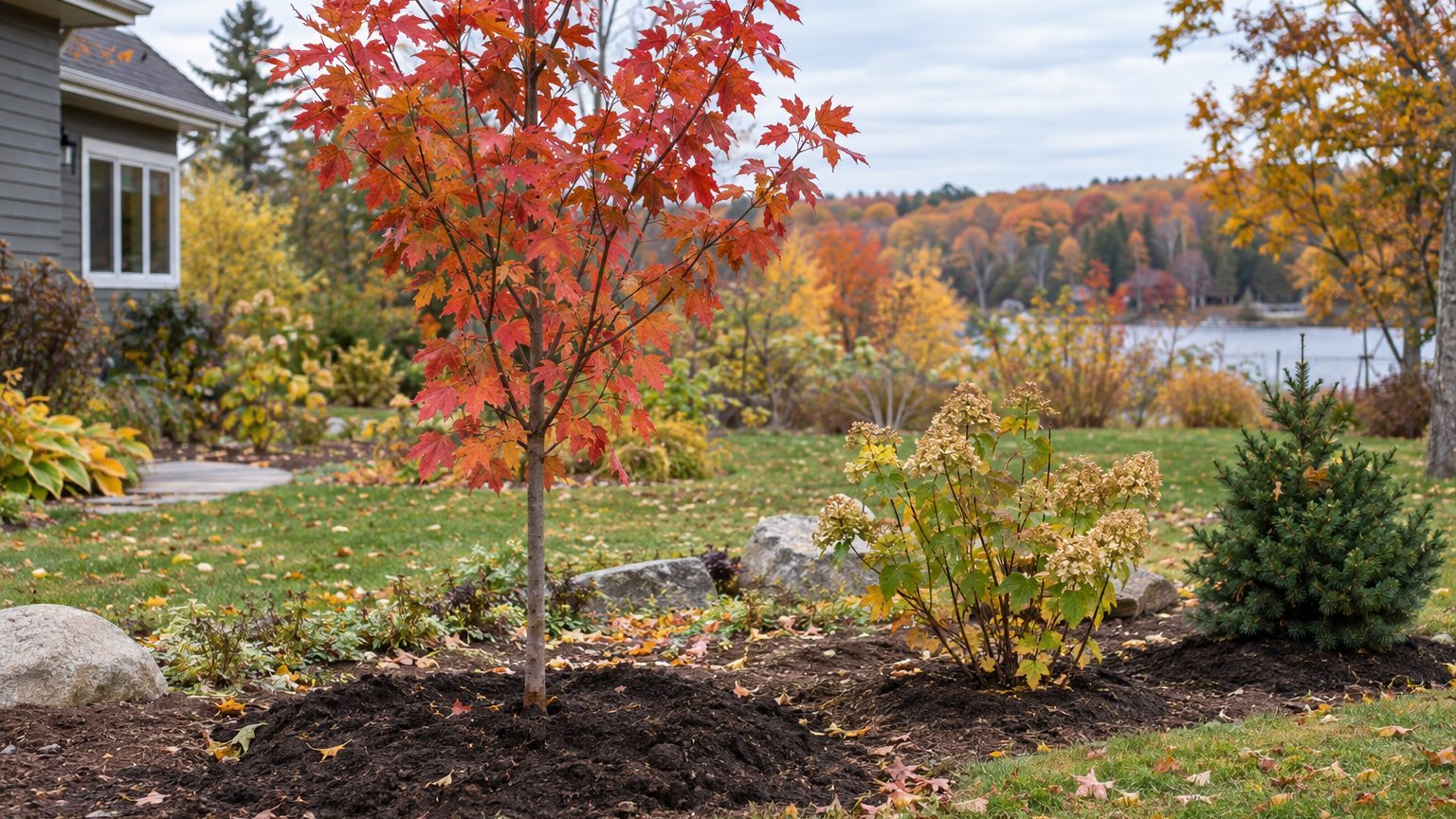

In South Carolina, the safe window for planting trees and shrubs in fall closes between October 9 and October 24, six weeks before the first fall frost of November 20 to December 5. That is a conservative target, not a hard wall. Roots keep growing in soil long after the air turns cold, and across much of the state the ground rarely freezes at all. For many Lowcountry yards, November through February is not late. It is prime planting time.
The deadline in South Carolina
Air and soil run on different clocks. Leaves react to a cold snap within hours, while soil holds summer’s heat for weeks and cools slowly. A newly planted tree keeps pushing roots into the surrounding ground as long as that ground is workable and above freezing, even after the top has dropped its leaves and gone dormant. Fall planting works because the plant has no foliage to feed, and its roots get a head start before spring demands growth.
The six-week countdown, worked from the frost range
The rule most extension programs lean on comes from Cornell Cooperative Extension, Orleans County: “Fall is an excellent time for transplanting, provided you get them to their new home at least 6 weeks before the ground freezes, allowing them time to establish roots before winter dormancy.” The clock starts at frozen ground, which arrives later than the first frost of the air. Because the first frost is easier to look up, it makes a cautious stand-in.
NOAA’s NCEI 1991-2020 Climate Normals for station USW00013880 put the first 32°F freeze between November 20 and December 5, using the 30-70% probability band. Count six weeks back from that range and the conservative deadline is October 9 to October 24. Write that range down. Plants that go in by then have the full six weeks even if frost shows up on schedule, and the actual limit, the ground freezing, usually falls later still.
The colder part of the state reaches both dates sooner. Upstate South Carolina runs several weeks tighter at both ends of the season than the airport station, so its first frost comes earlier and its planting deadline moves earlier with it. If you garden up there, look up your own first frost on the page for first and last frost dates in South Carolina and count back from that, not from the coastal numbers.
| Measure | Figure | Source |
|---|---|---|
| First fall 32°F freeze (30-70% band) | November 20 to December 5 | NOAA NCEI 1991-2020 Climate Normals, station USW00013880 |
| Conservative planting deadline | October 9 to October 24 | Cornell rule counted back from that frost range |
| Coldest-month mean daily minimum | 38.9°F | NOAA NCEI Climate Normals 1991-2020, Charleston |
Where the ground doesn’t freeze, the deadline doesn’t apply
That last row changes the answer for the coast. A coldest-month mean daily minimum of 38.9°F, from the same NOAA normals with Charleston as the reference station, stays above freezing. The ground does not freeze there in a normal winter, so Cornell’s six-week countdown has nothing to count back from. Fall and winter are the best planting seasons in that part of the state, and the cool, damp months are easier on a transplant than a South Carolina July. Peninsular Charleston is milder than the airport station, so the point holds even more strongly downtown.
One caution on hardiness. The USDA Plant Hardiness Zone Map 2023 runs from 7a to 9a across the state. It is built on a single variable, the average annual extreme minimum temperature, so it says whether a plant survives the winter, not when to plant it. Zones differ from the Upstate to the coast, so check the zone for your own location before you buy.
What to plant late, and what to wait on
Container-grown and balled-and-burlapped plants that are fully hardy for your area are the safest late buys. Their roots are intact and already in a medium that holds moisture, so they settle quickly in cool soil. Deciduous trees such as maples and oaks, and deciduous shrubs generally, go in well through the fall and into winter, because the bare branches lose almost no water. Bare-root stock, sold dormant, is a winter job by nature and suits the same months.
Good bets for November and beyond
Fully hardy trees and shrubs sit at the top of the list, along with perennials and ornamental grasses that need time to knit into the soil. Fruit trees and native shrubs are good candidates too, since they are adapted to the local winter. At nurseries in the Lowcountry, the stock you see in November is often there on purpose, because that is when it should go in the ground. The broader mechanics are laid out in Planting and Caring for Trees, Shrubs and Perennials.
Gardeners who want to see how another warm-winter state frames the same question can compare notes in How Late Can You Plant Trees and Shrubs in Fall in Arizona?
The risky categories
Two groups need more caution. The first is plants at the edge of their hardiness for your location, such as citrus, some palms, and tropical-leaning shrubs. They need mature, well-rooted growth to ride out a hard night, and a plant set out in late fall has not built that yet. The second is evergreens, which keep losing water through their leaves all winter. Roots in cold soil have trouble keeping up, and a freshly planted evergreen has fewer roots to do it with.
- Borderline plants: wait for spring, when the whole warm season is ahead of them.
- Evergreens planted late: fine on the coast with steady watering, riskier in the Upstate if they go in close to frost.
- Big root balls: the larger the plant, the more roots it lost at the nursery, and the more it needs the full six weeks.
The rule of thumb is simple: hold borderline plants until spring and plant hardy deciduous material whenever the soil is workable. A hardy plant in the ground in December will almost always beat a marginal one planted in October.
Watering and mulch until the ground freezes
The first winter is about roots, not growth. Whatever top growth a young tree shows next spring was largely decided by how well its root system spread over the cold months. Above ground, the plant is idle. Below ground, it is reaching into native soil, and a root system that is dry or smothered during that stretch pays for it in July.
Deep soaks, not daily sprinkles
Water the planting hole and the root ball thoroughly right after planting, then keep watering until the ground freezes in the colder parts of the state, or through the whole season where it doesn’t. Slow, deep soaks that reach below the root ball beat a quick daily wetting of the surface, which encourages shallow roots. Before each watering, check the soil with a trowel or finger. Soil that is damp below the surface needs no water that day.
Fall in South Carolina can run dry for weeks. Evergreens and anything planted in the last month or two should get a soak during any rainless spell, even in December or January. Dormant does not mean thirsty-proof.
Mulch in a ring, not a volcano
Mulch holds moisture and evens out soil temperature, which is exactly what a new root system needs. NC State Extension’s Gardener Handbook, in its woody ornamentals chapter, gives two sentences that point to the same depth. On weeds: “A 2-inch to 3-inch layer of mulch suppresses most annual weed seeds and makes it easy to hand-pull any that do germinate.” On trees: “Provide a 3-inch layer of mulch to reduce water loss and maintain uniform soil moisture and temperature around roots.”
So the working range is a 2-inch to 3-inch layer, spread in a wide ring around the plant. More is not better. Piling it against the trunk in a cone traps moisture on the bark, invites rot and pests, and keeps water from reaching the roots. Pull the mulch back until a bare collar shows at the base of the stem, with the flare of the trunk visible. For the full approach, see Mulching Without Killing the Plant.
What goes wrong
Planting too late for the local climate is the main failure, and it hits the Upstate harder than the coast. The first frost arrives several weeks earlier there than at the airport station, so the October 9 to October 24 range from the reference station is too generous for northern counties. A tree set out close to frost there has less than the six weeks Cornell recommends, and it enters winter with a root system that has barely left the pot. Count back six weeks from your own first frost, not the coast’s.
Winter burn is the second problem, and it belongs to places that get real cold and drying wind. Evergreens lose moisture through their needles and leaves all winter. Where the soil is too cold for roots to replace it, the foliage browns, usually at the tips or on the windward side. It is mainly an Upstate concern. On the coast, where the ground does not freeze, the same plants simply need water in dry spells.
Heaving is the third. If the ground does freeze and thaw on cold nights, a shallow root ball can be pushed upward and expose its roots, especially one planted without time to anchor. Mulch evens out those swings. Drying out is the failure everyone shares, because a dry fall can leave a new planting thirsty on the coast as easily as in the mountains. Other seasonal timing questions for the state sit in the South Carolina guides.
Common questions
Is November too late to plant a tree in South Carolina?
At the Charleston reference station, no. The first 32°F freeze falls between November 20 and December 5 in NOAA’s 1991-2020 normals, and the ground does not freeze there, so a hardy tree planted in November still has months of root growth ahead. Upstate gardeners are closer to the edge, because their first frost arrives several weeks earlier and the safe deadline moves with it.
Can I plant in December or January?
Along the coast, yes, as long as the soil is workable and you keep it watered. In the Upstate, a December planting is a gamble, because the ground may freeze before roots have anchored. Dormant, fully hardy deciduous trees and shrubs handle winter planting best. Skip frozen or waterlogged soil, where you cannot work the planting hole properly.
Does the six-week rule apply in Charleston?
The rule counts back from the date the ground freezes. The coldest-month mean daily minimum at the Charleston reference station is 38.9°F, which stays above 32°F, so the ground does not freeze there and the deadline does not apply. Fall and winter are the preferred planting months. The October 9 to October 24 range is a cautious target for colder parts of the state.
How deep should I mulch a new tree?
Give it a 2-inch to 3-inch layer, in a ring pulled back from the trunk. NC State Extension’s handbook gives that range for weed suppression and a 3-inch layer for holding soil moisture and temperature steady around tree roots. The two sentences land on nearly the same depth, so there is no extra benefit from piling more on.