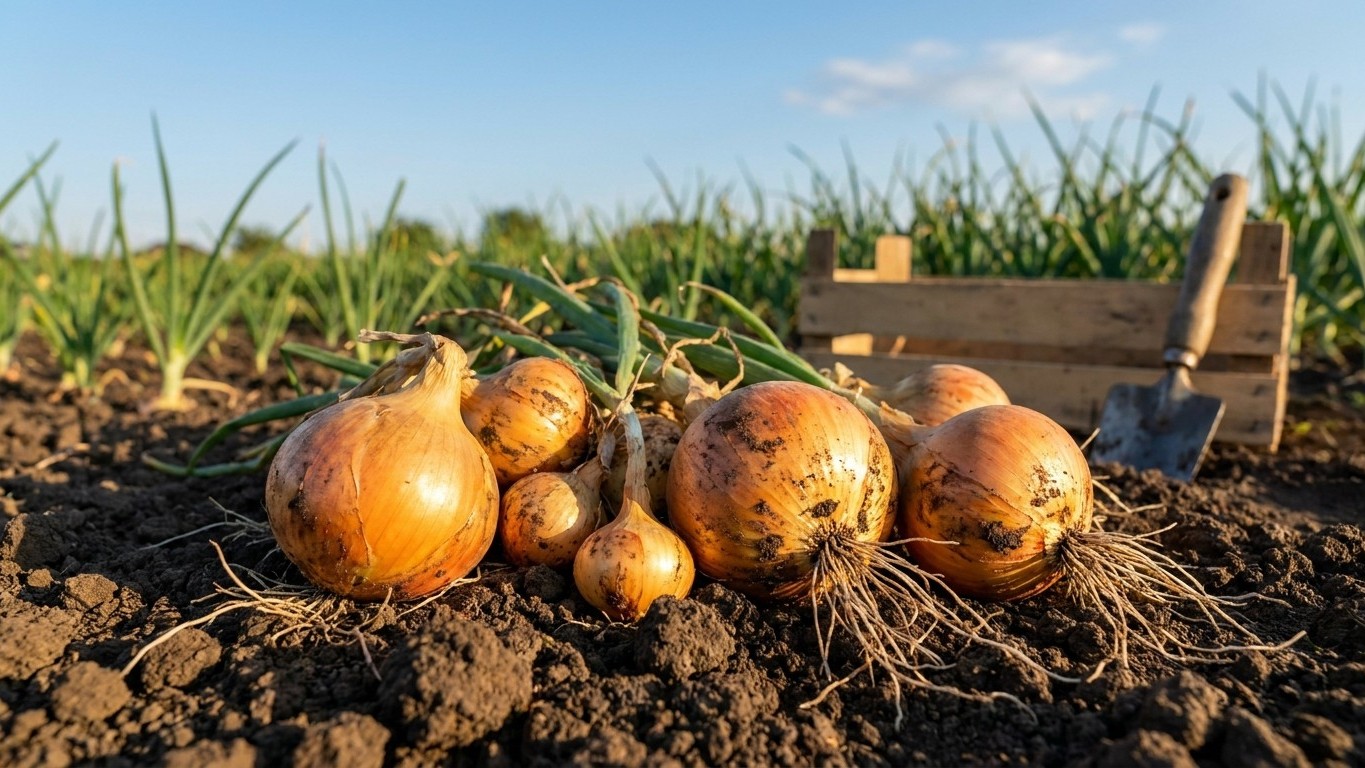

Onion pests in West Virginia follow the onion’s own calendar. Cutworms and onion maggots go after seedlings and young transplants in spring. Thrips move in once the leaves are full, usually in warm, dry weather. Bulb rots and mites take over in storage. Day length sets the growth stages, and the stages set the timing, so a pest that matters in May may be irrelevant by August. The Onions in West Virginia guide covers the broader growing picture.
The short answer for West Virginia
Charleston sits at 38.38 degrees north, and its longest day has 14 h 41 of daylight. That single number decides when your onions stop growing leaves and start swelling a bulb, and therefore how long they sit in the field as green, tender, pest-friendly foliage. Clemson Cooperative Extension puts the trigger for short-day onions at about 12 hours. Long-day types wait for 14 to 16 hours. Charleston’s peak falls short of the top of that range.
Warmth does not flip the switch. Light does. A plant that reaches its trigger with a big leafy top makes a big bulb, and a plant that reaches it small makes a small one. Anything that chews the leaves before that moment shrinks the harvest, because leaves are the factory that fills the bulb. That is why the pest question is really a timing question.
Roughly, here is how the threats line up across a season:
- Transplant and early leaf growth: cutworms clip seedlings at the soil line, and wireworms can be a problem in beds converted from sod.
- Cool, wet spring: onion maggots, the larvae of a fly, tunnel into the base of young plants and bulbs.
- Full leaf, warm and dry stretches: thrips rasp the leaves, leaving silvery streaks, and heavy feeding cuts the leaf area that feeds the bulb.
- Curing and storage: rots and bulb mites find bulbs with wounds or damp necks.
Exact flight dates and population peaks vary by county, elevation and year, and they are not published here. Your county extension office is the place to get them.
What will not work here
Planting the wrong day-length group is the mistake that no spray can repair. A long-day variety wants 14 to 16 hours of light before it bulbs. Charleston tops out at 14 h 41 on the longest day, so a variety asking for 15 or 16 hours never gets there. Even one that needs just over 14 hours sees that light only around the solstice. The plant puts out leaves all season, makes no bulb, and then rots in the ground as the season turns cool and wet. Meanwhile, those leaves sit in the garden for months as a host for thrips, and a thick, green, never-ending top holds moisture at the neck where rot begins.
Timing errors do their own damage. Planting late does not push the harvest back, it shrinks it. Whatever size the plant has reached when day length triggers bulbing is the size of the bulb. The When to Plant Onions in West Virginia page walks through the calendar in detail.
Here is what to cross off the list:
- Long-day types needing 15 to 16 hours: the longest day here is 14 h 41, so the trigger is never reached. Result: leaves, no bulb, rot.
- Long-day types at the low end of the range: the threshold arrives only near the solstice, when the season is already far along, so bulbs stay small and plants sit exposed to thrips and wet weather.
- Short-day types planted in spring: they start bulbing at about 12 hours, which comes early, so a plant set out late has barely grown when the switch flips.
- Any onion set out late “to catch up”: a small plant at trigger time makes a small bulb, and a pest hit on top of that makes it smaller still.
The fix is to match variety to day length first, and then to protect the leaves you have. The The Best Onion Varieties for West Virginia page sorts the options. Pest control works best as a supplement to a good match. It cannot rescue a bad one.
What changes across West Virginia
All the figures on this page come from Charleston, at 38.38 degrees north. West Virginia is not one latitude. The state runs from its southern border counties up to the Northern Panhandle, which pushes toward Pennsylvania and Ohio. The farther north you go, the longer the longest day gets, and the closer a garden comes to the long-day group’s threshold. Elevation adds another layer: a mountain valley can be weeks behind Charleston in spring, and that shifts when seedlings are vulnerable to maggots and cutworms.
| Location | Latitude and longest day | What it changes |
|---|---|---|
| Far southern counties | A bit south of 38.38 degrees north; slightly shorter longest day (exact figure not published here) | Bulbing triggers early; earlier spring, so early-season pests may arrive sooner |
| Charleston (reference) | 38.38 degrees north; 14 h 41 | Short-day and in-between types suit; 15 to 16 hour types cannot bulb |
| Northern Panhandle | North of 38.38 degrees; longer longest day (exact figure not published here) | Closer to the long-day threshold; later spring, so planting and pest windows shift later |
A reader at either edge should look up their own latitude instead of borrowing Charleston’s number. Near the state line to the north, the gap may be large enough to change which group fits, or to move planting by a couple of weeks. The figures above tell you the direction of the shift, not its exact size.
Sweet now, or onions that last
The bite of an onion comes from volatile sulfur compounds, and those same compounds help protect the bulb in storage. A sweet variety carries fewer of them. It tastes better raw, but it will not last the winter. The University of Missouri Extension puts it plainly: “As a rule, ‘sweet’ onions do not store as well as the more pungent types.” Day length lines up with this. Short-day types run sweeter, long-day types keep longer, and West Virginia sits on the sweeter side of the line.
By March, the pantry tells the story. A garden planted to sweet types has run out, or is down to soft, sprouting bulbs you are rushing to use. A garden planted to sharper, tighter-skinned types still has firm onions in a basket. Never count on a sweet onion to keep, however carefully you handle it.
Pests play into this choice. A bulb wounded by maggots or scarred by heavy thrips feeding is a poor keeper regardless of variety, so the damaged ones go to the kitchen first. For the rest, curing comes before anything else: store bulbs only once the necks are tight and the skins papery, never straight from the ground. Clemson Cooperative Extension gives the target as “between 45 °F and 55 °F, and 50 to 60 percent humidity” (Clemson HGIC). Onions want it dry, which is the opposite of carrots and other roots, so one cellar cannot hold both well.
Checking this against your own garden
Everything here is anchored to one city. Before you plan around it, spend a few minutes this week on these checks:
- Look up your latitude. If you live far from Charleston, your longest day differs from 14 h 41 and may sit closer to a different group.
- Get your local frost dates. This page does not publish them, and valley and ridge gardens can differ a lot.
- Call your county extension office and ask which onion pests are active locally and when they usually show up.
- Check your variety tags. Confirm the day-length group before planting, not after.
- Test your storage spot. A cheap hygrometer will tell you whether it is near 50 to 60 percent humidity and in the 45 °F to 55 °F range.
A state-wide figure is a starting point, not a verdict on your particular bed.
Common questions
What is the most common onion pest in West Virginia?
Thrips are a familiar summer problem for onion growers across the eastern US, and they feed on leaves when plants are at full size. Local pressure varies, so your county extension office can tell you how bad they run near you.
When do onion maggots show up?
They are an early-season problem, most associated with cool, wet springs, when plants are young. Exact timing is not published here and shifts with elevation and weather.
Can I grow long-day onions in West Virginia?
Not reliably. At Charleston the longest day is 14 h 41, and varieties that need 15 to 16 hours cannot bulb. Expect leaves, no bulb, then rot.
Can I store onions that insects damaged?
Damaged bulbs keep poorly, so eat them first. Store only well-cured, undamaged bulbs at 45 °F to 55 °F and 50 to 60 percent humidity.