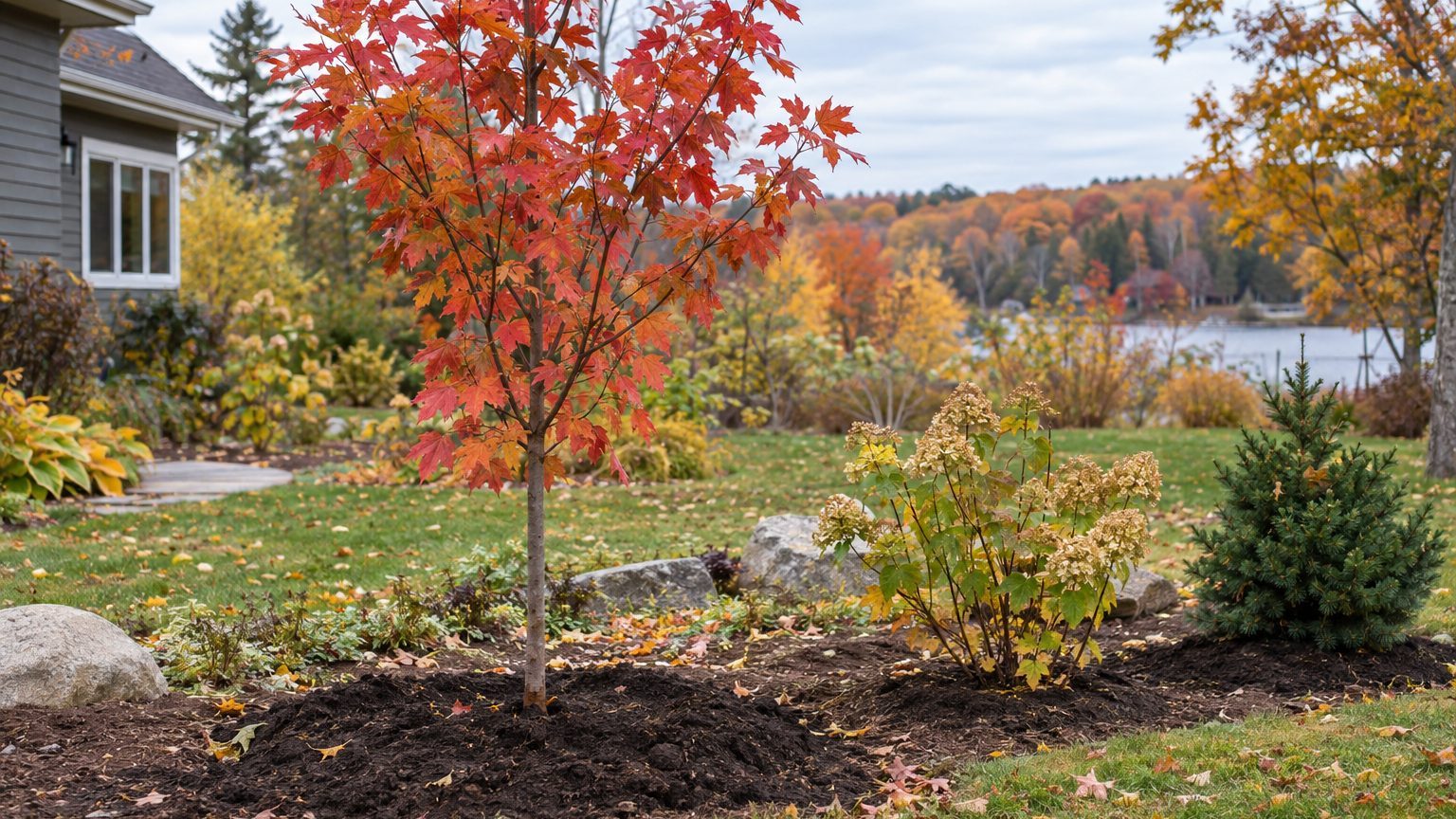

In New York City, the conservative deadline for planting trees and shrubs in fall is October 3 to October 16, six weeks before the first fall frost. That frost arrives between November 14 and November 27 in the NOAA 1991-2020 normals for Central Park. The hard limit comes later, when the soil freezes solid, and some late plantings survive anyway. Upstate and in the Adirondacks, frost arrives earlier, so your cutoff does too.
The deadline in New York
Roots don’t track the air temperature. They keep growing as long as the soil is workable and above freezing, and soil holds summer heat long after the nights turn cold. That lag is why fall planting works at all. The top of the plant slows down and stops spending energy on leaves and shoots, so whatever growth it manages goes underground, where it builds the root system that has to carry the plant through its first summer.
Working back from the first frost
The NOAA NCEI U.S. Climate Normals for 1991-2020 put the first 32°F freeze at the Central Park station between November 14 and November 27 (that is the 30 to 70 percent probability band, so treat it as a range, not a promise). Count back six weeks and you get a safe planting target of October 3 to October 16. Anything in the ground by then has roughly a month and a half of root-building weather before the cold takes over.
The six-week figure comes from Cornell Cooperative Extension, which says: “Fall is an excellent time for transplanting, provided you get them to their new home at least 6 weeks before the ground freezes, allowing them time to establish roots before winter dormancy.” Read that closely. Cornell counts from the day the ground freezes, not from the first frost in the air. The ground freezes later, so counting from the first frost builds in a cushion. October 3 to October 16 is the safe target, and the true limit usually falls later. How much later depends on the year, on snow cover and on your soil.
The coldest month in the city has a mean daily minimum of 27.9°F (NOAA NCEI Climate Normals 1991-2020), which sits below freezing. The ground does freeze in New York City, so the deadline applies here.
Why the Central Park number isn’t the state’s number
Central Park is a dense urban site, and the dates above are New York City figures, not state-wide ones. Upstate New York and the Adirondacks see their first frost far earlier in fall. Their ground freezes earlier too, so the planting deadline moves earlier as you go north or climb in elevation. Cornell’s quote above comes from its Orleans County office in western New York, a reminder that the rule was written for upstate gardeners, not just for the city.
To find your own date, look up your local first-frost range in First and Last Frost Dates in New York and count six weeks back from it. A gardener in the Adirondacks could be finished with the safe window well before a Long Island gardener has started.
What to plant late, and what to wait on
Container-grown and balled-and-burlapped plants that are fully hardy in your zone are the best candidates for a late-window planting. Their root masses arrive mostly intact, so there is little transplant shock to recover from. Hardiness comes first, though. The USDA Plant Hardiness Zone Map (2023 edition, built on 1991-2020 normals) rates New York from 3b to 7b, and the system rests on one variable, the average annual extreme minimum temperature. A plant that is comfortable in one part of the state can be a gamble in another, so check the tag against your own zone, not the city’s.
Borderline plants are the ones to hold back. A shrub rated for the very edge of your zone has to survive its first winter with a half-built root system, and that is the moment it is least able to handle a hard cold snap. In a place where the average coldest-month night already dips to 27.9°F, plants sold as “marginally hardy” can lose a lot of wood in a bad year. Wait for spring and give them a full season of roots first.
| Plant type | Late-window outlook | Reason |
|---|---|---|
| Hardy deciduous trees, container or balled | Good | Leaves drop soon after planting, so roots get the energy |
| Hardy deciduous shrubs, container | Good | Small root mass settles quickly in warm soil |
| Hardy perennials, container | Good, if early in the window | Need time to anchor before the ground heaves |
| Needled evergreens (pine, hemlock, arborvitae) | Fair, early end only | Keep losing water through needles all winter |
| Broadleaf evergreens (rhododendron, holly, boxwood) | Risky | Leaves lose water in wind and sun while roots are still small |
| Plants at the edge of their zone | Wait for spring | Little root growth to buffer a hard winter |
| Bare-root stock | Usually spring | Roots are fully exposed and have the least margin |
Evergreens deserve special mention because they never fully shut down. A maple drops its leaves and stops losing water. A hemlock keeps its needles, and on a sunny, windy day in January it keeps transpiring while frozen soil blocks any replacement. A freshly planted evergreen has the least ability to refill that tank. Plant them at the early end of the window and give them a sheltered spot, or wait until spring, when the whole growing season is ahead of them. A few deciduous species, birches and magnolias among them, also have a reputation for sulking when moved in fall, so if you have the choice, spring is kinder to those.
The short version for the shopping list: plant hardy container and balled stock first, and let borderline plants and bare-root stock wait until spring. The step-by-step of getting a plant into the ground is covered in Planting and Caring for Trees, Shrubs and Perennials.
Watering and mulch until the ground freezes
A fall-planted tree has one job before winter, and it isn’t growing taller. It is spreading roots out of the original root ball and into the surrounding soil. Whatever the branches do next spring depends on how far those roots got. That is why the first winter is about roots, not growth, and why watering matters more in October and November than most people think. Soil under a new planting can dry out quickly even when the air feels cool and damp.
The routine is simple. Water deeply until the ground freezes, a slow soak that reaches the whole root ball and the soil just beyond it, not a daily sprinkle that wets only the surface. Check the soil with your fingers or a trowel before each watering and skip it after a soaking rain. New York falls can swing between wet and bone dry, and the plants don’t read the forecast. Keep going into late fall, because roots that go into winter with moist soil around them fare better than roots in dust.
Mulch comes next, and the depth matters. NC State Extension, in its Extension Gardener Handbook, gives two sentences that point to the same depth. On beds: “A 2-inch to 3-inch layer of mulch suppresses most annual weed seeds and makes it easy to hand-pull any that do germinate.” On trees: “Provide a 3-inch layer of mulch to reduce water loss and maintain uniform soil moisture and temperature around roots.” One purpose is weed control, the other is moisture and temperature, and they land on the same range. More is not better.
Shape matters as much as depth. Spread the mulch in a flat ring that covers the root zone, and keep it from piling against the trunk or stems. A mound of mulch heaped up the bark, the so-called volcano, holds moisture against the trunk, invites rot and gives mice and voles a cozy winter shelter. A ring that looks like a doughnut, with a bare gap at the base, does the job. The details are in Mulching Without Killing the Plant.
Mulch also evens out soil temperature, which matters in a climate where the ground can freeze, thaw and freeze again over a single winter. Put it down after planting and top up as needed, so the soil stays closer to a steady temperature.
What goes wrong
The most common failure is simply planting too late. A tree that goes in just as the ground is stiffening has no time to anchor itself, and the first hard freeze finds a plant sitting in loose soil with its roots still inside the original root ball. The safe target of October 3 to October 16 exists because of that. Miss it and you are not doomed, but you are betting on a mild stretch of late fall, and the colder your part of the state, the worse the odds. If you are past the window, plant only hardy, container-grown stock and be ready to water, or hold the plant until spring.
Winter burn hits evergreens, mostly broadleaf ones. Leaves and needles keep losing water to wind and bright winter sun while the frozen soil blocks any refill. By late winter the foliage turns brown and crispy, usually on the side facing the wind. Plants with small, new roots are the most exposed. Deep watering before freeze-up, a sheltered planting site and an early planting date all lower the risk.
Heaving is the other winter problem. When soil freezes and thaws repeatedly, it can push shallow root balls and small plants up out of the ground, exposing the roots to air. Mulch reduces the temperature swings, and a plant that went in early has roots deep enough to resist the push. After a thaw, check new plantings and press any lifted root ball back down.
A dry fall can quietly do the same damage as a hard freeze, because roots that never got moisture can’t grow. More autumn guidance for the state is collected in the New York guides.
Common questions
Can I still plant a tree in New York in November?
In New York City the first fall frost arrives November 14 to November 27, and the soil is often still workable for a while after that. Planting then is past the safe target, so it is a gamble. If you go ahead, choose a hardy container-grown plant, water it deeply and mulch it. Stop when you can no longer dig the soil.
Does the October 3 to October 16 target apply upstate?
No. That range is derived from the Central Park first-frost range and applies to New York City. Upstate and the Adirondacks frost earlier, so their deadline falls earlier as well. Take your local first-frost range and count six weeks back from it.
What if the ground freezes before I finish planting?
Don’t chip at frozen ground. Keep container plants in a sheltered spot, water them when the soil in the pot is dry, and plant when the soil thaws, or hold them until spring. Balled plants can be heeled in with mulch until the ground opens up, though containers are easier to manage.
Is the deadline the same in other states?
The method is the same everywhere the ground freezes: find your first-frost range and count back six weeks. The dates differ. Utah’s are worked out in How Late Can You Plant Trees and Shrubs in Fall in Utah?, and in a part of any state where the coldest month’s average night stays above 32°F, the ground doesn’t freeze and the deadline doesn’t apply.