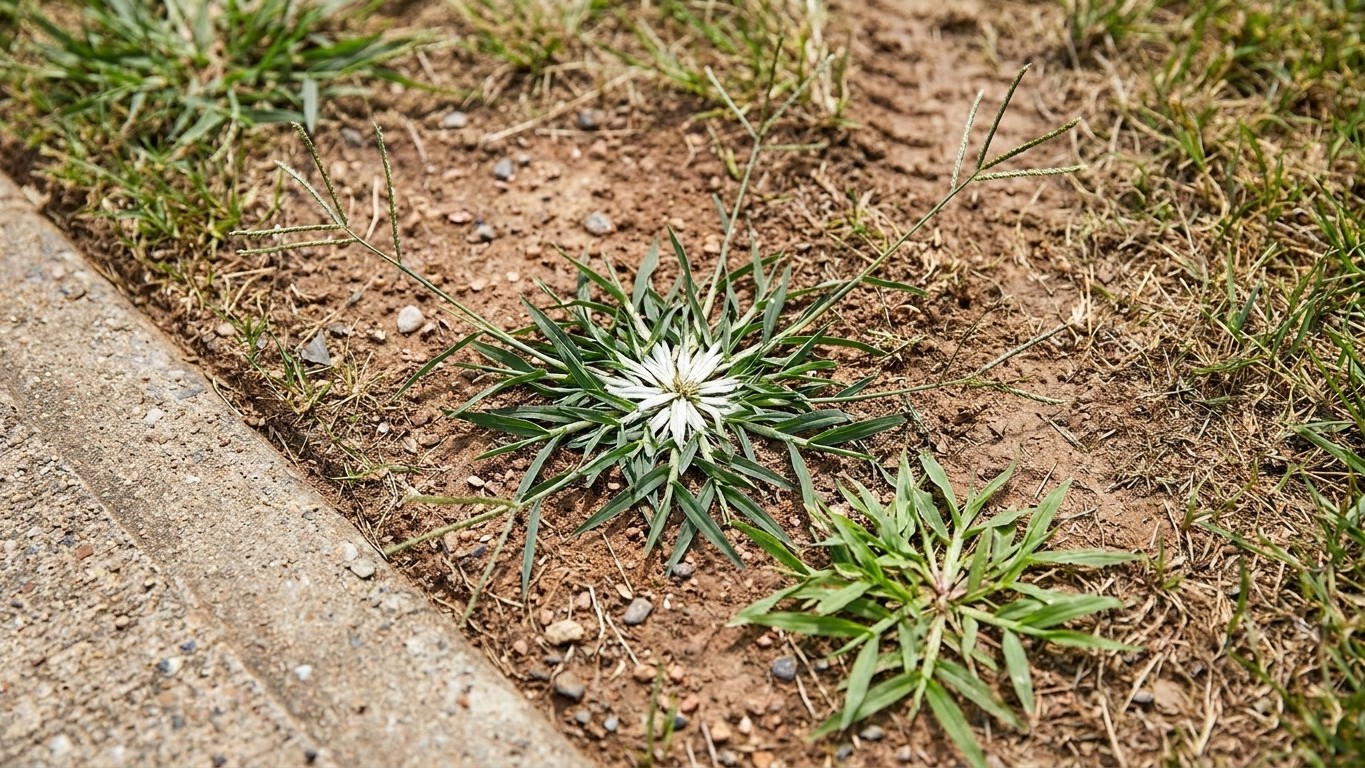

Most Kansas lawns never need dethatching, and the ones that do should be done in a narrow window. Cool-season lawns (tall fescue, Kentucky bluegrass, ryegrass) get it in early fall. Warm-season lawns (zoysiagrass, bermudagrass) get it in late spring, once they have fully greened up. Before you rent any machine, cut a wedge out of the lawn and measure the thatch layer. If it is under 0.75 inch, put the rake away.
Do you need to dethatch at all?
Thatch is the brown, spongy mat that sits between the green blades and the soil. It is made of stems, stolons and roots that die back more slowly than they grow. A thin layer is actually useful. It cushions foot traffic and insulates the crown of the plant. Trouble starts when it thickens enough to hold water at the surface, block fertilizer and give insects and fungus a comfortable home.
Measuring it takes two minutes. Push a spade in and lift out a wedge of turf, then look at the side of the plug. The thatch is the brown, fibrous band between the green growth and the dark soil. Under 0.5 inch is healthy. Above 0.75 inch, act. Anywhere between those two numbers, you are fine and can keep an eye on it. These are the thresholds used in turfgrass guidance from Clemson Cooperative Extension and Penn State Extension, and they hold across species.
Take plugs from three or four spots, not one. Thatch builds unevenly, and a sunny slope can look nothing like the shaded corner by the porch.
Which Kansas lawns actually build thatch
Grass type matters more than anything else. Much of Kansas sits in the transition zone, where neither cool-season nor warm-season turf has an easy time. A cool-season lawn struggles through July heat. A warm-season lawn is brown from October to April. There is no single best grass here, only a trade-off you choose between.
That trade-off carries over to thatch. Zoysiagrass and bermudagrass spread by runners above and below ground, and they pile up thatch faster than a bunch-type tall fescue lawn does. Kentucky bluegrass also spreads by rhizomes and can thicken over the years. Heavy nitrogen feeding and frequent shallow watering speed all of this up. Grass clippings, despite the old rumor, are not the cause. They break down quickly and mostly feed the soil.
The season to do it in Kansas
The right month depends on what is growing in your yard, because dethatching tears up turf. The grass needs to be growing hard enough afterward to fill the gaps before weeds do.
For cool-season lawns, early fall is the window. Soil is still warm, days are shorter and cooler, and weed pressure is falling. Seed put down after dethatching has several weeks to establish before winter. Spring is the weaker choice, because crabgrass germinates just as you open the soil, and young fescue seedlings then face summer heat with shallow roots.
Frost dates give you a deadline to count back from. In NOAA’s 1991-2020 Climate Normals, the reference airport station shows a first fall 32°F freeze between October 23 and November 2 (the 30 to 70 percent probability band). That is one station, not a statewide promise. Suburban and rural yards typically get their first fall frost earlier, often by one to two weeks, and more at elevation. Check your own county with your local extension office, or look at the resources from K-State Research and Extension.
What does that mean in October? You are at the tail end of the window. If you live somewhere that frosts early and have not started, skip the dethatch and seed this year. Seedlings that do not have time to root properly are a poor bet. Plan for September next year and spend this fall on a light cleanup and a healthy feeding.
Warm-season lawns run on the opposite calendar. Zoysiagrass and bermudagrass need to be fully green and actively growing, so wait until well after the last spring frost. The same NOAA reference shows a last spring 32°F freeze between April 4 and April 18, but your yard may see it a week or two later. Late spring into early summer is the usual sweet spot. Dethatching a dormant warm-season lawn in March exposes dormant crowns to late cold and gives weeds the first shot at open ground.
Rake, power rake, or core aeration
Once your plug says you need to act, the tool depends on how thick the layer is and how large the lawn is. For a general overview of the technique, see Dethatching a Lawn. Here is how the three methods compare for a Kansas yard.
| Method | Best for | Main drawback |
|---|---|---|
| Dethatching rake | Small lawns, thatch just over 0.75 inch | Hard work, and slow on anything large |
| Power rake (vertical mower) | Larger lawns, thick thatch, spreading grasses like zoysia and bermuda | Can tear turf if set too deep or used on stressed grass |
| Core aeration | Thatch near the threshold, compacted clay soil | Does not remove thatch directly, only helps break it down |
A manual dethatching rake has sharp curved tines that pull the mat to the surface. It suits a small yard or a patch problem, but it is real labor. Expect to fill a lot of yard-waste bags and to feel it in your shoulders the next day.
A power rake is the usual choice for a full lawn. Rental stores stock them, and they work in passes across the yard. Set the blades so they just skim the soil surface rather than gouge it. Run one direction, then a second pass at a right angle only if the first leaves a lot behind. Water the lawn a day or two ahead so the soil is slightly moist, not soggy. Avoid doing this to a lawn that is drought-stressed or in a heat wave.
Core aeration is the quieter option, and in Kansas it often makes more sense. Much of the state has heavy clay, which compacts easily. Pulling plugs opens the soil, lets water and air reach the roots, and feeds microbes that digest thatch. If your layer is hovering near the threshold rather than far above it, aerating on its own may be enough. Many people aerate right before overseeding, since the holes give seed a protected place to land.
What the lawn needs afterwards
Dethatching leaves a lawn looking rough. Expect thin patches, exposed soil and a lot of debris. Rake up the loosened material and compost it or bag it, then get the lawn growing again quickly.
Overseeding is the main recovery step for cool-season lawns, and the amount matters. The rates below are for a brand-new lawn, in pounds per 1,000 square feet. Overseeding an existing lawn uses half those rates. More seed is not insurance, since crowded seedlings compete and thin themselves out.
| Grass | New lawn (lb per 1,000 sq ft) | Overseeding (half rate) |
|---|---|---|
| Tall Fescue | 6 to 8 lb | 3 to 4 lb |
| Kentucky Bluegrass | 1 to 3 lb | 0.5 to 1.5 lb |
| Perennial Ryegrass | 4 to 10 lb | 2 to 5 lb |
| Zoysiagrass | 1 to 2 lb | 0.5 to 1 lb |
| Bermudagrass | 1 to 4 lb | 0.5 to 2 lb |
Those ranges blend guidance from several university extension sources, so where they differ, the range covers them. Zoysiagrass and bermudagrass are often established from sod or plugs rather than seed, and they usually recover from dethatching by spreading on their own, so many warm-season lawns need no seed at all.
Water matters more than any product. Keep the top inch of soil lightly moist until new seed sprouts, which can mean short, frequent watering for the first couple of weeks. Once seedlings are up, shift to deeper, less frequent watering so roots chase moisture downward. For feeding, a starter-type fertilizer helps new seed, while an established warm-season lawn should wait until it is growing strongly before getting a normal feeding.
Hold off on herbicides that stop germination until you have checked the label. Many pre-emergent products also stop grass seed from coming up.
Common questions
Can I dethatch in summer in Kansas?
It is a poor idea for any grass type. Cool-season lawns are already stressed by July and August heat, and opening the turf adds injury. Warm-season lawns can handle early summer, but wait out the hottest, driest stretches.
How do I know if my thatch is too thick?
Measure a spade wedge as described above. Above 0.75 inch, act. A bouncy feel underfoot or water running off instead of soaking in are further signs.
Is core aeration enough, or do I need to dethatch too?
If thatch sits near the threshold and your soil is compacted, aeration alone can be enough. If the layer is well over 0.75 inch, power raking removes it directly. Doing both in the same season is common on tired lawns, but space them out rather than stacking them in a single afternoon.
Where can I get advice specific to my county?
Your local extension office is the best source. K-State Research and Extension runs county offices across the state. They can tell you which grass suits your soil and local frost timing, which varies more than any single weather station suggests.