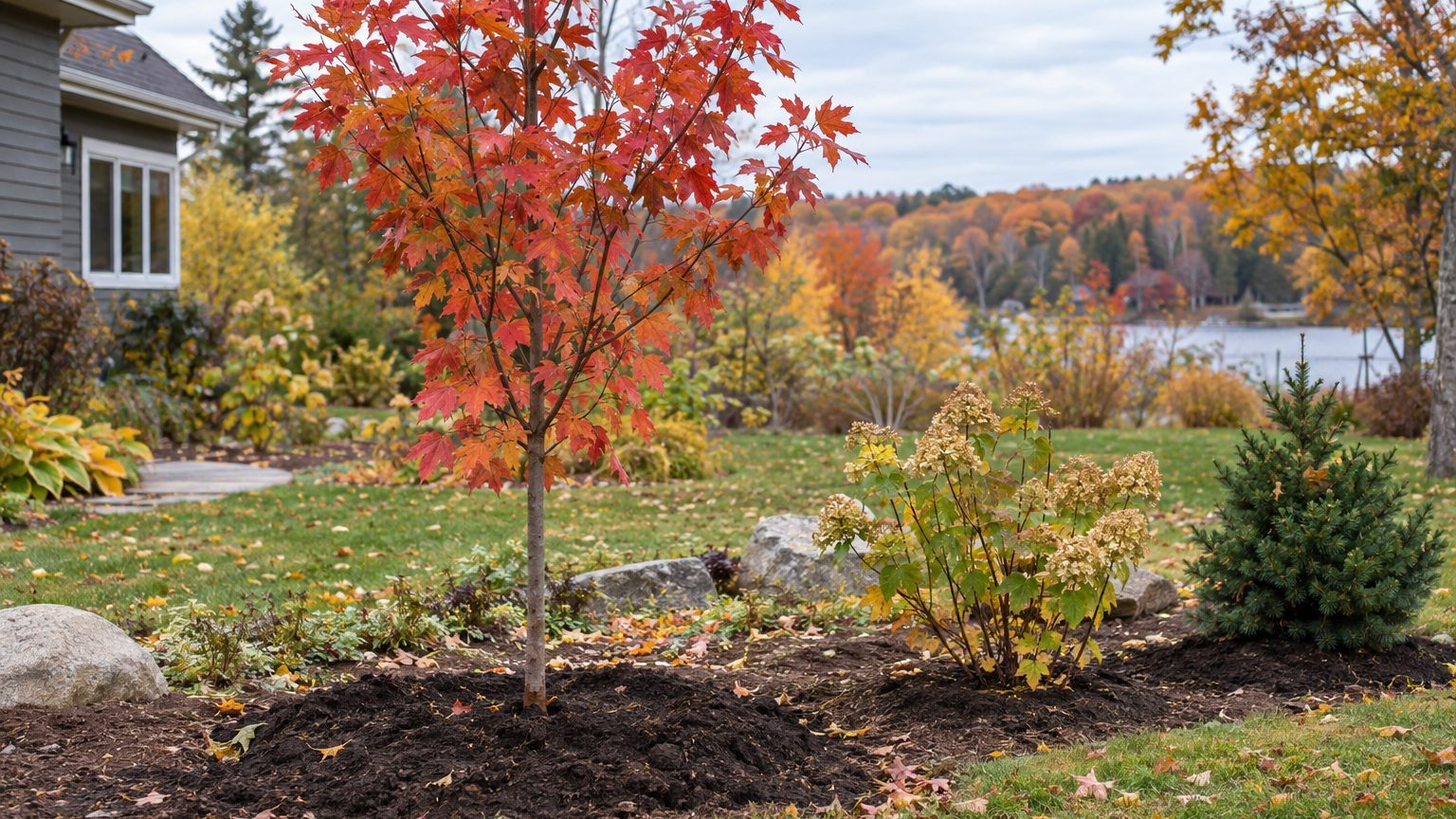

The safe target for planting trees and shrubs in Ohio is six weeks before the first fall frost. Ohio State University Extension’s Ohio Gardening Calendar puts that frost at October 5 to October 15 for zone 6a. Plant after that window and you are not doomed, since roots keep growing until the ground freezes, but you are spending margin. How much margin a given plant can spare decides whether October planting is a smart move or a gamble.
The deadline in Ohio
Air and soil run on different clocks. By the time the first frost blackens the tomato vines, the soil a few inches down has spent months soaking up summer heat, and it gives that heat back slowly. Tree and shrub roots keep extending in that soil as long as it is workable and above freezing, even while the branches above go dormant. That lag is why fall planting works at all. It also means the deadline is a matter of weeks of root growth, not how pleasant the weather feels to the person holding the shovel.
Why the ground, not the air, sets the limit
Cornell Cooperative Extension (Orleans County) states the rule this way: “Fall is an excellent time for transplanting, provided you get them to their new home at least 6 weeks before the ground freezes, allowing them time to establish roots before winter dormancy.” Look at what the clock counts from. It is frozen ground, not the first frost, and the ground freezes later than the air does, sometimes by a good stretch.
Most gardeners do not have a ground-freeze date handy, so counting back from the first frost makes a sensible, cautious stand-in. Take the Ohio State range of October 5 to October 15, subtract six weeks, and you land on a conservative deadline. For a yard like Columbus, August 24 to September 3 is the safe window to write on the calendar.
Treat it as a safe target, not a cliff. The true limit, the day the ground locks up, usually falls later. Hardy plants set in during mid-fall often establish fine. The earlier window simply gives every plant, including the fussy ones, the full runway the Cornell rule asks for.
Ohio is not a place where you can plant all winter, either. NOAA’s 1991-2020 Climate Normals for the Columbus reference station show a mean daily minimum of 22.0°F in the coldest month. That is well under freezing, so the ground does freeze here and the deadline applies. Once it locks up, the planting season is over until the thaw.
Reading the range for your yard
Columbus is the reference point for these dates, and Ohio is a big state. The USDA Plant Hardiness Zone Map (2023, built on 1991-2020 normals) places it in zones 5b-6b, and that range is built on a single variable, the average annual extreme minimum temperature. Where you fall inside it changes the calendar.
The colder parts of the state, farther north and at higher elevation, get their first fall frost earlier. Their ground freezes earlier too, so the planting deadline moves earlier with it. If that describes your yard, aim for the early end of the safe window or ahead of it. A gardener in a milder pocket can lean toward the later end. For a county-by-county feel, the First and Last Frost Dates in Ohio page shows how the numbers shift across the state.
What to plant late, and what to wait on
Plants that arrive in a container or with a balled-and-burlapped root system are the best candidates for late planting, provided they are fully hardy in your zone. Their roots come with soil attached, so there is less transplant shock, and they can start pushing new roots into warm ground right away. In Columbus, where NOAA’s coldest-month mean daily minimum sits at 22.0°F, a plant rated comfortably for the local zone will take winter in stride once its roots have settled.
Dormancy is on your side with deciduous trees and shrubs. A maple or a viburnum that has dropped its leaves is not trying to feed a canopy, so the roots can concentrate on anchoring. Plenty of experienced Ohio gardeners treat October as prime planting season for exactly this reason, and for a hardy deciduous tree, a planting after the safe window is a reasonable bet.
A quick sorting guide
| Plant type | Outlook for late-fall planting | What to do |
|---|---|---|
| Hardy deciduous trees and shrubs, container or balled | Good, even after the safe window | Plant while soil is workable; water until freeze-up |
| Hardy perennials in containers | Good if planted early enough to root in | Plant sooner rather than later; mulch after planting |
| Needled evergreens (pine, spruce, arborvitae) | Fair; they lose water all winter | Aim for the safe window; protect from wind |
| Broadleaf evergreens (rhododendron, holly, boxwood) | Risky late | Plant within the safe window or wait for spring |
| Plants at the edge of their hardiness | Risky late | Wait for spring |
| Bare-root stock | Poor in fall | Wait for spring |
Where the risk piles up
Evergreens are the awkward group. Needles and leaves keep losing water through the winter, while roots in cold soil cannot take up much to replace it. A well-established evergreen copes. A freshly planted one, with a root ball that has barely begun to knit into native soil, has little to draw on. That is why a September planting of a spruce usually goes better than a late October one, even though both are technically “fall.”
Borderline plants are the other trouble spot. A shrub that is only marginally hardy for your area can sometimes survive with a few seasons of roots behind it. A first winter in raw, unsettled soil is a bigger test, and the plant has no reserves to spend. Hold borderline plants and broadleaf evergreens until spring if you cannot get them in the ground by early September.
If you are building a bed from scratch, the basics of spacing, hole width and root flare matter as much as timing. The Planting and Caring for Trees, Shrubs and Perennials section covers those steps in detail.
Watering and mulch until the ground freezes
A fall-planted tree has one job before winter: grow roots. Top growth is a spring project, and it runs on whatever root system the plant managed to build the autumn before. That is why the first winter is about roots, not growth. A tree that sits quietly above ground can still be busy below it, and anything you do to help the roots pays off when buds break.
Water deeply, keep going until freeze-up
Fall can turn dry in Ohio, and a new planting cannot pull moisture from deep soil the way an established tree can. Water slowly so it soaks down through the root ball and the soil around it, rather than running off the surface. Check by pushing a finger or a screwdriver into the soil near the root zone. If it comes out dry, the plant needs a drink. Soggy soil is its own problem, so skip watering when rain has already done the job.
Keep this up until the ground freezes. Dormant does not mean thirsty-proof, and evergreens in particular go into winter better when the soil is moist than when it is bone dry. Skip fertilizer at planting, because it nudges tender top growth that winter will burn back, and the roots need no help in that department.
A ring of mulch, not a volcano
Mulch evens out soil moisture and temperature around new roots, which is what a fall planting wants most. NC State Extension’s Gardener Handbook (chapter 11, Woody Ornamentals) gives two figures. On weeds: “A 2-inch to 3-inch layer of mulch suppresses most annual weed seeds and makes it easy to hand-pull any that do germinate.” On trees: “Provide a 3-inch layer of mulch to reduce water loss and maintain uniform soil moisture and temperature around roots.” The depths are about the same, and the point of the second one is that more is not better. NC State is a southern source, but the logic of keeping moisture steady around roots holds anywhere a new planting is going through its first season.
Spread the mulch in a wide, flat ring, a 2-inch to 3-inch layer that stops short of the trunk. Piling it against the bark, the so-called volcano, keeps the trunk wet, invites rot and gives rodents a cozy place to chew. Pull it back so you can see the root flare. For more on getting this right, see Mulching Without Killing the Plant.
What goes wrong
Planting too late, and heaving
The most common failure is simply running out of time. A tree set in so close to freeze-up that the roots had no weeks to grow has nothing anchoring it when the soil starts cycling between frozen and thawed. Heaving follows: the freeze pushes the shallow root ball upward, and the thaw does not let it settle back. Ohio sees plenty of freeze-thaw swings, and a plant that has heaved can end up with roots exposed to air by late winter. If you notice one rising, press the soil back around it once the ground softens and top it up with mulch.
If you are planting after the safe window of August 24 to September 3, plan for this. Choose a hardy plant, firm the soil, mulch right away, and check the base after hard freezes. Neighbors across the Pennsylvania line face the same arithmetic, which How Late Can You Plant Trees and Shrubs in Fall in Pennsylvania? walks through for that state.
Winter burn and drying out
Winter burn shows up as brown, crisp needles or leaf edges on evergreens by late winter. The cause is water loss through foliage while the roots sit in cold or frozen soil, unable to replace it. A new planting is especially vulnerable, and sun and wind make it worse. Deep watering before the freeze and a steady mulch ring help. In an exposed spot, a burlap screen on the windward side can cut the drying wind.
A dry fall is the quieter threat. Roots cannot grow into dust-dry soil, so a plant that missed its autumn watering enters winter with a smaller root system than it should have. It may leaf out fine and then struggle in the first hot spell. The fix is dull but effective: check the soil, water when it is dry, and keep doing so until the ground freezes.
Common questions
Can I plant trees after the first fall frost in Ohio?
Yes, with conditions. The frost only tells you the air has gotten cold. Roots can keep growing as long as the soil is workable and above freezing. A hardy, container-grown or balled deciduous tree planted after the first frost, which Ohio State Extension lists as October 5 to October 15 for zone 6a, often does fine. The risk is a shorter root runway before the ground freezes, so water carefully and mulch well. Evergreens and borderline plants fare worse.
What if the ground freezes before I get my shrub planted?
Leave it in its container and wait. A pot in a sheltered spot out of the wind, kept from drying out, is a safer bet than chiseling a hole in frozen soil. Container roots are more exposed to cold than roots in the ground, so keep the pot against a wall or surrounded with mulch, and plant as soon as the soil thaws in spring.
Should I fertilize a tree I plant in fall?
No. Fertilizer encourages new top growth, and winter will kill it. Roots are what the plant needs to build before spring, and water and mulch do more for them than any feeding. Hold the fertilizer until the plant is growing again in spring.
Does northern Ohio have a different deadline than Columbus?
It does. The dates here are built around Columbus, where NOAA’s 1991-2020 normals give a coldest-month mean daily minimum of 22.0°F, and the USDA map (2023) shows zones 5b-6b across the state. Farther north and at higher elevation, frost and frozen ground arrive earlier, so the deadline moves earlier too. More local timing lives in the Ohio guides.