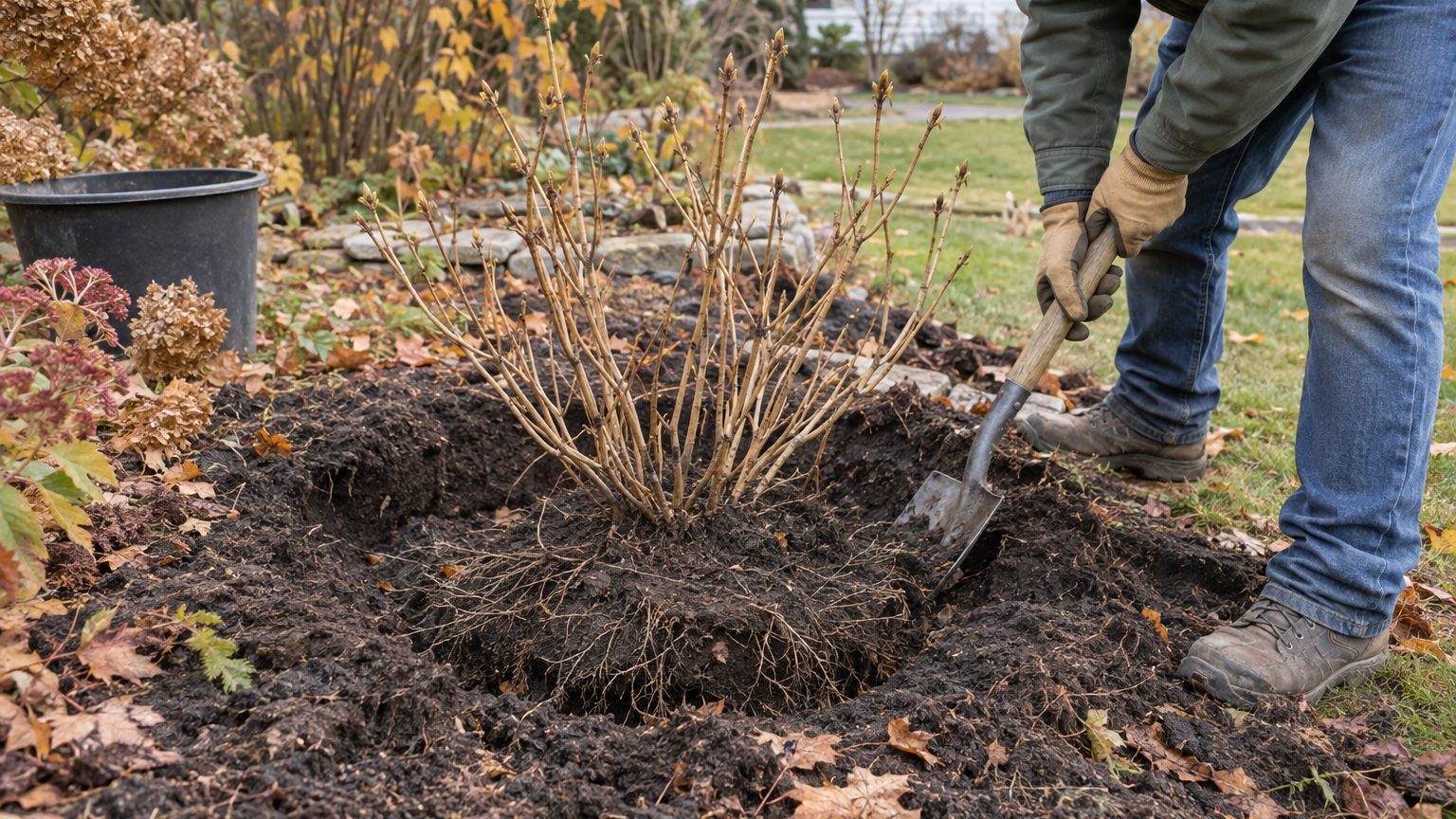

Move a hydrangea while it is dormant, with leaves down and buds not yet swelling, and lift a wide, shallow root ball rather than a deep one. Hydrangeas root close to the surface, so most of what feeds the plant sits in the top layer of soil. Your type decides how much bloom you give up. Below is what to watch for and how to lift it.
Why this matters
Bigleaf (H. macrophylla) and panicle (H. paniculata) are both shallow-rooted, according to the NC State Extension Gardener Plant Toolbox. Their feeder roots spread sideways through the top layer of soil. A spade driven straight down near the stem slices through that network and leaves a narrow, deep plug with little to drink with. Both species grow fast, which works in your favor: a plant that keeps a decent share of its roots usually rebuilds quickly.
Skip the care and the damage shows in two places. First, wilting that does not recover, because a small root ball cannot supply a full canopy. Second, lost flowers on the old-wood types. Bigleaf forms its buds the previous summer, so a stressed plant or a careless cutback can erase a whole year of bloom. Panicle flowers on the current season’s growth and forgives far more.
When to do it
Read the plant, not a calendar. The best window opens after the leaves have yellowed and dropped, and closes before the buds start to swell and break. The plant is not pulling water through leaves then, so it needs far less from a disturbed root system. On a bigleaf, the plump buds along the stems are next year’s flowers. Handle those stems gently.
Where that window falls depends on your zone and on which hydrangea you have. Hardiness for the genus runs from USDA zones 3a through 9b, but it depends entirely on the type, so the state pages in this guide are the place for local timing. Ground conditions matter too. Wait until the soil is workable, neither frozen solid nor sodden, because a wet root ball turns to mud and falls apart as you lift it.
Avoid moving a plant in full leaf or in flower if you can. If a bulldozer or a building project forces it, expect heavy wilting and plan to shade and water the plant.
How to do it

Prepare the new spot first
Dig the new hole before you touch the plant, so the roots spend minutes in the air rather than an afternoon. Make it noticeably wider than you expect the root ball to be, and only as deep as the ball. Because hydrangeas are shallow-rooted, a deep hole just invites the plant to settle below its old soil line. Fill the hole with water. If it is still standing there the next morning, the drainage is wrong. Hydrangeas tolerate occasional wet feet, but not a bathtub.
Check the light as well. Panicle is the only hydrangea that takes full sun well, while bigleaf wants dappled light or shade. The full breakdown is in How Much Sun Hydrangeas Need, and Which Ones Take Full Sun.
Lift the root ball
You need a sharp round-point shovel or spade, hand pruners, a tarp or a piece of burlap, and a wheelbarrow for anything heavy. No source here publishes a root-ball diameter, so size it from the plant. Mark a circle on the ground well out from the main stems, wider than deep, and cut straight down around it with the spade to sever the roots cleanly. A clean cut heals better than a torn one. Then undercut the ball from several sides, working the shovel beneath it at a shallow angle.
On a bigleaf, tie the stems loosely with soft twine so they do not snap while you work, and trim only dead wood. On a panicle you can cut the plant back hard, since it blooms on new growth. If you cut stems, leave them at 12 to 24 inches tall rather than ground level, because native bees nest in hollow stems.
Slide the tarp under the ball, rock the plant onto it and drag or carry it to the new hole. Keep the ball intact. If it crumbles, wrap it in burlap and keep it damp.
Replant and settle it
Set the plant at the same height it grew before, with the top of the root ball level with or a touch above the surrounding soil. Backfill with the soil you dug out, pressing gently with your hands to remove big air pockets. Do not stamp on it. Water slowly with a hose trickle until the whole root zone is soaked, then add mulch over the roots, since both bigleaf and panicle benefit from it. Keep the mulch a hand’s width away from the stems. The plant will probably look limp for a while, and that is normal.
What goes wrong

The most common failure is the small, deep root ball. You recognize it afterward by a plant that wilts badly, drops leaves and stays sulky for a season. The second is planting too deep. The stems then sit buried, growth is weak, and the plant gradually declines instead of collapsing. Check by scraping back soil at the base. If the stems vanish underground rather than flaring out, it is too deep.
Drying out comes third. A root ball left uncovered in wind and sun for an hour can lose more than you would guess. Brown, crisp leaf edges and shriveled tips are the giveaway.
The error that looks like extra care is feeding and drenching the plant right away. Fertilizer on freshly disturbed roots does little good, and many starter products lean heavily on phosphorus. High-phosphorus fertilizer locks aluminum in the soil, which pushes blue flowers toward pink. A move that was supposed to help ends up as a color problem. Daily soaking is the other version: constantly saturated soil starves roots of air. Water thoroughly once, then only when the top layer of soil dries out.
A related mistake is chopping a bigleaf back hard to “balance” the lost roots. That removes the buds already formed, and you get a green plant with no flowers. Finally, deer browse hydrangeas (the source lists them as a damaging agent, despite a conflicting entry elsewhere), and a weakened new transplant takes the hit worst. If browsing is common where you live, protect it.
A moved bigleaf can also change color, because soil pH at the new site may differ. Blue appears below about pH 5.5 and pink above about pH 6.5, with purple in between. For what actually shifts that, see How to Turn Hydrangeas Blue or Pink, and What Actually Works.
Doing it differently
The right tradeoff changes with the type. This table covers what matters for a move.
| Type | Flowers on | What a move costs |
|---|---|---|
| Bigleaf / mop-head / lacecap (H. macrophylla) | Last year’s wood | Risk to this year’s buds; handle stems gently |
| Panicle (H. paniculata) | Current season’s growth | Can be cut back hard; most forgiving |
| Smooth (H. arborescens) | New wood | Hardiest of the genus; little bloom risk |
| Oakleaf (H. quercifolia) | Old wood | Buds at risk; plan for a lighter bloom |
| Mountain (H. serrata) | Old wood | Buds take late frost better than bigleaf |
| Climbing (H. petiolaris) | Old wood | Clings by aerial rootlets; very slow to flower |
Potted plants need none of this. You can move a container hydrangea whenever the weather is mild, because the roots stay in their soil. Moving between pots or from a pot into the ground means keeping the root ball intact and loosening any circling roots.
If a plant is simply too large to lift, a division is often better than a risky dig. You can leave the original and start a new plant by layering a low branch, covered in Growing Hydrangeas From Cuttings and by Layering. For the wider picture of care, the main guide is How to Grow Hydrangeas.
Common questions
Can I move a hydrangea while it is blooming?
You can, but it is the hardest time. The plant has full leaf area and lots of water demand, so wilting is heavy and the flowers often fade quickly. Dormancy is kinder to the roots, especially on old-wood types where buds are already set.
Will it flower the year after I move it?
A panicle or smooth hydrangea, which bloom on new growth, often recovers fast and can flower again. Bigleaf, oakleaf, mountain and climbing types bloom on old wood, so root stress or lost buds may reduce flowering. Climbing hydrangea is very slow to start flowering even without a move.
Will my blue hydrangea turn pink in the new spot?
It might, if you move a bigleaf or mountain hydrangea. Those are the only two types where soil pH changes flower color. Panicle, smooth, oakleaf and climbing types do not respond to soil acidity. They age to white, cream, pink or green whatever the soil.
Is it safe to handle and dispose of the trimmings?
Yes, with ordinary sense. Only H. macrophylla is documented as toxic, and only when large quantities are eaten, causing nausea, stomach pain, vomiting and sweating. The compounds are hydracyanosides, found in bark, flowers, leaves and stems. They also affect cats, dogs and horses, so keep bigleaf trimmings out of reach of pets and livestock.