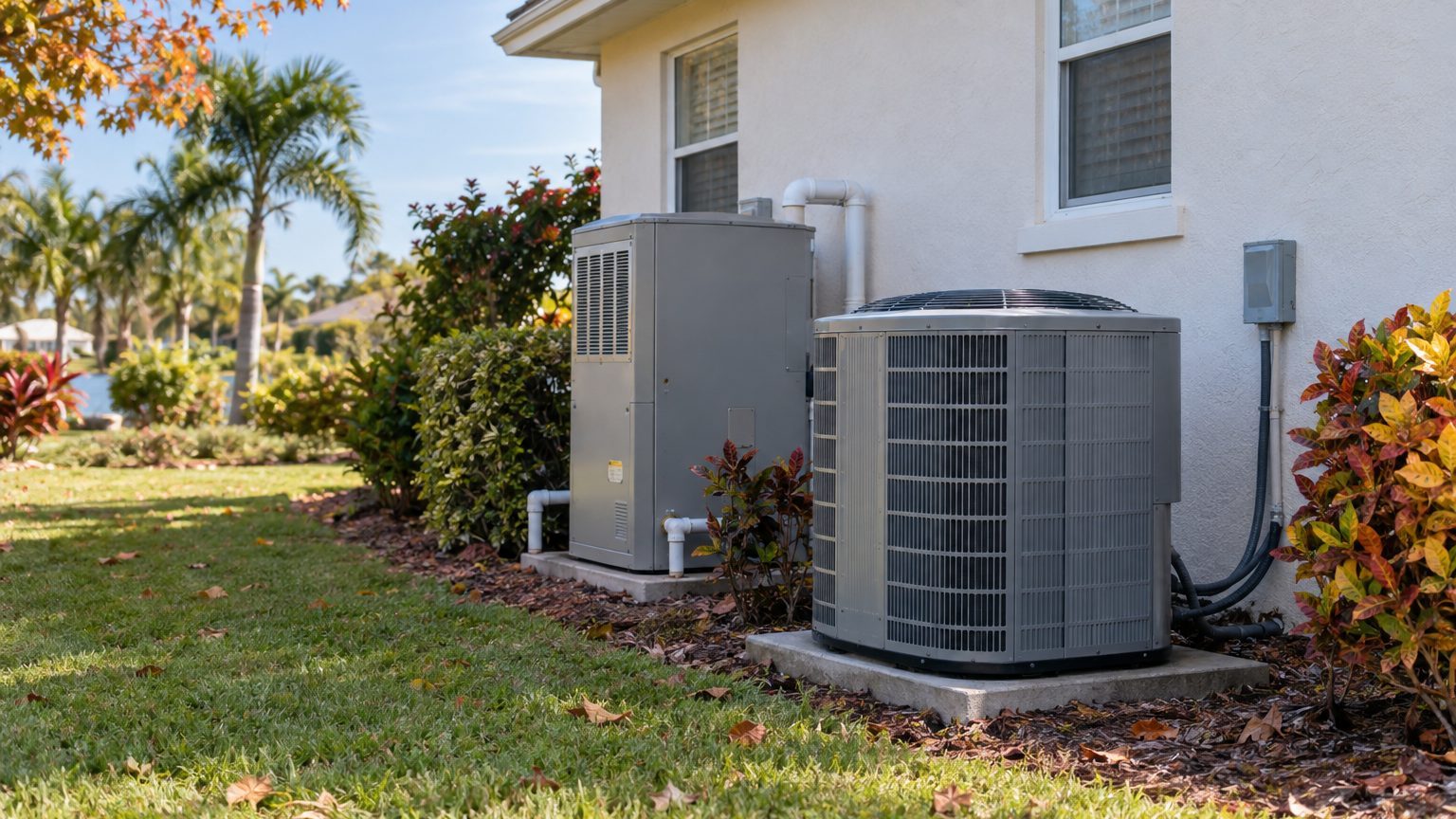

Quebec’s electricity is cheap, which tilts the heat pump versus gas furnace question before any math starts. Two numbers settle it: what a million Btu of heat costs from electricity, and what it costs from a gas line. The first is verified below. The second depends on the gas utility’s published rate, so it has to come from your own bill or a written quote.
The short answer for Quebec
At Hydro-Québec’s average residential price, a heat pump rated at 8.1 HSPF2 (a seasonal coefficient of performance of about 2.4) delivers a million Btu of heat for C$10.23. Electric baseboard heating, at 100% efficiency, delivers the same amount for C$24.30. The heat pump is cheaper to run by C$14.07 per million Btu. These figures were computed from Hydro-Québec’s average residential price and ENERGY STAR efficiency levels, using the standard conversion of 3,412 Btu per kilowatt-hour.
Natural gas is the missing piece. No verified gas price backs this comparison, so ranking a gas furnace against the heat pump here would be guesswork. Quebec gas prices come from the local gas utility, and the next section shows how to put that rate on the same scale.
Two limits apply to every number above. They are running costs for the same unit of delivered heat, not a yearly bill, which depends on the size of the house, its insulation and how it is lived in. They are also not equipment or installation prices, and they use a seasonal heat pump average that slips on the coldest days.
If the house has no gas line, the heat pump is the cheaper system to run; if it has one, get the gas utility’s rate and run the same per-million-Btu math before choosing.
What each option costs to run in Quebec
| System | Efficiency used | Cost per million Btu delivered |
|---|---|---|
| Electric resistance (baseboard) | 100% | C$24.30 |
| Heat pump at 8.1 HSPF2 | Seasonal COP about 2.4 | C$10.23 |
| Gas furnace | Rated efficiency of the unit | No verified gas price; ask the local gas utility |
All dollar figures are in Canadian dollars. The electricity price behind the first two rows is 8.29 cents per kWh, an average residential price before taxes for 1,000 kWh a month, measured in Montreal under the rates in effect in April 2025 (source: Hydro-Québec’s comparison of electricity prices in major North American cities). It is a city average that works for comparing fuels, not your bill, and taxes come on top.
To rank a gas furnace, take the utility’s price per cubic foot and divide it by about 1,037 Btu per cubic foot, the standard energy content of natural gas. Scale that to a million Btu, then divide by the furnace’s rated efficiency. If the bill is in another unit, convert it first. The result is the number to set against C$10.23.
Why efficiency counts as much as the fuel price
A baseboard returns one unit of heat for each unit of electricity. A heat pump at a seasonal COP of about 2.4 returns about 2.4 units, because it moves heat from outdoor air instead of making it from scratch. A gas furnace’s fuel is priced per volume, and only the share that reaches the house counts. A low fuel price with a poor efficiency can cost more than it looks, and a higher electricity price multiplied by a good COP can cost less.
The 8.1 HSPF2 used here is the ENERGY STAR minimum for ducted split systems and single-package equipment. Non-ducted split systems must reach 8.5 to earn the same label, because with no duct losses they start with an advantage. These are minimums to earn the label, not typical values. What HSPF2 Measures, and Why Ductless Asks for More explains why two units must be compared on the same letter, HSPF2 for heating and SEER2 for cooling.
Compare fuels only after converting each one to delivered heat per million Btu; a price per kWh and a price per cubic foot cannot be set side by side.
How cold it gets, and what that does to a heat pump
Montreal-Trudeau records about 4,363 heating degree days a year below 18 °C (Environment and Climate Change Canada, Canadian Climate Normals 1981-2010). Twice the degree days means roughly twice the fuel for the same house. This figure has a Celsius base of 18 °C, which is 64.4 °F, and a 1981-2010 period, so it should not be lined up against U.S. degree-day totals, which use other bases and years. It also describes one station, and colder parts of the province will run higher.
At the Montreal reference station, the mean daily minimum in the coldest month is -14.1 °C. That is an average night low, not a record, so many nights run colder.
Where the seasonal number bends
The C$10.23 figure rests on a seasonal average. Over a whole winter, a heat pump spends many hours in mild conditions where it performs well, and some hours in deep cold where its efficiency drops and it costs more to run than the seasonal figure suggests. That is why cold-climate installations pair the heat pump with a backup, either resistance strips or a furnace, to carry the coldest nights. The average still favors the heat pump over baseboard heating, but it hides a spread. The full picture is laid out in How Cold Is Too Cold for a Heat Pump.
No single outdoor temperature in these figures marks where a heat pump stops being worth running, and none should be invented. Budget on the seasonal figure, plan for a backup to cover the coldest nights, and treat the savings as a winter average, not a guarantee every night.
What homes in Quebec already heat with
Statistics Canada’s table 38-10-0286 (primary heating systems, 2023) shows the province’s main heating equipment. Electric baseboard heaters lead at 54%. Heat pumps follow at 16%, forced-air furnaces at 11%, boilers with hot-water or steam radiators at 4%, and heating stoves at 2%. These are province-wide shares, not a count for any one town, and they cannot be set beside American shares, since the survey, year and categories differ. The “forced-air furnace” category also does not name the fuel, so it cannot be read as a gas count.
For the choice at hand, the equipment matters more than the fuel. A house heated by baseboards has no ductwork, so the realistic comparison is a heat pump against baseboard heating, C$10.23 against C$24.30 per million Btu. Gas never enters. A house with a gas line and a forced-air furnace already has ducts, and that comparison needs the gas utility’s rate. A boiler house is another conversion again: hot-water radiators use no ducts, so replacing the boiler is not the same job as swapping a furnace. Heating a Home in Quebec covers how these setups fit into the province’s wider picture.
When the other choice wins
Cheaper to run does not always mean the right call. A working furnace with years of life left is the clearest case. Savings of C$14.07 per million Btu over baseboards say nothing about replacing a furnace that already runs; the real question is the gap between your gas cost and the heat pump line. Repairing a Furnace or Replacing It walks through that timing.
If your gas quote, converted to delivered heat, comes in below C$10.23 per million Btu, gas wins on running cost, and the heat pump has to earn its place on other grounds. A gas line that serves the house today does not by itself mean the gas furnace is cheaper.
Cooling can tip the scale the other way. The facts here carry no cooling degree day count, so no cooling cost can be stated. But a heat pump also cools, and ENERGY STAR sets a minimum of 15.2 SEER2 for the label. A house that needs air conditioning gets two jobs from one system; a house that never runs one gets nothing from that side of the ledger. For ductless versus ducted distribution, see Ductless or Central.
Keep the furnace if it still runs well or the gas quote lands below C$10.23 per million Btu; choose the heat pump if there is no gas line or if cooling is also on the list.
Common questions
Is a heat pump cheaper to run than baseboard heating in Quebec?
Yes. At Hydro-Québec’s average residential price, a heat pump at 8.1 HSPF2 delivers a million Btu for C$10.23, against C$24.30 for baseboards, a gap of C$14.07. It is a running cost on the same unit, not a yearly bill.
Can I compare a gas price directly to 8.29 cents per kWh?
No. The two prices use different units and different efficiencies. Convert the gas rate to a cost per million Btu delivered, using about 1,037 Btu per cubic foot and the furnace’s rated efficiency, then compare it with C$10.23.
Will a heat pump keep up when it reaches -14.1 °C?
-14.1 °C is the mean daily minimum of the coldest month at the Montreal reference station, so some nights are colder. A heat pump’s efficiency drops in deep cold, and a backup, either resistance strips or a furnace, carries the coldest nights. The C$10.23 figure is a seasonal average, not a rate for any single night.
Does an 8.5 HSPF2 ductless unit mean it is better than an 8.1 ducted one?
Not necessarily. ENERGY STAR asks 8.5 of non-ducted split systems and 8.1 of ducted ones for the same label, because ductless systems have no duct losses and start ahead. Both are minimums to earn the label, so compare units on the same letter, HSPF2 against HSPF2.