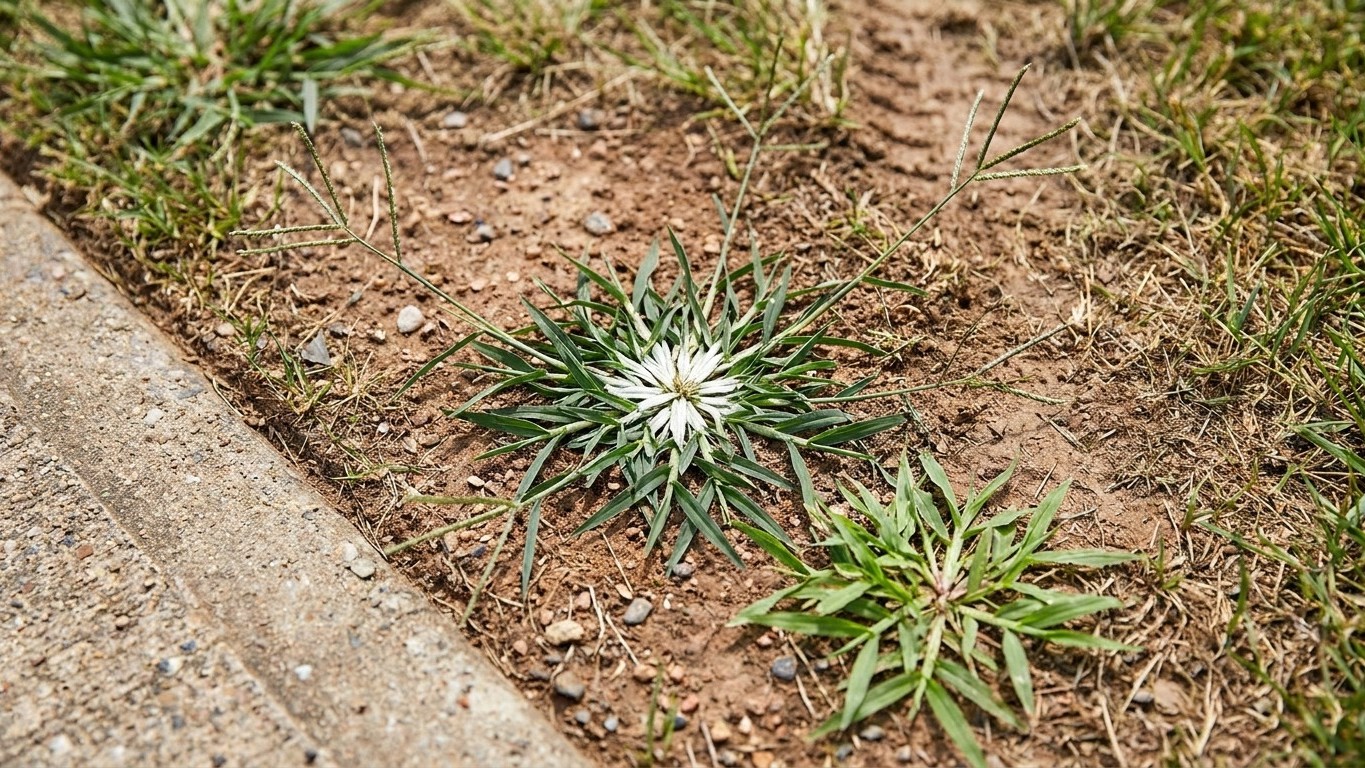

Most Quebec lawns never need dethatching. Cut a wedge of turf with a spade, and if the brown, spongy layer between the green blades and the soil is under 0.5 inch, put the rake away. Only above 0.75 inch does the job pay off. Then the best window runs from late summer into early fall, with spring as a workable second choice. The Montreal frost dates below describe one weather station, not the whole province.
Do you need to dethatch at all?
Thatch is not the green clippings left behind by the mower, and it is not the same thing as the dead-looking mat you see after snow melts. It is a layer of stems, roots and runners that die faster than they decompose, packed between living turf and soil. A thin layer is useful. It cushions foot traffic and insulates the crown of the plant. Trouble starts when it thickens enough to shed water and hold roots in a shallow zone where they dry out and winterkill more easily.
The test takes two minutes. Push a spade in on three sides and lift out a wedge of turf, then look at the side of the plug. You are measuring the brown, spongy band, not the green growth above it and not the dark soil below. Under 0.5 inch is healthy. Above 0.75 inch is where Clemson Cooperative Extension and Penn State Extension turfgrass guidance says to act. Between those two numbers, you are in a gray zone where better watering and mowing habits usually do more than any machine.
Take a few samples from different parts of the yard. Thatch builds unevenly, and a sunny, heavily fertilized strip along the driveway can run thick while the shady back corner stays thin.
Why most lawns pass the test
A lawn that gets moderate nitrogen, is mowed regularly with clippings left in place, and gets deep watering rather than daily sprinkles tends to break down its own debris. Soil organisms do the work. Dethatching a lawn that passes the test only tears healthy turf and opens bare ground for weeds. That is a real cost, because a cool, short growing season leaves little time to recover.
Some lawns do build thatch. Kentucky bluegrass spreads by underground runners and is a common culprit, so older bluegrass lawns are the likeliest to fail the spade test. Heavy nitrogen feeding, compacted soil and frequent shallow watering all speed the buildup. If your lawn fails the test, the general method is covered in Dethatching a Lawn. What follows is how the calendar, and the cold, change the plan in Quebec.
The season to do it in Quebec
Dethatching only works when the grass can regrow quickly, which means a cool-season species in active growth. That matches what survives Quebec winters: Fine Fescues, Kentucky Bluegrass, Perennial Ryegrass, Rough Bluegrass and Tall Fescue. Grasses of the other group, the warm-season types, grow best in summer heat and go dormant when it cools. They do not hold up under a Quebec winter, so they are not a fallback if you strip a lawn bare and want something different.
Late summer to early fall: the better window
At the MONTREAL/ST-HUBERT A station, the first fall frost arrives on average on October 5, according to Environment and Climate Change Canada’s Canadian Climate Normals for 1981-2010. That is a mean date. In one year out of two, frost comes later than that, and in the other half it comes earlier. Treat it as the midpoint of a window, never as a safe date.
Work backward from it. Dethatching and overseeding need time for new seedlings to establish before hard cold, so the job belongs in late summer, not in the first week of October. Soil is still warm, weeds are slowing down and moisture usually improves. Northern and upland districts of Quebec run weeks behind Montreal, and the figure comes from one station, so a yard in a colder district should plan on frost arriving earlier than October 5.
Spring as the backup
The same station gives a mean last spring frost of May 6, again a midpoint, with frost falling later than that in one year out of two. Wait until the lawn has greened up and the ground has drained from the thaw. Power raking a soggy lawn tears out crowns along with the thatch. Spring dethatching followed by seeding also competes with the surge of weeds in that season, which is why fall is the stronger option.
One caution on the numbers: Canadian normals cover 1981-2010, while the US figures elsewhere on this site cover 1991-2020, so do not compare a Montreal date directly with a Vermont or New York one. Readers in the cold-winter Midwest can see how the same logic plays out in When to Dethatch a Lawn in Iowa, and the Pacific Northwest picture in When to Dethatch a Lawn in Oregon runs on a very different calendar.
Rake, power rake, or core aeration
The right tool follows the measurement. A layer just past 0.75 inch on a small lawn does not call for a rental machine, and a layer much thicker than that will wear out your arms long before it clears.
| Method | Best for | Stress on the lawn |
|---|---|---|
| Dethatching rake | Small lawns with a layer just over 0.75 inch | Low to moderate; slow, hard work |
| Power rake (vertical mower) | Larger lawns or a layer well above 0.75 inch | High; it pulls out a lot of material and thins the turf |
| Core aeration | Thatch near the threshold, plus compacted soil | Moderate; pulls soil plugs rather than shredding turf |
A manual dethatching rake has curved tines that pull debris up as you drag it. On a small yard it gives you the most control, and you can stop the moment the lawn starts to look scraped. A power rake, also called a vertical mower, uses spinning blades or tines. Set it shallow, because the aim is to comb through the thatch, not slice deeply into the soil. Expect a lawn that looks rough for a couple of weeks afterwards, which is another reason to schedule it in late summer and not right before the cold.
Core aeration works differently. A machine pulls small plugs of soil out of the lawn, and the soil organisms in those plugs, along with better air and water movement, help break the thatch down in place. It will not clear a thick layer quickly. It is the gentler choice when the spade test sits near the threshold, or when the real problem is compacted soil under a yard that gets a lot of foot traffic. Many homeowners find it easier than power raking, and it can be followed by overseeding straight away.
Whichever you choose, rake up the loosened material and compost or remove it. Leaving it on the surface smothers the grass you just freed.
What the lawn needs afterwards
A dethatched lawn has thin spots and open soil, so the next step is overseeding. Choose from the cool-season species above, matched to your light. Fine Fescues are the usual pick for shade, while Kentucky Bluegrass and Tall Fescue suit sunnier, harder-wearing areas. Perennial Ryegrass sprouts quickly, and Rough Bluegrass is a species that tolerates damp shade.
The seed rates below, in pounds per 1,000 square feet, are for a new lawn. Where extension sources differ, the ranges cover them. Overseeding an existing lawn uses half these rates.
| Species | New-lawn rate (lb per 1,000 sq ft) |
|---|---|
| Tall Fescue | 6 to 8 lb |
| Fine Fescues | 4 to 6 lb |
| Rough Bluegrass | 2 to 3 lb |
| Kentucky Bluegrass | 1 to 3 lb |
| Perennial Ryegrass | 4 to 10 lb |
More seed does not act as insurance. Crowded seedlings compete for light and water, and they thin themselves out, often leaving weaker plants behind. Stick to the rate for your species and spread it evenly.
Watering matters more than anything else in the first weeks. Keep the top of the soil consistently moist until the seedlings are up, which usually means short, frequent watering, then shift back to deeper, less frequent soakings once the new grass has rooted. Hold off on heavy nitrogen at the moment of dethatching, since too much of it is a classic cause of thatch in the first place. For provincial agricultural guidance and contacts, MAPAQ is the Quebec government department to start with.
Common questions
Is spring or fall better for dethatching in Quebec?
Fall, meaning late summer into early fall, is the better choice because soil is warm, weeds are slowing and seedlings get time to establish before frost. Spring works if you wait until the lawn has greened up and the soil has drained. Remember that May 6 is a mean last-frost date for one station, so frost can still arrive after it.
How do I know if my lawn has too much thatch?
Cut a wedge with a spade and measure the brown, spongy layer between the green growth and the soil. Under 0.5 inch is healthy, and action is warranted above 0.75 inch. Most lawns fall below that and do not need dethatching.
Can I use the October 5 frost date as my deadline?
Not as a safe cutoff. It is an average for the MONTREAL/ST-HUBERT A station, so in one year out of two frost comes later and in the other half it comes earlier. Colder, northern or upland districts run weeks behind Montreal, so finish well before that date.
Does dethatching replace overseeding?
No. Dethatching removes the buildup, while overseeding fills in the thin patches it exposes. When you overseed an existing lawn, use half the new-lawn rate for your species. A thick thatch layer is also a sign to look at fertilizing and watering habits, because the machine only treats the symptom.