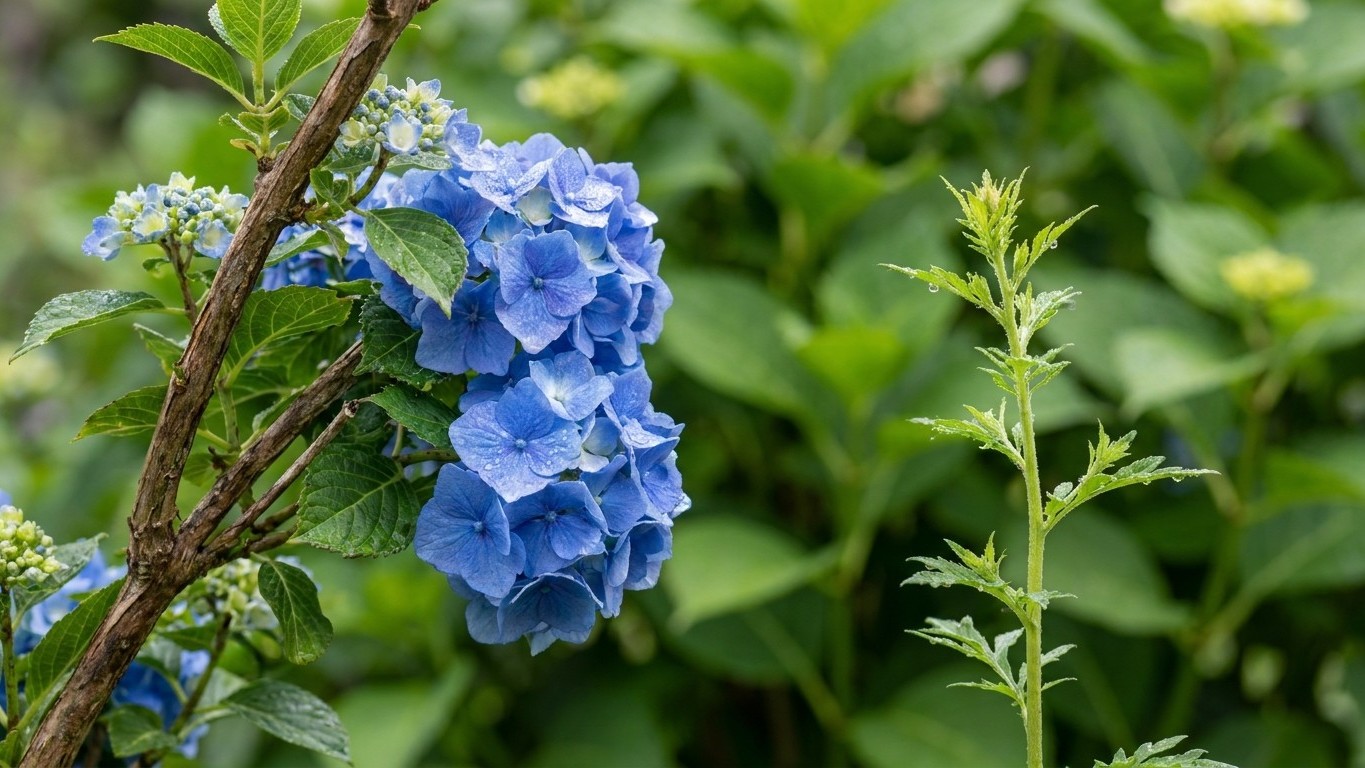

In Maine, plant container-grown hydrangeas in early May, once the last spring frost window has closed, or in late summer so roots settle before the ground freezes. Skip seed. Choose panicle or smooth hydrangeas if you want flowers every summer, because bigleaf types can lose their buds to a hard winter. Flower color, pests and cold protection all follow from those first choices.
When to plant Hydrangeas in Maine

The reference city here is Portland, and Portland is the mild end of the state. NOAA’s 1991-2020 Climate Normals put the last spring 32°F freeze between April 22 and May 1, using the 30-to-70-percent probability band (NOAA NCEI station data). The first fall freeze falls between October 9 and October 21. Inland, northern and higher-elevation Maine run substantially later in spring and earlier in fall, so move every date below to match your own town.
Spring planting from nursery pots
A dormant hydrangea shrub shrugs off cold. The danger is the new foliage and flower buds that follow. Bigleaf hydrangeas leaf out early and a late freeze can blacken the tips, so wait until the frost window has passed, which means the first week of May on the coast and later as you head inland. Panicle and smooth hydrangeas leaf out later and tolerate earlier planting once the soil is workable.
Buy plants that have been sitting outdoors at the garden center. If yours has spent time in a heated greenhouse or your kitchen, harden it off first: a week of gradually longer outdoor stints, starting in shade. Counting back from a May 1 planting, that means starting about April 24. Cold nights still arrive in that stretch, so bring pots into a garage if the forecast dips toward freezing.
Cuttings, and why seed is a poor bet
Hydrangeas grown from seed take years to bloom and rarely match the parent. Cuttings are the practical home route. Take softwood cuttings in late June, root them for about a month and a half, and keep them in a bright, protected spot through winter. Then follow the same count-back: a week of hardening off starting around April 24, and planting out after the frost window closes. A cutting taken in June is therefore roughly 10 months old on planting day.
Fall planting
Late summer is the second window, and many gardeners find it easier on the plant than spring because the soil is warm and rain returns. A rule of thumb (mine, not a published figure) is to have shrubs in the ground about six weeks before the first freeze. Counting back from the Portland window of October 9 to October 21 gives roughly August 28 to September 9. Inland gardeners should shift earlier. Water through October, then mulch after the ground cools.
Soil and site preparation
Morning sun and afternoon shade suits most hydrangeas. Maine’s summers are cooler than the mid-Atlantic’s, so panicle and smooth types handle more sun here than the usual garden advice suggests, provided the soil stays moist. Bigleaf and oakleaf types still do better with a break from afternoon heat. Along the coast, wind and salt spray can scorch leaves, so a fence or a building at your back helps more than extra fertilizer.
Texture matters as much as light. Hydrangeas want moist but well-drained soil, and they sulk in both soggy clay and fast-draining sand. Dig a test hole, fill it with water, and see whether it drains within a few hours. Standing water in the morning means choose a different spot or build the bed up with compost and soil. Rocky ground is common in much of Maine, so expect to pull stones when you dig.
Start the prep weeks ahead. Take a soil sample in the fall before a spring planting, or in early summer before a late-summer one, and send it to a lab. The test tells you pH and organic matter, and pH is what decides flower color on bigleaf types. Lime and sulfur work slowly, so they need a head start. Work 2 to 3 inches of compost into the whole bed rather than just the hole, since roots that hit a sharp boundary tend to circle.
On planting day, dig a hole about twice the width of the pot and no deeper than the root ball. Loosen circling roots, set the crown level with the soil, backfill, and water slowly. Space plants at the mature width printed on the tag, measured center to center. Hydrangeas planted too close need constant pruning and develop more mildew in humid weather.
Varieties that suit Maine
The trait that matters most in Maine is whether the plant blooms on new wood or old wood. New-wood bloomers grow stems in spring and flower on them by summer, so winter dieback barely matters. Old-wood bloomers set buds the previous summer and carry them through winter, so a cold snap or a late freeze can cost you the whole season of flowers. The old determinate-or-indeterminate question for vegetables maps onto this one for hydrangeas.
| Type | Widely sold examples | Blooms on | Good for |
|---|---|---|---|
| Panicle (H. paniculata) | ‘Limelight’, ‘Bobo’, ‘Quick Fire’ | New wood | Dependable flowers after cold winters, sunnier sites, cut and dried blooms |
| Smooth (H. arborescens) | ‘Annabelle’, ‘Incrediball’ | New wood | Shadier spots, big white flower heads, cold-proof performance |
| Bigleaf reblooming (H. macrophylla) | ‘Endless Summer’ series | Old and new wood | Blue or pink color, a second chance at flowers if buds are lost |
| Oakleaf (H. quercifolia) | ‘Snow Queen’ | Old wood | Fall leaf color, sheltered sites in milder parts of the state |
Panicle hydrangeas are the safest choice for a first Maine hydrangea. They bloom late, hold their flower heads into fall, and the white blooms age to pink. Smooth hydrangeas are similar in reliability and tolerate more shade. Of the smooth types, Incrediball was bred for stiffer stems than Annabelle, which tends to flop after a heavy rain.
Bigleaf hydrangeas are the ones most people picture, and the ones that cause most Maine disappointment. A bigleaf planted on an exposed hillside may leaf out green every year and never flower. A reblooming type improves the odds, since it can still make flowers on new growth. Plant bigleafs near a south- or east-facing wall where winter wind is blocked. Variety names and traits are the breeders’ claims, so check tags and your county extension office before committing to a big purchase.
Flower color is a pH matter on bigleaf types only. Acidic soil (roughly below pH 5.5) with available aluminum yields blue, and pH above about 6.5 gives pink. Panicle, smooth and oakleaf flowers do not shift. White ones stay white, so no amount of sulfur turns a ‘Limelight’ blue.
What to plant alongside
Hydrangeas are shallow-rooted and thirsty, so the best neighbors do not compete hard for water. Hostas, ferns, astilbe and heuchera share the same moist, partly shaded conditions and cover the bare soil around the base. That cover keeps roots cooler and cuts weeds, which is a real benefit, not a design flourish. Pachysandra or other low spreaders do the same job where you want a carpet.
Pollinators are a quieter reason to choose carefully. Panicle and smooth hydrangeas carry small fertile flowers that bees visit. Mophead bigleafs, with their showy but mostly sterile florets, draw far fewer. If you want pollinator value, mix in a native shrub or perennial that blooms in July and August, such as bee balm, where there is enough sun.
Keep hydrangeas away from large, greedy tree roots. Maples, birches and similar trees drain the topsoil in the same layer hydrangeas feed from, and the shrub will wilt every afternoon no matter how often you water. Also avoid planting them right beside crowded perennials like phlox and bee balm in a stuffy corner. The issue is poor airflow and powdery mildew in humid weather, not a disease passing from one plant to the other.
One claim to be skeptical of is that marigolds or other strong-smelling plants confuse hydrangea pests. There is no solid evidence for that, and hydrangeas have few serious insect enemies anyway. Another myth is that coffee grounds make flowers blue. Soil pH and aluminum availability do that, and a test tells you more than any kitchen trick.
Watering, feeding and support
Water deeply and less often. A slow soak that wets the root zone down to 6 to 8 inches beats a daily sprinkle, because shallow watering keeps roots near the surface where they dry out first. During a normal Maine summer, roughly an inch of water a week from rain and hose combined is a sensible target, more in the first two years and during dry spells. Wilting at 3 p.m. that perks up by evening is heat stress, not a watering emergency. Wilting in the morning means water now.
Mulch holds moisture and moderates soil temperature. Spread 2 to 3 inches of shredded bark or leaf mold around the plant, leaving a gap at the stems so the bark does not stay wet against the crown. Refresh it each spring. Mulch also matters in winter, covered below.
Feed lightly. One application of a slow-release balanced fertilizer in spring, as growth begins, is plenty for most plants in decent soil. Heavy nitrogen produces big leaves, weak stems and fewer flowers, and late-season feeding pushes soft growth that early frost can kill. Stop feeding by midsummer. Compost on top of the bed each spring often does more good than bags of fertilizer.
Support is a variety decision. Smooth hydrangeas like Annabelle benefit from a grow-through hoop or a peony ring set early in the season, before the stems get heavy. Panicle types carry their blooms on sturdier wood and normally need nothing.
Pruning follows the bloom wood. Prune panicle and smooth hydrangeas in late winter or early spring, cutting back by up to a third for sturdier stems. Prune bigleaf and oakleaf types only after flowering, and no later than early August, or you will remove next year’s buds. In spring, remove only wood that stays brown after the leaves emerge. Suckers sprouting from the base are normal, and you can dig and pot them as free divisions in spring, or remove them to control spread.
Common problems

The most frequent complaint is a healthy plant with no flowers. On a bigleaf or oakleaf it usually means winter or a late freeze killed the buds, or that someone pruned in the fall. Check by scratching a stem with a thumbnail in late spring. Green underneath means living wood. Flowering after a stretch of cold winters points to switching to a new-wood variety.
Afternoon wilting with firm, green leaves is heat and thirst. Chronic wilting with a damp base can mean overwatering or poor drainage, and a plant that stays limp after a deep soak deserves a look at the roots.
Yellow leaves with green veins (chlorosis) typically show up in soil with high pH, often after generous lime applications meant to turn flowers pink. The fix is a soil test and, if the pH is high, an acidifying amendment and patience. Brown spots with purple edges are leaf spot, and a white powdery film on leaves in humid August is mildew. Both tend to appear in crowded, shaded and stagnant air. Thin neighbors, water the soil and not the foliage, and clean up fallen leaves in fall. Neither ordinarily kills the shrub.
Browning flower edges in a hot spell are sunscald, and flower heads that turn brown after rain on pale blooms are simply old flowers. Stems collapsing at ground level, with a slimy or hollow base, point to rot from wet soil. Rabbits and deer also browse hydrangeas hard in Maine, usually in spring and winter, and the damage looks like stems cut at a clean 45-degree angle or stripped leaves. A fence or repellent protects young plants until they are established.
Pests that actually show up in Maine
The University of Maine Cooperative Extension highlights several pests in its home and garden materials (UMaine Home and Garden IPM). The list is not exhaustive and is built around vegetable gardens, so most names on it do not target hydrangeas directly. The ones below can matter around a hydrangea bed, and your county office can identify anything you cannot.
Browntail moth is the one to respect. Caterpillars overwinter in silken nests on branches, then become active in spring, and adult moths fly in July and August. You will first notice webbed nests at branch tips in winter or ragged leaves on nearby trees in spring. The hairs can cause a nasty rash and breathing irritation, so do not handle them bare-handed. The control that works is removing winter nests with protective gear or hiring a licensed arborist. Be aware that it favors trees and shrubs in the rose family and oaks more than hydrangeas, but it affects anyone working in the yard.
Winter moth caterpillars feed on opening buds and young leaves in spring. You will see tiny holes in new leaves, or a bud that opened already chewed. Check plants at bud break, since that is when it starts. Hand-picking works on a small shrub, and your extension office can advise on a biological spray labeled for caterpillars on ornamentals.
Lily leaf beetle does not eat hydrangeas, but it matters if lilies grow beside them. Bright red adults emerge from very early spring through June, with one generation per year. Gardeners see them first on lily shoots. Hand-picking the adults early is the control that works, and it keeps the larvae from building up.
Emerald ash borer kills ash trees. The first sign is thinning crowns and woodpecker flecking on bark. If hydrangeas grow in the shade of an ash, tree loss changes their light overnight. Have an arborist assess ash trees before they decline, and plan for more sun on the bed.
Harvest and end of season
Cut flowers in the morning, when stems are full of water, and take the stem long with a sharp, clean cut. Smooth hydrangeas are best fully open. Panicle blooms last longer if you wait until they age and the petals feel papery, which is also the stage for drying. Hang stems upside down in a dry, dark place for a few weeks, or stand them in a vase with about an inch of water and let them dry as it evaporates. For fresh bouquets, recut stems and place them in cool water right away.
Resist cutting blooms heavily on a young bigleaf, because it needs foliage to store energy for winter. Leave the leaves on until frost, since they feed the roots. Around Portland the first fall freeze arrives between October 9 and October 21. Plan to finish cleanup and mulching just after that, and earlier inland.
Winter protection is where Maine growers earn their flowers. After the ground begins to cool, mound 6 to 12 inches of shredded leaves, bark or compost over the base of bigleaf and oakleaf plants. For exposed sites, build a cage of chicken wire around the shrub and fill it with leaves. Do not prune old-wood types in the fall. Panicle and smooth types need little more than a layer of mulch. If you find browntail nests on shrubs or trees nearby while cleaning up, leave removal to someone equipped for it.
Local help
Frost dates, soil pH and pest pressure vary a lot between the coast, the interior and the north. University of Maine Cooperative Extension offers county-level planting guidance, soil testing and pest identification. For more Maine pages see our Maine guides, and for the full rundown on the plant itself, read How to Grow Hydrangeas: The Complete Guide.
Common questions
Can hydrangeas grow in northern Maine?
Yes, with the right type. Panicle and smooth hydrangeas bloom on new wood, so they flower even after a hard winter. Bigleaf types are a gamble there. Plant after your local frost risk passes, which comes later than in Portland, and mulch heavily for winter.
Why are my hydrangeas leafy but not blooming?
Bud loss is the usual cause on bigleaf and oakleaf types: winter cold, a late freeze, or pruning at the wrong time. Too much nitrogen and too much shade also trade flowers for leaves. Switch to a new-wood variety if it keeps happening.
How do I turn hydrangeas blue in Maine?
Only bigleaf hydrangeas change color. Test your soil first, because blue needs acidic soil with available aluminum. If the pH is too high, apply a soil acidifier according to the label and give it a season or two. White varieties stay white.
Should I cut back hydrangeas in the fall?
Generally no. Bigleaf and oakleaf types carry next year’s buds on old stems, so fall cutting removes flowers. Panicle and smooth hydrangeas can be pruned in late winter or early spring. Dead flower heads left in place add winter interest and some insulation.
When is it too late to plant hydrangeas in fall?
There is no published cutoff. My rule of thumb is roughly six weeks before the first freeze, which at Portland (October 9 to October 21) means late August to early September. Inland, plant sooner. A late planting with deep mulch and steady watering can still survive, but spring is safer.