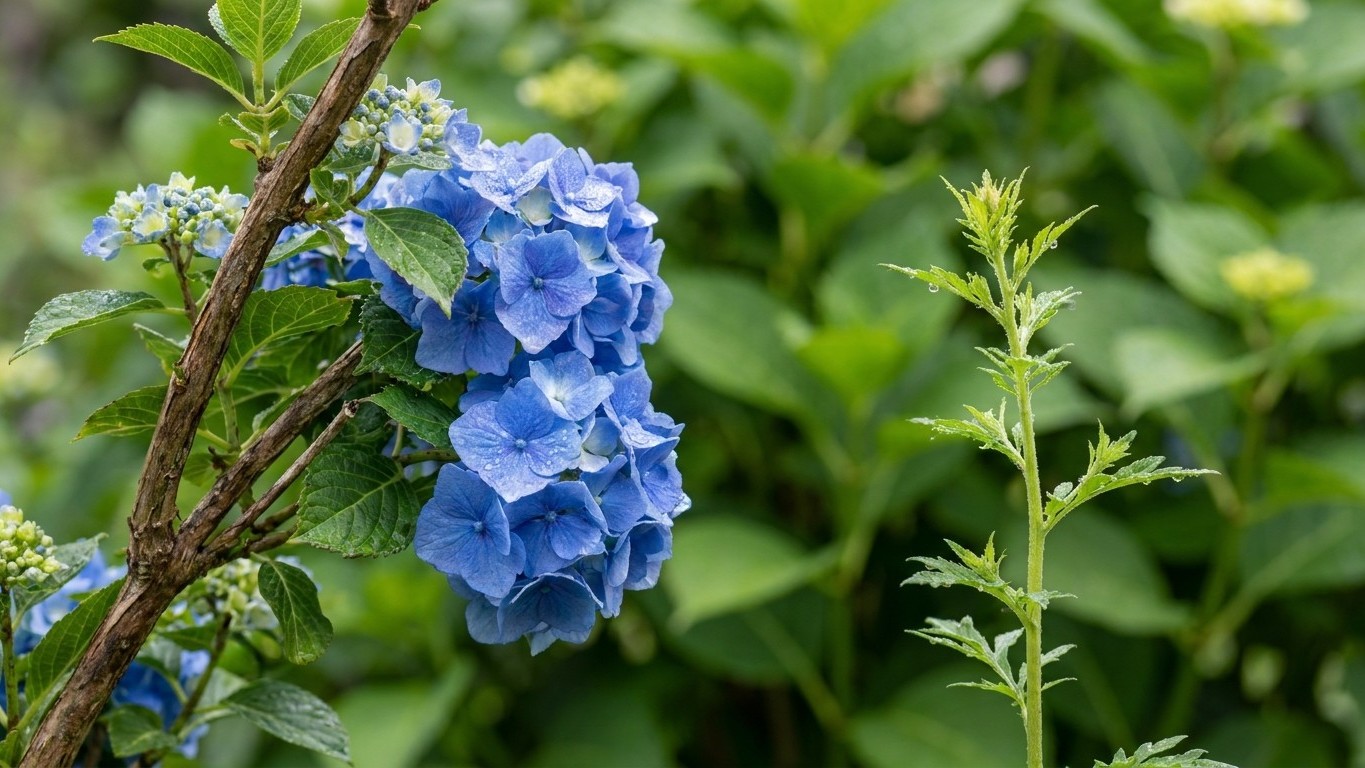

Hydrangeas can grow in Manitoba, but only certain types, and only with a little planning. Smooth hydrangeas (Annabelle and its relatives) and panicle hydrangeas bloom on the current season’s growth, so a hard winter doesn’t cost you the flowers. Bigleaf types often lose their buds. Set plants out around the end of May in the Winnipeg area, later farther north, and give them a mulched crown before freeze-up.
When to plant Hydrangeas in Manitoba
The reference point here is Winnipeg. Environment and Climate Change Canada’s Canadian Climate Normals (1981-2010) for the Winnipeg Richardson International Airport station put the average last spring frost at May 23 and the average first fall frost at September 22, with 121 frost-free days between them. Those are means, not guarantees. In one year out of two, the last frost lands after May 23. Treat it as the middle of a window, not a safe date. Northern Manitoba and higher-elevation districts run weeks behind the airport, so a gardener at Dauphin or The Pas should push every date below later. (These Canadian normals cover 1981-2010, while US figures elsewhere on this site cover 1991-2020, so don’t compare them to the decimal.)
Seeds, cuttings and nursery plants
Almost nobody starts hydrangeas from seed, and for good reason. Named varieties don’t come true from seed, and a seedling may take several years to flower. Most gardeners buy a potted shrub or root softwood cuttings. If you do want to start seed or cuttings indoors, count back from your planting-out date. Plant out around May 30, a week past the mean frost date to hedge the coin flip. Subtract 10 weeks (70 days) and you land on March 21 for indoor sowing. That’s a rule of thumb, not a Manitoba-published schedule.
Hardening off and transplanting out
Plants raised indoors, and even greenhouse-grown nursery stock, need 7 to 10 days of gradual exposure to wind and sun. Subtract that from May 23 and you start on May 13 to 16: an hour or two of shade at first, then longer stretches, then a full day. Bring the pots in on any night with frost in the forecast. Tender new shoots on a smooth hydrangea blacken quickly, though the plant usually resprouts from the base.
Fall planting is a gamble on the prairies. If you try it, count back about six weeks from the September 22 mean first frost, which gives roughly August 11, so the roots can settle before the ground locks up. Spring planting gives a full season of root growth, and that’s what carries a young shrub through its first January.
Soil and site preparation
Most hydrangeas want morning sun and some afternoon shade. Smooth hydrangeas cope with part shade, while panicle types bloom best in six or more hours of sun as long as the soil stays moist. Shelter helps more than you’d expect. A spot on the east side of a house or fence, away from the worst prairie wind, also tends to catch drifting snow, which is free insulation.
Many Winnipeg-area yards sit on heavy clay. Clay holds water well, which hydrangeas like, but it can sit soggy in spring. Dig a hole about a foot deep, fill it with water, and come back the next day. If water is still standing, plant in a raised bed or a broad mound instead. I’m not quoting local soil survey numbers, because conditions change from lot to lot. A lab soil test (see the last section) tells you more than any regional average.
Timing matters as much as the recipe. Four weeks before planting, clear weeds and sod and send off the soil sample. Two to three weeks out, work 2 to 3 inches of compost into an area several feet wide, not only the planting hole, because a pocket of rich soil in clay acts like a flowerpot and water collects in it. Dig the hole about twice as wide as the root ball and no deeper. Set the crown level with the surrounding soil and water in slowly.
For spacing, read the plant tag. As a rough guide, smooth and standard panicle types need 4 to 6 feet between plants at maturity, and dwarf panicles about 3 feet. Crowding invites mildew, because air can’t move between the leaves.
Varieties that suit Manitoba
A tomato gardener shops by days to maturity. A hydrangea gardener shops by which wood carries the flower buds. Types that bloom on new wood grow fresh stems each spring and flower on them, so winter dieback barely matters. Types that bloom on old wood set buds the previous summer, and a Manitoba winter often kills them. After that come bloom timing, stem strength and sun tolerance.
| Type | Widely sold examples | Blooms on | Manitoba fit |
|---|---|---|---|
| Smooth (H. arborescens) | Annabelle, Incrediball, Invincibelle Spirit | New wood | Very reliable; tolerates part shade |
| Panicle (H. paniculata) | Limelight, Quick Fire, Bobo, Little Lime, Pinky Winky | New wood | Reliable; best in sun; bloom time varies |
| Bigleaf (H. macrophylla) | Endless Summer and similar | Old and new wood | Marginal; buds often killed |
| Oakleaf (H. quercifolia) | Various | Old wood | Marginal |
Annabelle is the classic for a reason: tough, forgiving and cheap. Its weakness is floppy stems, which bend to the ground in rain. Incrediball was bred with sturdier stems and bigger heads, so it suits gardeners tired of staking. Invincibelle Spirit adds pink flowers to the smooth group.
Among panicles, Limelight is the common choice, with large lime-to-cream blooms that age to pink. Quick Fire is sold as an early bloomer, which matters in a 121-day season, and Bobo and Little Lime stay compact for small beds. Cold hardiness ratings printed on tags vary and use different zone systems (Canadian and USDA zones don’t match), so favor the new-wood types and treat tag ratings as a starting point.
Bigleaf hydrangeas are the ones people fall for at the garden center. Some reblooming types can flower on new growth, but results in Manitoba are inconsistent. If you want one, grow it in a large pot you can move into an unheated garage for winter. For comparison, Growing Hydrangeas in British Columbia: Types, Colour and Winter shows how much the picture changes on a mild coast, while Growing Hydrangeas in South Dakota: Types, Colour and Winter is the closer prairie parallel.
What to plant alongside
The best companions share the hydrangea’s taste for moist, rich soil and part shade. Hostas are the standard pairing, and their broad leaves shade the soil around the shrub’s base, which keeps roots cooler and slows evaporation. Ferns, astilbe, heuchera and lamium do the same job, and sweet woodruff works as a low ground cover. Keep ground covers shallow-rooted and non-aggressive, since anything that spreads hard will fight the shrub for water.
Spring bulbs such as daffodils and species tulips fill the gap before hydrangeas leaf out in late May. Their foliage fades just as the shrub takes over, and the two don’t compete much. Late-blooming perennials like coneflower and bee balm pull in pollinators during the weeks the hydrangea flowers, although most hydrangea blooms are visited lightly.
The real competitors are big trees and hedges. Manitoba maples, ash, spruce and cedar hedges all have greedy, shallow roots that drain the soil. A hydrangea planted close to one will wilt every hot afternoon. Keep it outside the drip line, or accept a lot of extra watering.
Some pairings are repeated more than they’re proven. You’ll read that marigolds, garlic or chives planted around a shrub confuse pests or repel them. There is little solid evidence for that on hydrangeas, so don’t rely on it for protection. Black walnut deserves caution too, since its roots release a compound that harms some plants, but hydrangea tolerance is reported inconsistently. The safe answer is distance.
Watering, feeding and support
Hydrangea means “water vessel” in Greek, and the plants behave accordingly. Aim for about an inch of water a week from rain and hose combined, delivered slowly and deeply. A long soak twice a week trains roots down, where a daily sprinkle keeps them at the surface and the plant wilts at the first hot spell. Water at the base, in the morning, to keep the leaves dry.
Mulch does two jobs. A 2 to 3 inch layer of shredded bark or leaf mold keeps summer soil moist and, applied again after the ground freezes in fall, insulates the crown. Pull it back an inch or two from the stems so it doesn’t hold moisture against them.
Feed once, lightly. A slow-release shrub fertilizer as growth starts in spring is plenty, and compost topdressing is a gentler substitute. Stop feeding by midsummer. Late nitrogen pushes soft growth that won’t toughen up before frost.
Pruning follows the wood. Smooth and panicle hydrangeas bloom on new growth, so cut them back in late winter or early spring before leaves emerge. Smooth types can go down to 6 to 12 inches, and panicles can be shortened by about a third. Leaving the old flower heads over winter protects the buds below. Bigleaf and oakleaf types need almost no pruning beyond dead wood, since cutting them hard removes the flower buds.
Staking is mostly an Annabelle issue. Ring-style supports set up in spring, while the shrub is small, let the stems grow through and hide the hardware. Smooth hydrangeas also spread by underground shoots. Dig out the unwanted ones in spring, or enjoy a colony.
Common problems
Blossom end rot and fruit cracking are tomato problems, and hydrangeas don’t get either. The failures that do show up are quieter. Start with the most common: a healthy shrub that simply doesn’t bloom. The usual causes are old-wood buds killed by winter on a bigleaf type, hard pruning at the wrong time, or too much shade.
Wilting at midday on a hot day is normal, and the plant recovers by evening. If leaves are still limp the next morning, the soil is too dry, or too wet and the roots are failing. Check by pushing a finger 3 inches down. Yellow leaves with green veins point to iron chlorosis, which is common in alkaline soils. A soil test confirms it, and an iron chelate product or a lower-pH amendment helps.
Gray-white powdery film on the leaves is powdery mildew, which shows up in humid weather and crowded plantings. It looks bad but seldom kills the shrub. Better airflow, morning watering and cleaning up fallen leaves cut it back. Brown spots with darker edges are usually a leaf spot fungus. Remove affected leaves and avoid overhead watering.
As for insects, the only pest list available is from NDSU Extension and the University of Minnesota Extension, both in neighboring US states. No Canadian province publishes an equivalent home-garden list. The biology crosses the border, but the calendar doesn’t always, so I can’t say which pests dominate in Manitoba. Of the documented pests, Japanese beetle is the one known to chew ornamental shrubs, skeletonizing leaves in summer. Many others on that list (squash vine borer, cabbage maggot, corn earworm) belong to vegetable gardens. Don’t assume any pest is absent from the province. Take a sample or photo to Manitoba Agriculture for identification before spraying anything.
Ripening before the frost comes back
Hydrangeas don’t fruit, so the question changes. Two clocks run against the first frost: the flowers must open and look good, and the new wood must harden enough to survive winter. The frost-free figure for the Winnipeg station is 121 days, running from the May 23 mean last frost to the September 22 mean first frost. If you plant out around May 30, you’ve already used a week. Roughly 115 days remain before the average first frost, and in half of years frost arrives sooner than that.
Smooth hydrangeas and most panicles flower well inside that window, with blooms typically open by midsummer. The risk sits with late-blooming panicle selections that open in late August or September. A frost in the third week of September can brown them before they peak. That’s why an early type such as Quick Fire is a sensible choice for a short season. Since bloom dates vary by variety and by year, check the tag and subtract: take 121 days, remove however many days you lose to a late planting date, and see whether the stated bloom time falls before your own district’s first frost.
What buys extra weeks? Planting a larger nursery pot gives a head start. A sheltered, south- or east-facing spot warms earlier. A lightweight frost cloth draped over new shoots on a cold May night saves the first flush. Farther north, where the window is shorter than Winnipeg’s, favor the earliest bloomers and the new-wood types, and skip the borderline bigleafs. Stopping fertilizer by midsummer helps the wood harden before winter.
Harvest and end of season
Hydrangeas are harvested for flowers, not fruit. For fresh bouquets, cut stems in the early morning once most florets on the head have opened, and plunge them into water immediately. Smooth hydrangeas wilt fast, so a short soak up to the neck helps.
For drying, wait until the flower heads feel papery and the color has shifted to a muted tone, usually late summer into fall. Cut with 12 inches of stem, strip the leaves and hang the bunches upside down in a dry, shaded spot for a couple of weeks. Panicle types, especially, dry well on the plant, and you can leave some heads standing for winter.
The September 22 mean first frost is a midpoint, so half of years it comes earlier. Cut the bouquets you want before any frost warning rather than gambling on the date. Keep watering until the ground freezes, because a dry shrub heads into winter at a disadvantage. After the ground freezes, mound 4 to 6 inches of shredded leaves or bark over the crown, and for young bigleaf plants add a wire cage filled with leaves. Wait to prune until late winter or early spring. Snow will do much of the insulating, and cutting stems in fall removes it.
Local help
Frost dates, soil tests and pest identification vary by district, and a province isn’t one climate. Manitoba Agriculture is the place to ask about local dates, soil testing and unfamiliar insects. For the wider picture on types and care, see How to Grow Hydrangeas: The Complete Guide, and for other provincial pages browse the Manitoba guides.
Common questions
Can bigleaf hydrangeas survive Manitoba winters?
The plants often survive, but the flower buds usually don’t, because they form on old wood. Reblooming types can flower on new growth, though results are inconsistent. Smooth or panicle hydrangeas are the safer choice.
When should I plant hydrangeas in Winnipeg?
Wait until after the May 23 mean last frost. Planting around May 30 hedges the odds, since frost falls later than the mean in one year out of two. Districts north of Winnipeg should wait longer.
Why won’t my hydrangea bloom?
The usual causes are winter-killed buds on an old-wood type, pruning at the wrong time, or too much shade. Smooth and panicle types should bloom reliably on new wood if they get adequate sun and water.
Do I need to protect hydrangeas in winter?
Smooth and panicle types need little beyond a mulched crown after the ground freezes. Bigleaf and oakleaf plants benefit from extra protection, such as a leaf-filled wire cage or a move into an unheated garage if potted.
Which hydrangea is easiest in Manitoba?
Annabelle and its stronger-stemmed relatives are the most forgiving. Among panicles, early bloomers make the most of a short season. Whichever you choose, check how your own district’s frost dates compare with the Winnipeg station figures, because the Winnipeg normals are only a reference point.