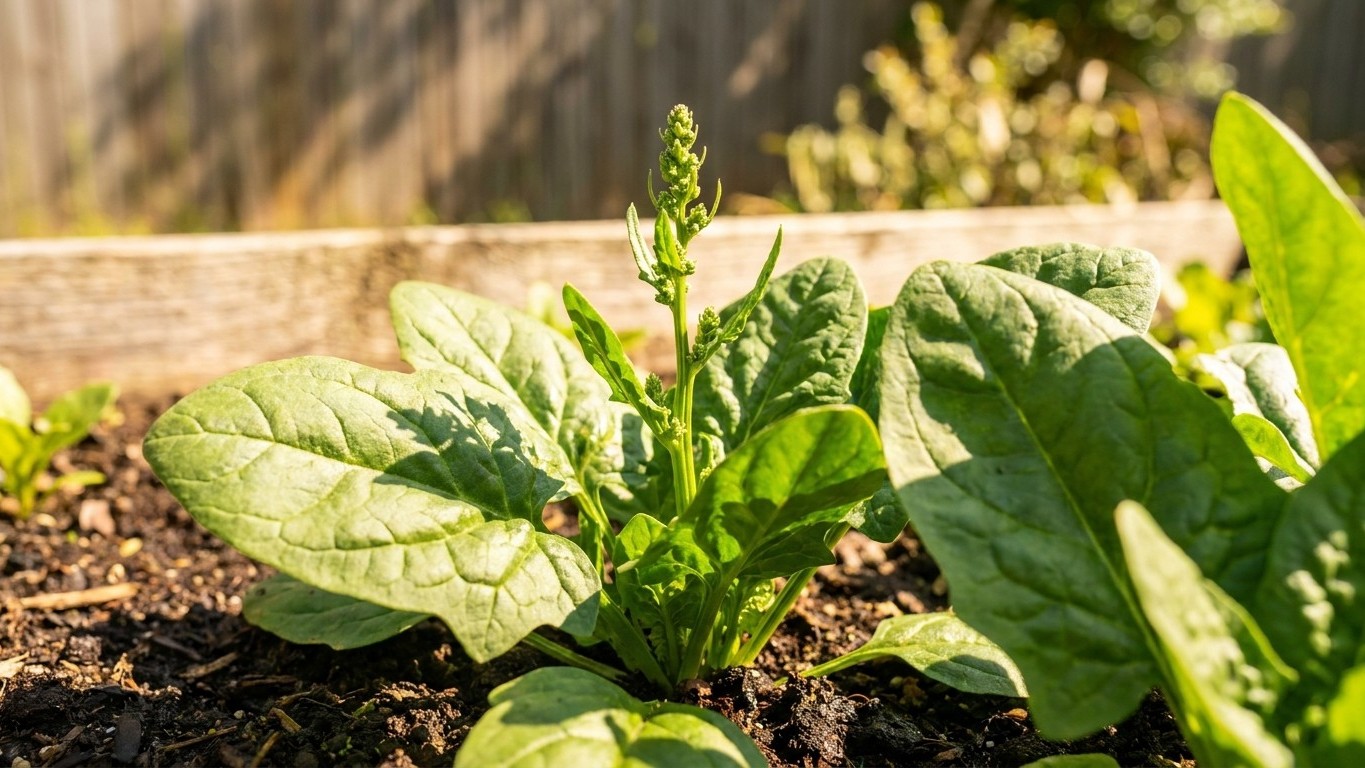

In North Dakota, what eats spinach is mostly the calendar. Daylight peaks at 15 h 41 on the longest day, and long days plus warmth push the plant to flower, which ends the harvest as surely as any insect would. Two windows work: a spring sowing that opens in mid-April, and an autumn sowing that has to beat the first frost. Leaf-chewing pests and deer exist, but this page sticks to the clock, because that is where the sourced numbers are.
The short answer
At the Fargo reference station, the longest day of the year delivers 15 h 41 of daylight. That is a lot of light, and for spinach it is a problem. According to Utah State University Extension, spinach bolts during long days and warm temperatures. Long days alone are enough to trigger flowering, so a cool summer does not buy extra weeks. A gardener in a mild, overcast June still has a plant reading a 15-hour day and getting ready to send up a seed stalk.
So the limit here is both day length and heat, and they stack. Day length is the one you cannot do anything about. Heat is the one you can sometimes dodge by timing, shade, or watering, but not by much. The same Extension source says spinach grows best where temperatures do not exceed 75 F. That number does double duty: it is the point where growth stops being good, and it is also the point where the leaves turn bitter. One figure, two consequences.
Fargo records an average of 11.7 days a year at 90 F or more. That sounds modest, and it is easy to read it as “summer here is mild.” It is not the right yardstick. Spinach quits at 75 F, which is far below 90, so the stretch of weather that hurts the crop is much longer than the 90-degree count suggests. The heat is not extreme by southern standards, but it does not need to be.
The frost dates frame everything else. At the airport station behind NOAA NCEI’s 1991-2020 climate normals, the last spring freeze falls between May 4 and May 15, and the first fall freeze between September 25 and October 5. Those are reference-city figures, not a statewide guarantee. Suburban and rural gardens typically see the last spring frost later and the first fall frost earlier, often by one to two weeks, and more at elevation. Check your own county’s dates before you mark a calendar.
The practical shape of the year follows from that. Spinach gets a spring run that is squeezed between thaw and the first warm spell, and an autumn run that is squeezed between hot soil and frost. If you want the full growing picture, start with Growing Spinach in North Dakota. If your plants have already sent up stalks, Will Spinach Bolt Early in North Dakota? goes into what to do next.
How long the spring window really is
The rule of thumb is to sow spinach 2 to 3 weeks before the last frost. Here is how that plays out in North Dakota, step by step.
- Start with the last frost. At the Fargo reference station it falls between May 4 and May 15. Rural gardens often run one to two weeks later, so your own date may sit at the end of May.
- Count back 3 weeks from the early date. Three weeks before May 4 is about April 13. That is the earliest sowing the rule supports at the reference station.
- Count back 2 weeks from the late date. Two weeks before May 15 is about May 1. That closes the sowing window, which makes it roughly two and a half weeks wide.
- Shift for your location. If your garden frosts one to two weeks later than the airport, slide both dates later by the same amount. The window keeps its width and moves along the calendar.
- Find the other end, which is heat. Growth stops being good above 75 F. The sources used here give no calendar date for that, and it would be wrong to invent one. It arrives when it arrives, so watch your own thermometer, not a date.
Put in words, that leaves a short run. The seed goes in during the second half of April, or later in a late-spring garden. The leaves have to grow and be harvested between sowing and the first stretch of 75 F weather. The Extension source publishes no days to maturity for spinach, so there is no honest way to say how many weeks of picking you get. What the arithmetic does show is that the early end of the sowing window is worth more than the late end. A seed in the ground on April 13 has more cool days ahead of it than one sown May 1, and the long days are already stacking up against both.
Sowing is also gated by the ground, not just the air. The rule assumes the soil can be worked, and in a cold, wet spring it cannot always be. A gardener who waits for ideal conditions can lose the whole window. Plan to sow as soon as the bed is workable, inside the dates above.
The autumn crop, and when the soil lets you sow
The Extension source says to plant a fall crop 50 to 75 days before the date you want to harvest. It gives no days to maturity for spinach, so that planting rule is the only count available. In North Dakota, two things get in the way, one at each end. They are covered in more detail in When to Sow Autumn Spinach in North Dakota.
Warm soil blocks the sowing, not cold
Seed germination is reduced when the soil is above 80 F. That is the surprise of autumn spinach: the obstacle in late summer is warmth, not chill. Seed pressed into a hot bed in July germinates poorly, and the gardener who sowed on time by the calendar ends up with gaps in the row. In a hot stretch the window opens when the soil falls below that line, and the sources carried here give no date for it. A soil thermometer is the only authority worth trusting. Shaded, well-watered beds cool sooner than bare ground, which matters in a garden that bakes in the afternoon.
Frost closes the season
At the Fargo reference station the first fall freeze falls between September 25 and October 5. Count back 50 to 75 days from those two dates. From September 25, that lands between about July 12 and August 6. From October 5, it lands between about July 22 and August 16. On paper, the sowing window therefore runs from mid-July to mid-August.
The two obstacles collide here. The back-count says July, but the soil in July is often still above 80 F. In practice the usable part of that range tilts toward the later dates, once the beds have cooled. And because rural and suburban gardens often frost one to two weeks earlier than the airport, the whole range moves earlier, which squeezes the cool-soil end even harder. Set your harvest date from your own county’s first frost, count back from it, and then wait for the soil to agree.
Four varieties come up in the Extension source: Bloomsdale, Melody, Teton and Olympia. The source gives no data about any of them, so there is no sourced way to say which suits a North Dakota autumn better. Treat that as an open question to test in your own beds.
Common questions
Does a cool summer in North Dakota keep spinach from bolting?
No. Long days alone trigger flowering, and the longest day here brings 15 h 41 of daylight. Cool weather helps with bitterness and growth, but it does not cancel the day-length signal.
Is heat or day length the bigger limit?
Both count. Spinach bolts under long days and warm temperatures, and it grows best where temperatures stay at or below 75 F. In spring the heat arrives while the days are still lengthening, so the two pile up on the same weeks.
Which variety should I plant?
The Utah State University Extension source names Bloomsdale, Melody, Teton and Olympia. It publishes no data on any of them, so nothing sourced here ranks them for bolting, heat or cold. Pick one, sow a few rows, and keep notes.
How long does harvested spinach keep?
UC Davis Postharvest gives an optimum of 32 F and 95 to 98 percent relative humidity, and says spinach will not maintain good quality for more than 2 weeks. That is a ceiling, not a plan. At the 41 to 50 F that a home fridge door actually holds, it yellows in days. Put it at the back of the bottom shelf, in a bag or box that holds moisture, and eat it early.