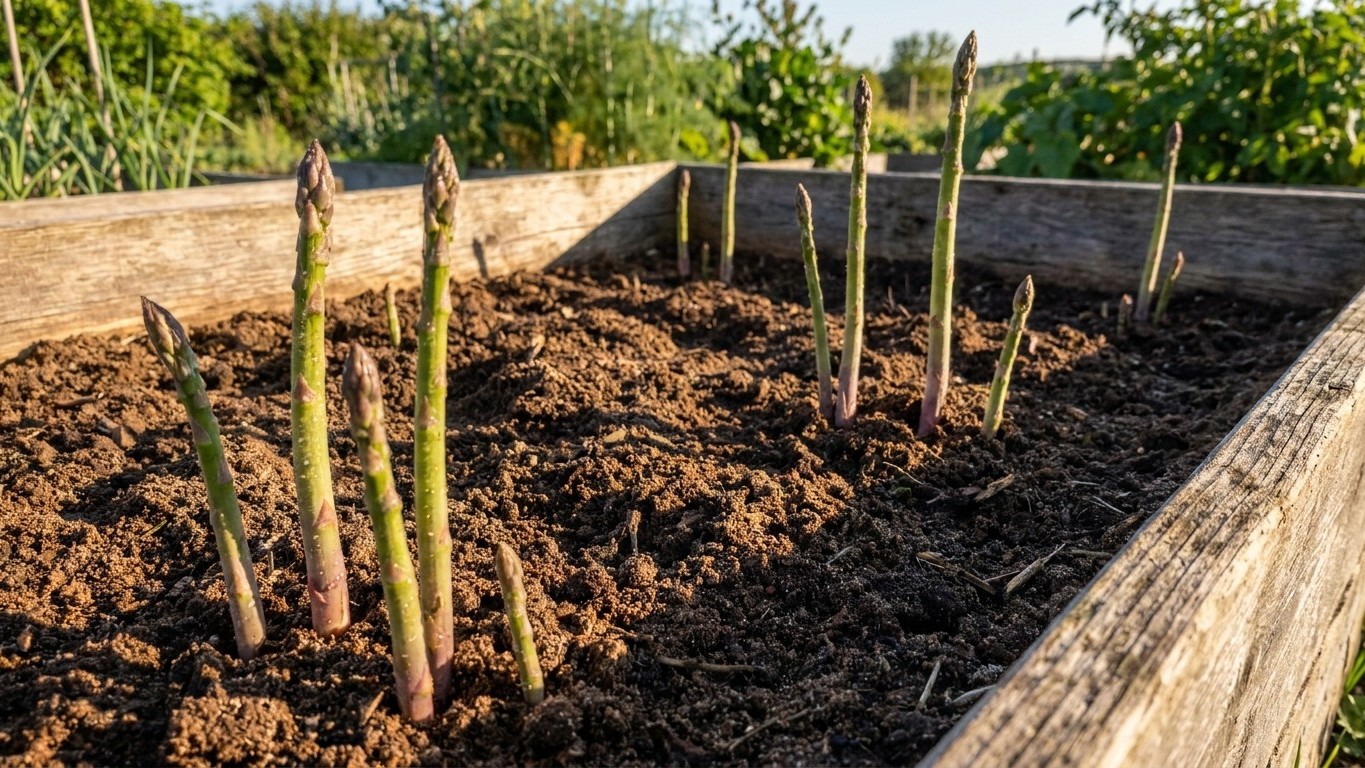

Stop cutting when most of the spears coming up are thinner than a pencil. That’s an object you can see, not a date on a calendar. Before the rule ever applies, the bed gets no cutting at all until year 3, and the spears you do cut keep best at 32 to 35°F with their cut ends standing in water. All of it depends on getting the bed right first, which is what Growing Asparagus in Hawaii covers in full.
The short answer
Hawaii’s state soil is the Hilo series, an Andisol, which is a volcanic-ash soil. USDA describes it as light, porous and unusually good at holding both water and phosphorus. The representative surface values read 10 percent sand, 35 percent clay and 55 percent silt, with organic matter around 9.0 percent and a pH of about 5.8, slightly acid. USDA also classes it as well drained. Utah State University Extension, the authority for this page, says a bed lasts 10 to 15 years and that most soils will do provided they drain. So on paper, the soil Hawaii is known for passes the only test the source sets.
On paper. A state spans hundreds of soil series, and the Hilo figures describe the mapped surface of that one series, not your garden bed. A lot scraped by a builder, a filled slope or a low spot behind the house can behave nothing like it. The pH above is the series value and not yours. The Utah State guide gives no pH target for asparagus, so a soil test will hand you a number, but this page can’t tell you what to aim for.
If your ground does not drain
Fifteen years changes the math. With tomatoes, a heavy soil is an annual nuisance you amend each season. With asparagus it’s a decision you can’t undo, because the crowns stay put. Before planting, dig a hole about a foot deep, fill it with water, and come back the next day. If water is still standing, believe it. The practical answers are a raised bed built up above the surrounding grade with loose, free-draining soil, or a different spot altogether. Planting and hoping is the one option that fails slowly enough to waste three years. The Will Hawaii Soil Hold an Asparagus Bed for Fifteen Years? page goes deeper on testing a spot.
What the harvest clock asks of the bed
Planting is as 8-inch furrows of crowns, and nothing gets cut in year 3’s predecessors. The first harvest comes in year 3, and even then it’s short: about four weeks. The next season stretches to six weeks, then eight. Don’t soften this into “a few spears won’t hurt.” The waiting is what the bed pays for the decade or more of cutting that follows.
Inside each season, the rule is the pencil. Keep cutting while spears come up thicker than one. When most of what’s emerging is thinner than a pencil, you’re done for the year, whatever week it happens to be. Let the rest grow out.
Will the summer here water it for you?
No. The bed wants 1 to 2 inches of water every other week for its first two years, then every three weeks after that. NOAA’s 30-year climate normals for the Hawaii reference station put June, July and August together at about 1.9 inches (June 0.5, July 0.52, August 0.84), out of 16.4 inches for the whole year. These are normals, what the region can usually expect, not a forecast and not your yard. Here is how to turn that into a hose schedule:
- Count what the schedule asks for. A 13-week summer holds six or seven every-other-week waterings of 1 to 2 inches each. That works out to roughly 6 to 14 inches (my arithmetic, not a published figure). The normal summer rain is 1.9. June alone, at 0.5 inches, doesn’t cover even one light watering. The gardener supplies nearly all of it.
- Read the rain against your soil. The same inch behaves differently on different ground. A sandy surface lets it through within the day, while clay can hold it for a week. Hilo-type ash soil holds water well, so a bed on it may stay moist longer between soakings. A bed on sand or thin fill will not.
- Discount storms and hot days. One summer downpour mostly runs off instead of soaking in, and hot, windy days pull moisture back out. A half inch that arrives in ten minutes isn’t worth half an inch of watering.
- Drop to every three weeks after year two. That’s about four waterings across the same summer, or 4 to 8 inches, and the normal rain still covers only a slice.
- Put a rain gauge on your own plot. Windward versus leeward exposure, elevation and a nearby slope can all shift rainfall a long way from the reference station. Count what the gauge catches and water only the shortfall.
When to put the crowns in
The source says early spring, and it ties that to the end of frost. Hawaii has no such date to count from. NOAA’s normals for the reference station show zero days per year at or below 32°F, and no freeze occurs in inhabited areas. Frost reaches only the high summits of Mauna Kea, Mauna Loa and Haleakala, never where people garden. A frost-based calendar would be fiction here.
What governs planting instead is rainfall, elevation and windward versus leeward exposure. Treat “around early spring” as a starting season, not a deadline, and let your own rain gauge and exposure set the working week. The source doesn’t say how Hawaii’s mild year shifts the advice, so this page won’t guess. One practical point does follow from the numbers: June is the driest summer month at the reference station, so crowns that go in with a few weeks of establishment ahead of it mean less hose time.
Plant them in 8-inch furrows, then fill the furrow in gradually: about two inches every other month, not all at once. The furrow levels out across the year instead of burying the crowns on day one.
Starting from seed is the alternative route. The facts behind this page carry no seed calendar and no germination figures, so there is nothing to quote. The no-harvest-until-year-3 rule is stated for crown beds. Check a seed packet for its own timing and don’t assume it matches.
On varieties, Utah State names four and gives only their sex. Jersey Giant and Jersey Knight are all-male. UC 157 F1 and Purple Passion are male/female. No flavor, yield or reason to prefer one is published, so any claim that one tastes better or yields more is not coming from this source.
Common questions
Can I cut a few spears before year 3?
No. The source says not to harvest until year 3. Then come four weeks, then six, then eight.
How do I know when to stop cutting for the season?
Look at the spears. When most of them are thinner than a pencil, stop. There’s no week number attached, because the bed tells you.
How do I keep cut spears?
UC Davis Postharvest gives an optimum of 32 to 35.6°F with 95 to 100 percent relative humidity. The window is narrow on both sides. Above 50°F the spears toughen quickly, within hours. At about 30.9°F or lower they suffer freezing injury, turning water-soaked and then extremely soft. In a home kitchen, high humidity is easiest to manage by standing the butts in water or wrapping them damp. Spears lose moisture through the cut end faster than anywhere else. A cheap fridge thermometer will tell you whether your refrigerator sits in the target range. Full details are at UC Davis Postharvest.
What else will take the spears before I do?
Pests vary by season and by location on the islands. What Eats Asparagus in Hawaii, and When sorts out which to watch for.